
Last updated February 2026
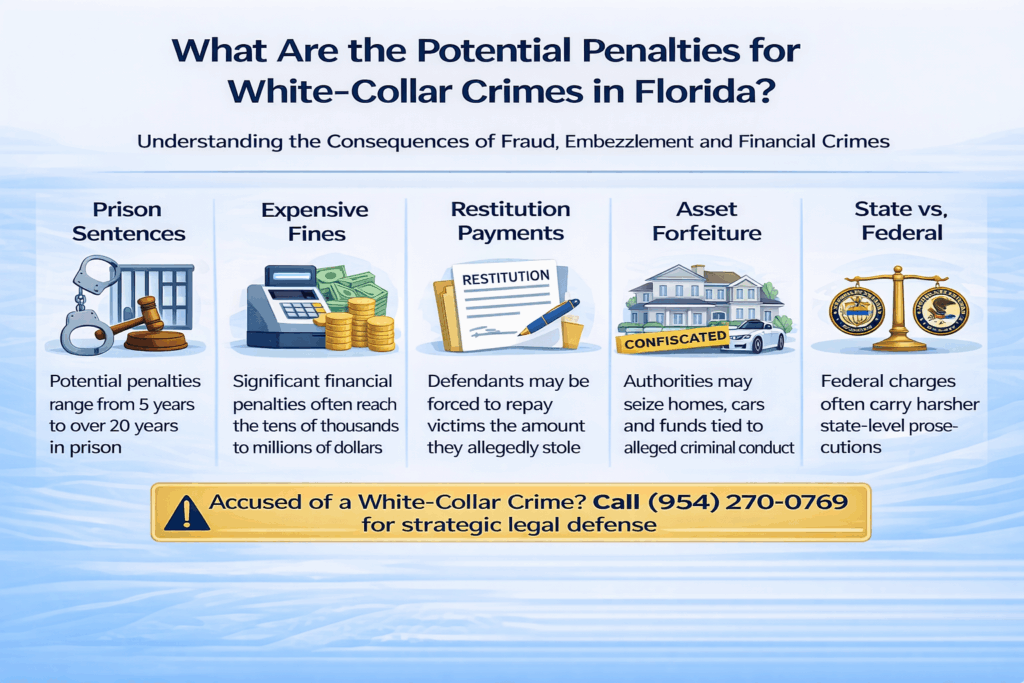
White collar crime penalties in Florida vary dramatically depending on whether a case is prosecuted in state or federal court, the alleged financial loss, and how prosecutors characterize your role in the offense.
For a broader overview of white collar crime laws and defense strategy, visit our guide to Florida White Collar Crime Charges.
Understanding how penalties are calculated is critical — particularly in cases involving significant loss amounts or federal investigation.
🎥 Watch: Understanding White-Collar Crime Penalties in Florida
In this short video, Fort Lauderdale defense attorney Michael White explains how white-collar crime penalties are calculated, why federal cases are often far more severe than state prosecutions, and which factors most influence sentencing in fraud and financial crime cases.
🇺🇸 Federal White Collar Sentencing
Federal white collar cases are governed by the United States Sentencing Guidelines.
Unlike Florida state court, federal sentencing focuses heavily on:
Alleged financial loss amount
Number of victims
Sophistication of the offense
Abuse of trust or fiduciary position
Leadership or managerial role
Federal Penalties May Include:
Multi-year or multi-decade prison sentences
Restitution orders
Substantial fines
Asset forfeiture
Supervised release after incarceration
Loss calculations often drive sentencing exposure. Even disputes over accounting methodology can significantly change advisory guideline ranges.
Federal prosecutions are typically handled by the U.S. Attorney’s Office and investigated by agencies such as the FBI, IRS Criminal Investigation, or Homeland Security.
🟦 Florida State White Collar Penalties
White collar crimes prosecuted in Florida state court are charged under statutes such as:
Fraudulent Practices (Fla. Stat. § 817)
Grand Theft (Fla. Stat. § 812)
Forgery and Identity Theft statutes
Financial transaction offenses
Penalties depend on felony degree and alleged loss amount.
State-Level Consequences May Include:
Jail or prison time
Fines (often up to $10,000 per felony count)
Restitution
Probation
Permanent criminal record
Unlike federal court, some Florida defendants — particularly first-time offenders — may qualify for:
Withhold of adjudication
Diversion programs (where available)
Potential record sealing after case resolution
However, these outcomes depend heavily on case posture and prosecutorial discretion.
💰 Financial Loss and Sentencing Exposure
In both state and federal cases, loss amount often drives sentencing.
Key considerations may include:
Actual vs. intended loss
Whether losses were repaid
Number of alleged victims
Whether the defendant personally benefited
Disputes over loss calculations frequently become a central battleground in sentencing.
🔒 Asset Forfeiture and Restitution
White collar penalties frequently extend beyond incarceration.
Courts may order:
Seizure of bank accounts
Forfeiture of property
Restitution to alleged victims
Financial monitoring conditions
For many defendants, the long-term financial consequences exceed the criminal penalties themselves.
⚖️ Early Strategy Matters
Because sentencing exposure is often tied to financial interpretation, early defense strategy may focus on:
Challenging loss calculations
Narrowing alleged victim counts
Contesting role enhancements
Negotiating charge reductions
Preserving eligibility for diversion or alternative sentencing
These strategic decisions can significantly affect final outcomes.
📞 Facing White Collar Charges?
If you are facing fraud, embezzlement, or other financial crime charges in Florida, understanding potential sentencing exposure is critical.
Call (954) 270-0769 to schedule a confidential consultation.