
Last updated November 2025
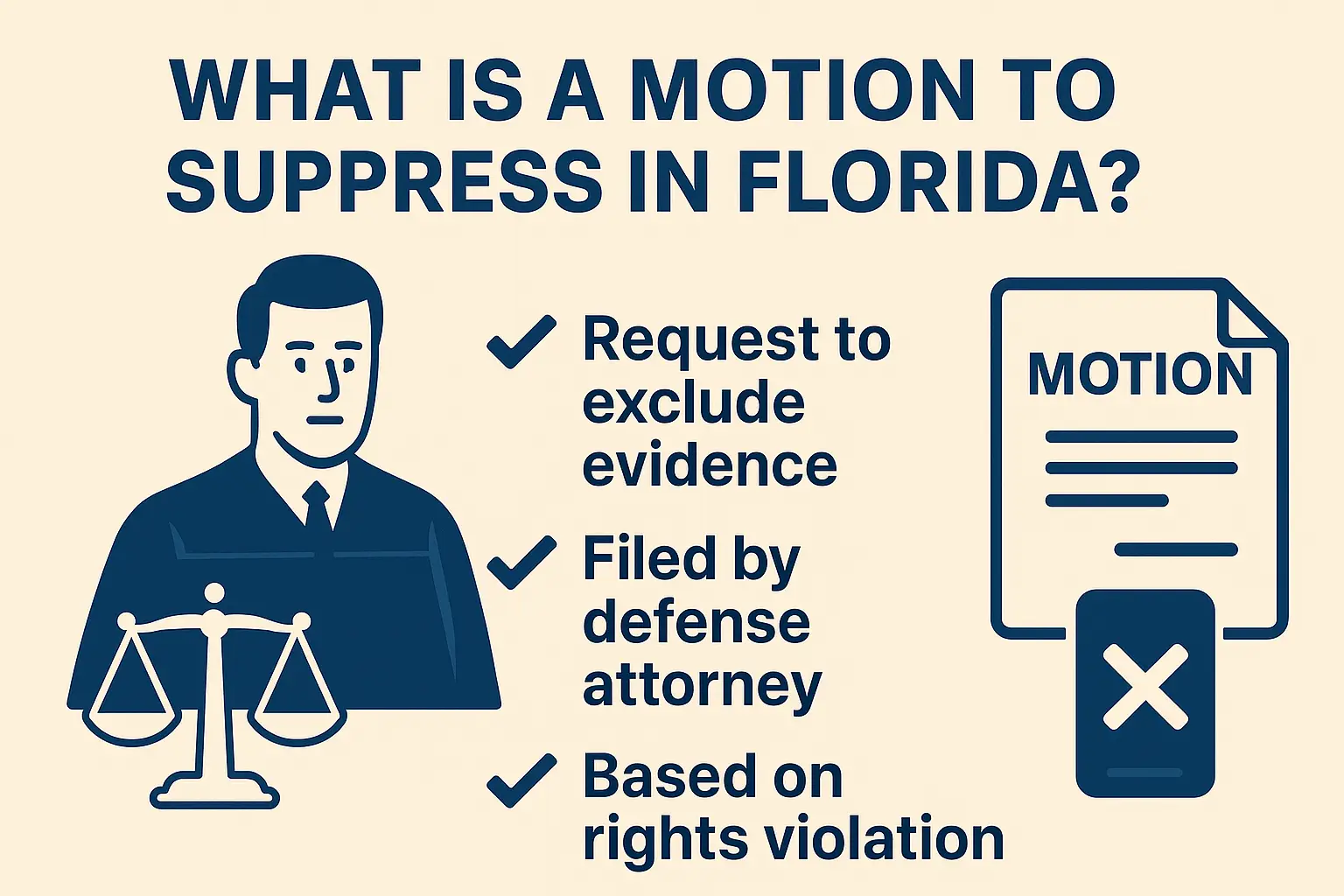
A motion to suppress is one of the most powerful tools in Florida criminal defense. It allows your attorney to challenge evidence obtained through an illegal search, unlawful detention, improper interrogation, or any violation of your constitutional rights.
In Fort Lauderdale and across Broward County, suppression motions often determine the outcome of DUI cases, drug charges, gun crimes, resisting charges, and home-entry cases. When evidence is excluded, prosecutors may be forced to reduce or even dismiss charges entirely.
This is a core strategy in many of your cases—especially where police exceeded their authority during street encounters, traffic stops, cellphone searches, or home entry situations.
🚨 When a Motion to Suppress Applies
A motion to suppress can be filed when police:
Stopped or detained you without reasonable suspicion
Searched your car, phone, or home without a lawful basis
Used coercion to obtain “consent”
Extended a traffic stop unlawfully
Conducted an illegal pat-down
Entered your home without a warrant
Seized evidence without probable cause
Violated Miranda rights during interrogation
These issues show up constantly in DUI cases and drug prosecutions. For example, an unlawful extension of a traffic stop can invalidate everything that follows, including field sobriety exercises and statements.
📱 Examples of Evidence That Can Be Suppressed
Drugs or paraphernalia found after an unlawful search
Breath, urine, or blood results obtained after an improper detention
Text messages or phone data taken without a warrant
Guns discovered during an illegal pat-down
Statements made after police ignored your request for an attorney
Evidence seized after police entered your home without a warrant
This ties directly to your other rights-based content, such as when officers try to search your phone during a traffic stop or run a passenger’s name without cause.
Text messages or phone data taken without a warrant, especially during a traffic stop, may be suppressible, as we discuss in more detail in our guide to police searching your phone during a traffic stop in Florida.
⚖️ What Happens at a Suppression Hearing?
A suppression hearing is essentially a mini-trial focused only on whether police acted lawfully. Key elements include:
1. Officer Testimony
The State must show the search or detention was legal. Cross-examination is critical.
2. Body-Worn Camera Footage
Your attorney analyzes:
Officer approach
Tone/commands
Timeline
Claims of consent
Reason for extending the stop
3. Burden of Proof
In many cases, the State must prove the search or seizure was lawful—not the defendant.
4. Judge’s Ruling
If the judge suppresses key evidence, the prosecution may lose its case entirely.
This is why investing time in a well-prepared suppression motion can have greater impact than any other defense strategy.
📝 Legal Authority: Warrantless Searches & Suppression
One of the landmark U.S. Supreme Court cases protecting against unlawful searches is Mapp v. Ohio. It established the exclusionary rule, preventing illegally obtained evidence from being used in court.
Read the full opinion here.
🛡️ Why Suppression Motions Work
A successful motion to suppress puts the Constitution front and center. For many clients, the entire case hinges on a single legal question:
Did the officer follow the law?
If the answer is “no,” the evidence cannot be used—and the case often collapses.
This aligns closely with your strategies in unlawful home-entry, cellphone search, and unreasonable detention cases, where even small deviations by police can trigger exclusion.
Questions about whether police could lawfully run your name as a passenger often end up at the center of suppression hearings, because an unjustified warrant check can taint everything that follows.
⚖️ Speak With a Fort Lauderdale Criminal Defense Lawyer Today
If you believe police searched you, detained you, or seized evidence unlawfully, a motion to suppress may be the strongest defense available.
Contact Michael White, P.A. to review your case and protect your rights.
❓ FAQs — Motions to Suppress in Florida
1. What is a motion to suppress in Florida?
It’s a legal filing that asks the court to exclude evidence obtained through an unlawful search, seizure, or interrogation.
2. When can evidence be suppressed?
When police violate constitutional rights—such as illegal stops, warrantless searches, or improper questioning.
3. Can a DUI be dismissed after a successful suppression motion?
Yes. If the judge suppresses key evidence like observations or breath results, prosecutors may have no case left.
4. Does consent always make a search legal?
No. Consent must be voluntary, not pressured or coerced. Many “consent searches” are unconstitutional.
5. How long do suppression hearings take?
It varies, but many hearings last 30–90 minutes depending on officer testimony and evidence.