
Last updated April 2026
During a traffic stop in Fort Lauderdale or anywhere in South Florida, one of the most intrusive actions an officer can take is attempting to search your phone. A smartphone contains far more personal data than most physical possessions — messages, photos, location history, financial apps, and private communications.
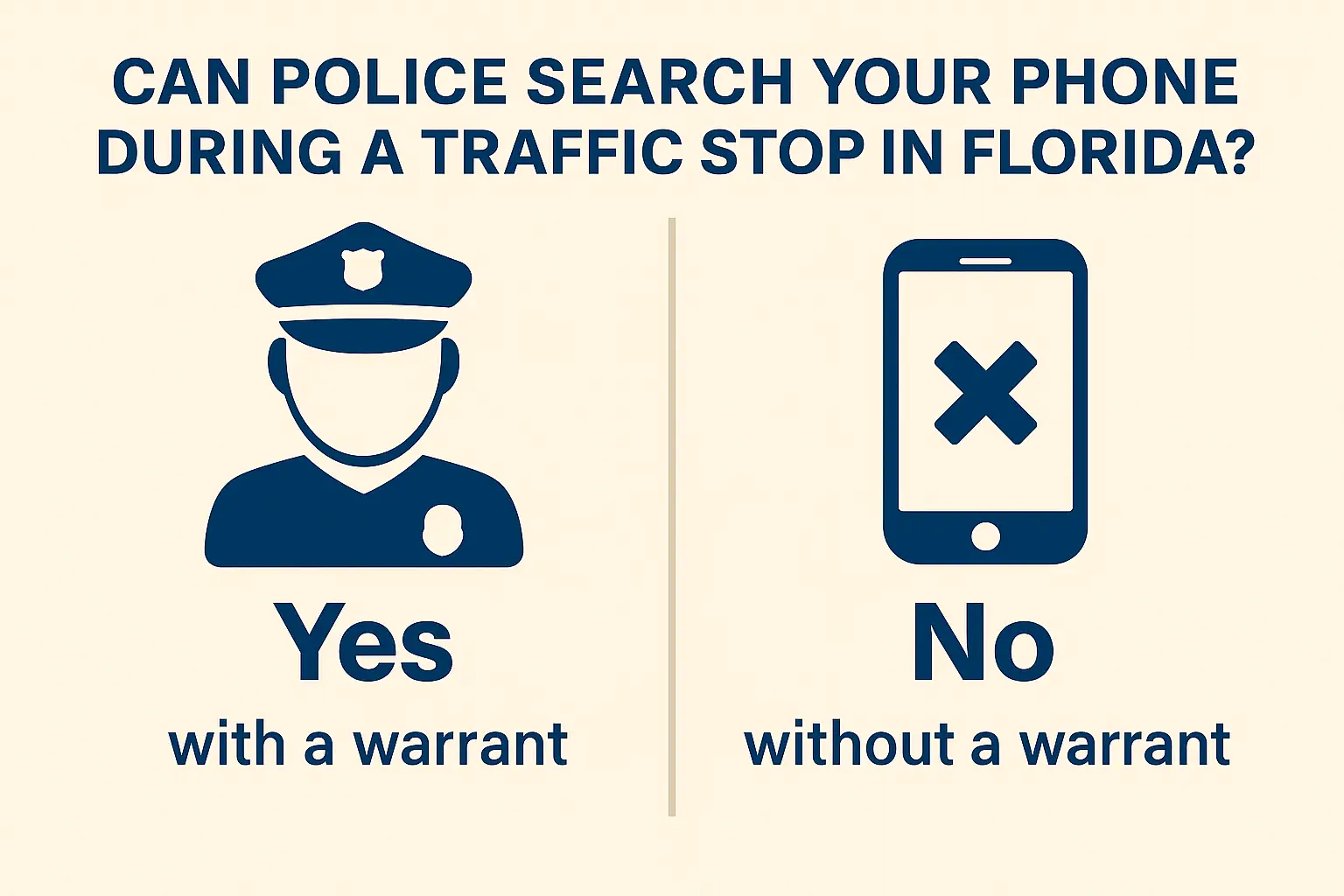
Under the Fourth Amendment, police generally cannot search your phone during a traffic stop without a warrant or a recognized exception.
Digital searches are one category of unlawful search and seizure. For a broader look at these constitutional protections, see our guide to Illegal Search and Seizure in Florida.
Here’s what Florida law actually allows — and what it does not.
⚖️ When Police May Search Your Phone
There are only limited situations where a phone search may be lawful.
1️⃣ You Give Clear, Voluntary Consent
Officers often phrase requests casually:
-
“Let me see your phone for a second.”
-
“Mind if I check something real quick?”
If you clearly agree, the search may be considered lawful.
Consent must be voluntary — not the product of coercion, threats, or deception. Courts analyze bodycam footage carefully to determine whether consent was truly voluntary.
You always have the right to refuse consent.
2️⃣ Police Obtain a Valid Search Warrant
In Riley v. California, the United States Supreme Court held that police generally must obtain a warrant to search the digital contents of a cellphone — even after a lawful arrest.
Courts recognize that smartphones contain far more personal information than physical items traditionally carried during a stop, which is why digital searches are treated differently under the law.
A routine traffic stop does not justify a digital search.
A warrant must:
-
Be supported by probable cause
-
Particularly describe what may be searched
-
Avoid becoming overly broad
Overbroad digital warrants are frequently challenged.
Even after an arrest, police still face strict limits on accessing digital data. Learn how those rules apply in phone searches after arrest in Florida.
3️⃣ Exigent Circumstances (Rare)
In extremely limited situations, police may argue that an emergency justified immediate access — such as preventing imminent harm or destruction of evidence.
In ordinary traffic stops, this exception rarely applies.
🚫 When Police May NOT Search Your Phone
During a routine traffic stop, officers generally cannot:
-
Scroll through your text messages
-
View your photos or apps
-
Search your email or banking apps
-
Demand access “just to verify something”
-
Search out of curiosity or suspicion alone
Your phone is afforded heightened constitutional protection due to the vast amount of private data it contains.
🔎 How Courts Analyze Phone Searches During Traffic Stops
When a digital search is challenged, courts analyze the encounter step by step:
-
Whether the traffic stop was lawful at its inception
-
Whether the officer unlawfully prolonged the stop
-
Whether consent was truly voluntary
-
Whether a warrant existed and was properly limited
-
Whether officers exceeded the scope of any warrant
Even small timing issues — such as when the stop legally ended — can determine whether digital evidence is admissible.
Whether the traffic stop was lawful at its inception is critical. Learn more in illegal traffic stops in Florida.
⏱ Unlawful Prolongation of a Traffic Stop
Even if a stop begins lawfully, officers cannot extend it beyond the time reasonably necessary to address the traffic violation unless new reasonable suspicion develops. Asking to search a phone — or waiting for additional justification — after the purpose of the stop has ended can make any resulting evidence suppressible.
🚓 Common Tactics Used During Traffic Stops
Officers may attempt:
-
Asking you to unlock your device “just to check something”
-
Suggesting refusal makes you look suspicious
-
Framing the request as routine
-
Claiming it’s necessary to verify identity
You cannot be punished simply for refusing consent.
If you do not wish to allow access, clearly state:
“I do not consent to a search of my phone.”
Then remain silent.
🧠 Where Phone Search Traffic Stop Cases Often Break Down
In many cases, the issue is not whether police eventually obtain a warrant — it’s whether they accessed or pressured access to the phone before doing so.
Common problems include:
- requesting access after the legal purpose of the stop has ended
- suggesting compliance is required when it is not
- obtaining consent during an unlawful detention
- accessing data before a warrant is issued
These timing and consent issues often determine whether digital evidence is admitted or suppressed.
🔐 Can Police Force You to Unlock Your Phone?
The law surrounding compelled unlocking is evolving and fact-specific.
In many situations, courts have distinguished between:
-
Forcing disclosure of a memorized passcode (often treated differently), and
-
Compelling biometric unlocking (such as fingerprint or facial recognition).
If officers attempt to compel access without a warrant or valid legal authority, that issue may be litigated through a motion to suppress.
The law in this area continues to evolve, and whether unlocking can be compelled often depends on the specific facts and the type of access requested.
🛡️ How Illegal Phone Searches Are Challenged
When digital evidence is obtained during a traffic stop, we evaluate:
✔ Whether consent was voluntary
✔ Whether the stop was unlawfully extended
✔ Whether a warrant existed and was properly limited
✔ Whether the warrant exceeded permissible scope
✔ Whether exigency truly existed
If the search violated the Fourth Amendment, the digital evidence may be excluded.
👉 For a deeper look at how suppression hearings work, see our Motion to Suppress Guide.
⚖️ Why Digital Suppression Matters
Phone searches frequently uncover:
-
Text messages
-
Photos
-
Location data
-
Call logs
-
Social media activity
In many cases, this digital evidence becomes the backbone of the prosecution’s theory.
If the search was unlawful, suppressing that evidence can significantly weaken — or sometimes dismantle — the State’s case.
If the search violates the Constitution, any evidence obtained may be excluded under the fruit of the poisonous tree doctrine.
📍 Fort Lauderdale Defense for Unlawful Phone Searches
Digital evidence cases are often won or lost on the legality of the initial stop and search. If the Fourth Amendment was violated at any stage, the resulting digital evidence may be excluded.
If police searched or attempted to search your phone during a traffic stop, the legality of the stop, consent, and any warrant must be analyzed carefully.
At Michael White, P.A., we review bodycam footage, warrants, and digital extraction reports to determine whether your constitutional rights were violated.
📞 Call (954) 270-0769 for a confidential consultation.
Serving Fort Lauderdale, Broward County, Miami-Dade, Palm Beach County, and South Florida.
❓ FAQs — Phone Searches During Traffic Stops in Florida
1. Can police search my phone during a traffic stop without consent?
No. Without a warrant or valid exception, officers cannot search your phone.
2. Can police make me unlock my phone?
No. You cannot be compelled to give your passcode or fingerprint during a routine stop.
3. What if I verbally agree under pressure?
Consent must be voluntary. Coerced consent can often be challenged.
4. Can police seize my phone even if they can’t search it?
Sometimes. If police have probable cause to believe the phone contains evidence of a crime, they may temporarily seize it while seeking a warrant.
5. What should I say if an officer asks to look at my phone?
Politely say: “I do not consent to a search of my phone.”
This preserves your rights and prevents accidental waiver.