
Last updated April 2026
Being pulled over by police is stressful — but not every traffic stop in Florida is legal.
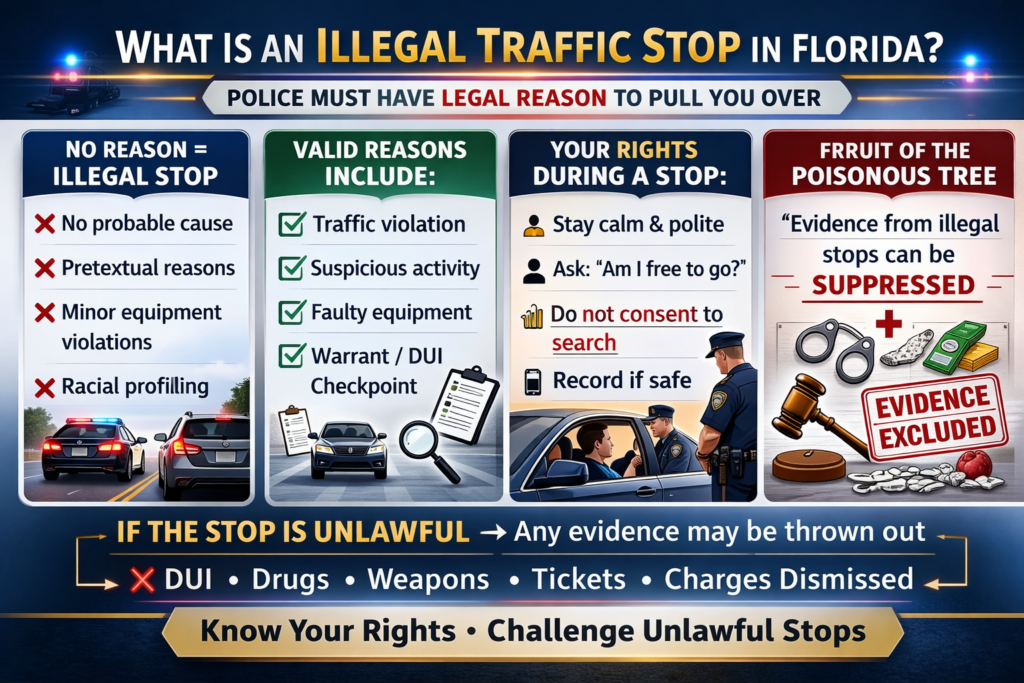
If officers stop your vehicle without reasonable suspicion, the entire case against you may be compromised. In many situations, an illegal stop can lead to suppressed evidence and, in some cases, complete dismissal.
Understanding what makes a traffic stop unlawful is critical because the legality of the stop often determines everything that follows.
These protections are part of Florida’s broader constitutional rules against illegal searches and seizures.
⚖️ The Legal Standard: Reasonable Suspicion at the Start of the Stop
To lawfully stop a vehicle, police must have reasonable suspicion that:
-
A traffic law was violated, or
-
A crime is occurring or has occurred
Reasonable suspicion must be based on specific, articulable facts — not a hunch, guess, or generalized suspicion.
If the stop is invalid at its inception, everything that follows — questioning, searches, field sobriety tests, K-9 sniffs, or arrests — may be suppressed. This is part of what courts refer to as the fruit of the poisonous tree doctrine.
🚫 What Makes a Traffic Stop Illegal in Florida?
A traffic stop may be unconstitutional when:
❌ 1. No Actual Traffic Violation Occurred
Police cannot invent or misinterpret traffic laws to justify a stop. Common examples include:
-
Claiming “lane weaving” without crossing marked lanes
-
Misstating turn-signal requirements
-
Incorrectly citing window tint violations
-
Relying on non-existent equipment violations
If the alleged violation did not occur, the stop may be unlawful.
❌ 2. Stop Based on a Mistake of Law
An officer’s misunderstanding of traffic statutes does not automatically justify a stop. Courts examine whether the mistake was reasonable — and many are not.
❌ 3. Anonymous or Vague Tips
An anonymous tip, without corroboration of illegal conduct, often fails to create reasonable suspicion.
Police must independently verify suspicious behavior before initiating a stop.
❌ 4. “High-Crime Area” Alone
Driving in a so-called high-crime area does not justify a stop.
Location alone is never enough.
❌ 5. Pretext Without Legal Basis
While pretextual stops are sometimes lawful when an actual violation exists, officers cannot fabricate a violation to justify a stop.
If the alleged reason is unsupported by dashcam or bodycam footage, suppression may follow.
🚓 Common Real-World Examples in South Florida
Illegal stops frequently arise from:
-
DUI investigations without proper basis
-
Drug interdiction patrols along I-95
-
“Smell of marijuana” claims without corroboration
-
K-9 deployments after minor traffic violations
-
Passenger name checks used to prolong the stop
If the initial stop lacked reasonable suspicion, all evidence discovered afterward may be excluded.
🧠 Where Illegal Traffic Stop Cases Often Break Down
In many cases, the issue is not whether the officer claims a violation occurred — it’s whether the evidence actually supports it.
Common weaknesses include:
- dashcam footage contradicting the officer’s stated reason
- vague descriptions like “weaving” without lane departure
- timing inconsistencies between the stop and investigation
- reliance on generalized suspicion instead of specific facts
These details often determine whether a stop is upheld or thrown out.
🧪 What Happens If the Stop Was Illegal?
If a court determines the stop was unlawful:
-
Drugs found during a search may be suppressed
-
Statements made during questioning may be excluded
-
Field sobriety exercises may be invalidated
-
Breath or blood test results may be thrown out
-
Firearms discovered after the stop may be inadmissible
This is typically raised through a motion to suppress in Florida, where the defense challenges the legality of the stop and seeks to exclude the evidence.
When the stop collapses, the case often collapses with it.
🔄 Illegal Stop vs. Unlawful Prolonged Stop
It’s important to distinguish between:
-
A stop that was illegal from the beginning, and
-
A stop that was initially valid but later unlawfully extended
Even when a stop begins lawfully, police may violate the Constitution by prolonging it beyond its original purpose without additional reasonable suspicion.
👉 Learn when a stop goes too far in unlawful prolonged traffic stops in Florida
🛡️ How We Challenge Illegal Traffic Stops
At Michael White, P.A., we carefully review:
-
Dashcam footage
-
Body-worn camera recordings
-
Dispatch logs
-
Timing of events
-
Officer statements
-
Alleged traffic violations
-
Bodycam inconsistencies
Small factual inaccuracies often determine suppression outcomes.
Judges in Broward, Miami-Dade, and Palm Beach closely examine whether officers truly had reasonable suspicion at the moment the stop began.
📍 Fort Lauderdale Defense Strategy
Illegal traffic stop challenges are common in:
-
DUI cases
-
Drug possession prosecutions
-
Gun possession arrests
-
Probation violation arrests
-
Outstanding warrant arrests
When a stop is unconstitutional, the exclusionary rule may prevent prosecutors from using any evidence obtained afterward.
🚨 Charged After a Questionable Traffic Stop?
If you believe police pulled you over without a lawful reason, you may have powerful constitutional defenses.
📞 Call (954) 270-0769 for a free consultation.
We will review the stop, examine the footage, and determine whether the evidence can be suppressed.
❓ FAQs — Illegal Traffic Stops in Florida
Can police pull me over just because they suspect something?
No. Officers must have reasonable suspicion supported by specific facts.
Is weaving within a lane enough to justify a stop?
Not necessarily. Courts require more than minimal or momentary movement within a lane.
Does driving in a high-crime area justify a stop?
No. Location alone is not enough.
What if the officer was mistaken about the law?
Some reasonable mistakes may be upheld, but many traffic stops based on misinterpretations are invalid.
Can evidence from an illegal stop be suppressed?
Yes. If the stop lacked reasonable suspicion, evidence discovered afterward may be excluded through a motion to suppress.