
Last updated February 2026
In Florida, you do not have to sell drugs to be charged with a serious felony.
Possession with intent to sell or deliver is one of the most aggressively prosecuted drug charges in the state — and it is often based on circumstantial evidence, not actual transactions.
Many people are shocked to learn that prosecutors can pursue intent charges even when:
no sale occurred,
no buyer exists, and
no money changed hands.
Understanding how Florida defines intent — and how these cases are defended — is critical to protecting your freedom and your record.
For a broader overview of Florida drug offenses, see:
👉 Drug Crimes Defense
🎥 How “Intent to Sell or Deliver” Is Charged in Florida
In many Florida drug cases, prosecutors file possession with intent charges even when no sale occurred. In this video, Attorney Michael White explains how law enforcement claims intent, what evidence they rely on, and why many of these cases are far more defensible than people realize.
⚖️ How Florida Defines Possession With Intent
Possession with intent to sell or deliver is prosecuted primarily under Florida Statute § 893.13.
To prove this charge, the State must show:
Possession of a controlled substance, and
Intent to sell, deliver, or distribute it.
Importantly, intent is rarely proven through direct evidence. Instead, prosecutors rely on inferences drawn from surrounding circumstances.
🧪 How Does Florida Prove Intent to Distribute?
Florida law differentiates simple possession from intent to distribute based on the circumstances of your arrest.
You may face an intent to distribute charge if:
- Drugs are packaged into multiple baggies
- Large amounts of cash are found nearby
- Scales or measuring devices are discovered
- You make statements to police about selling drugs
Example: One bag of cannabis = simple possession. Ten smaller baggies = possible intent to distribute.
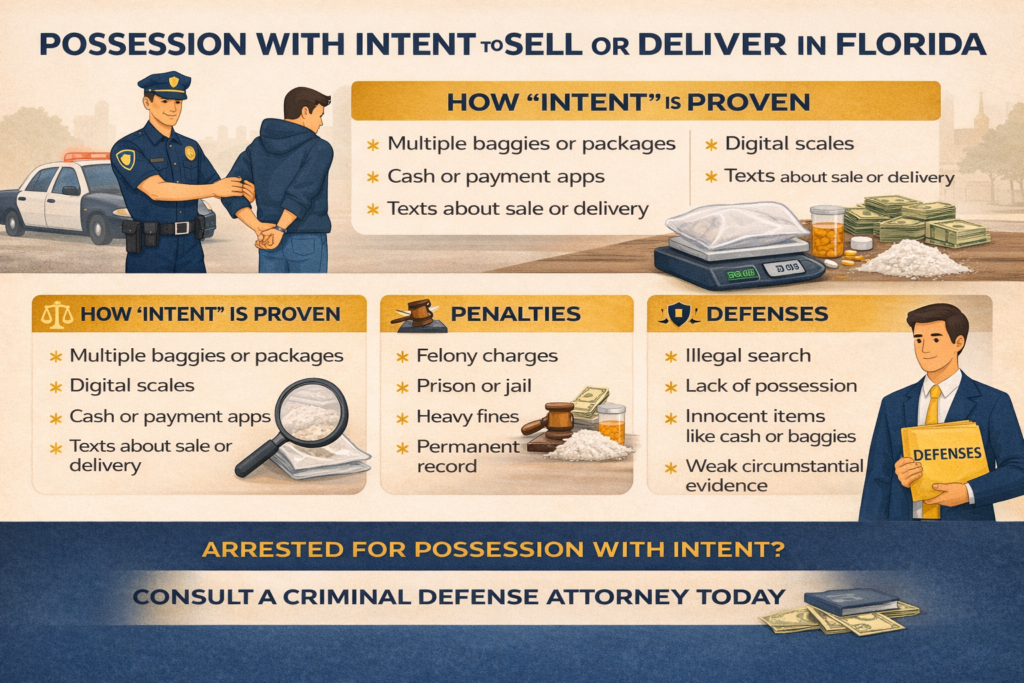
📦 What Prosecutors Use to Claim “Intent”
Florida law does not require an actual sale. Prosecutors often allege intent based on factors such as:
Multiple baggies or individual packaging
Digital scales
Cash or payment apps
Text messages or social media communications
Quantity inconsistent with “personal use”
Statements made during arrest
Surveillance or confidential informants
No single factor automatically proves intent. These cases often turn on interpretation, not hard facts.
🧠 Possession vs. Possession With Intent
Simple possession and possession with intent are very different charges.
Drug possession focuses on whether you knowingly had control over a substance.
Possession with intent adds a second layer: what the State claims you planned to do with it.
👉 For how possession is defined, see Drug Possession in Florida
Many intent cases collapse when the underlying possession itself cannot be proven.
⚠️ Possession With Intent vs. Sale or Delivery
Possession with intent is distinct from actual sale or delivery.
Sale or delivery requires proof of a transfer.
Intent charges rely on alleged preparation or planning.
In practice, prosecutors often:
overcharge intent cases early, and
reduce them later when evidence is weak.
Intent charges are also commonly used as leverage to pressure early pleas.
🚨 Penalties for Possession With Intent in Florida
Possession with intent is almost always charged as a felony.
Penalties depend on:
the substance involved,
the amount alleged, and
any prior criminal history.
Consequences may include:
prison or jail exposure,
probation,
mandatory fines,
driver’s license suspension, and
a permanent felony record.
Intent charges can also make cases ineligible for certain diversion programs.
🛡️ Common Defenses to Intent Charges
Possession with intent cases are often highly defensible, especially when challenged early.
🚓 Illegal Stop or Search
If police lacked reasonable suspicion, probable cause, or a valid warrant, evidence may be suppressed.
🧍 Lack of Possession
If the State cannot prove actual or constructive possession, intent becomes irrelevant.
📱 Innocent Explanations
Items like cash, baggies, or phones often have lawful explanations unrelated to drug activity.
⚖️ Insufficient Evidence of Intent
Circumstantial factors must add up. Weak inferences often fail under cross-examination.
🔍 Suppression & Evidence Issues
Chain-of-custody problems, testing errors, and unlawful searches can derail intent cases entirely.
🔗 How Intent Charges Fit Into Florida Drug Law
Possession with intent sits between:
simple possession, and
drug trafficking, which is driven primarily by weight thresholds and mandatory minimums.
👉 For weight-based offenses, see Drug Trafficking in Florida
Understanding where your charge falls on this spectrum is key to defense strategy.
📞 Charged With Possession With Intent in Florida?
Intent charges are serious — but they are not automatic convictions.
Many cases are reduced, dismissed, or defeated entirely when the evidence is tested early.
📲 Call Michael White, P.A. at (954) 270-0769
💬 Or request a confidential consultation online.
We’ll review the evidence, explain your exposure, and build a defense strategy tailored to your case.
❓ FAQs — Possession With Intent in Florida
Q1: Do prosecutors have to prove I sold drugs?
No. They only need to prove alleged intent, not an actual sale.
Q2: Can intent charges be reduced to possession?
Yes. Many intent cases are reduced when evidence is weak or suppressed.
Q3: Does the amount of drugs matter?
Yes. Larger amounts make intent allegations easier — but amount alone is not enough.
Q4: Can text messages be used to prove intent?
Yes, but messages are often ambiguous and heavily challenged.
Q5: Is possession with intent always a felony?
Almost always, yes — and it carries serious long-term consequences.