
Last updated February 2026
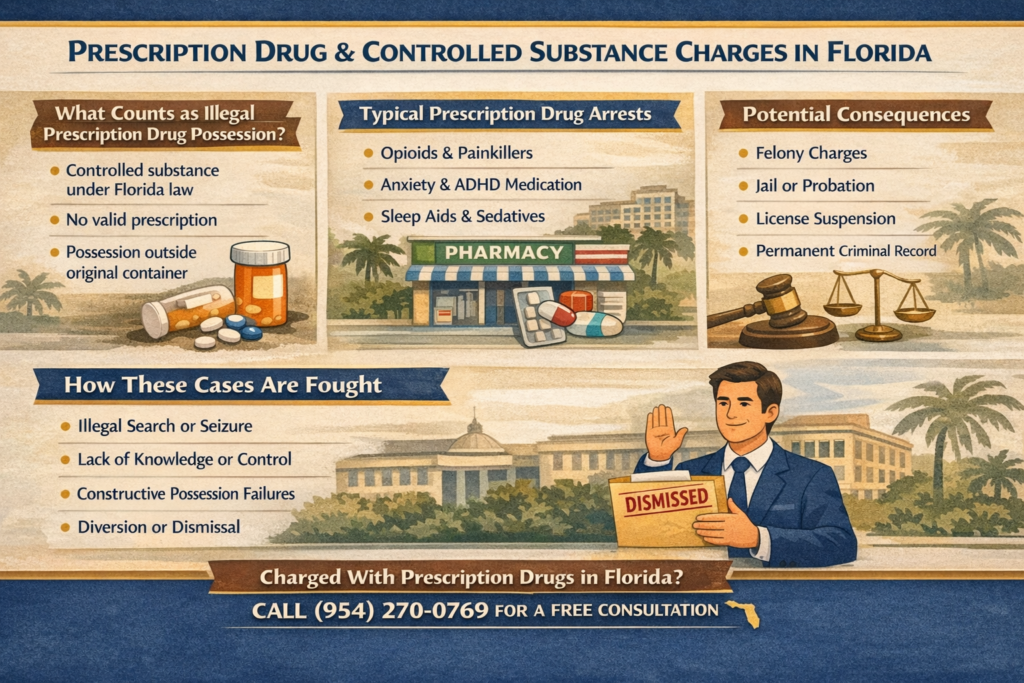
Being arrested for prescription drugs or other controlled substances in Florida often comes as a shock. Many people assume that pills are only illegal if they involve street drugs—but under Florida law, possessing prescription medication without a valid prescription can lead to felony charges, jail time, and a permanent criminal record.
Whether the allegation involves opioids, anxiety medication, stimulants, or pain pills, prescription drug cases are prosecuted aggressively. Understanding how Florida defines controlled substances—and how these cases are defended—is critical to protecting your future.
Florida aggressively prosecutes prescription drug and controlled substance cases as part of its broader drug crimes enforcement framework.
This page explains how prescription drug and controlled substance charges work in Florida, what prosecutors must prove, and how these cases are often resolved.
⚖️ What Is a Controlled Substance Under Florida Law?
Florida classifies drugs as “controlled substances” based on their potential for abuse and accepted medical use. Many prescription medications—including opioids, benzodiazepines, and stimulants—are considered controlled substances under state law.
Possession becomes illegal when:
the medication is not prescribed to you,
the prescription is expired or altered,
pills are carried outside the original container, or
the State alleges intent beyond personal use.
Most prescription drug cases are charged as possession offenses, meaning the prosecution must still prove knowledge, control, and lawful seizure of the evidence.
🚔 Common Prescription Drug Charges in Florida
Prescription drug arrests often involve medications such as:
painkillers (opioids)
anti-anxiety medications
ADHD stimulants
sleep aids or sedatives
Depending on the substance and circumstances, charges may include:
possession of a controlled substance,
possession without a valid prescription,
possession in a shared space (constructive possession), or
possession with alleged intent to sell or distribute.
Even first-time offenders may face felony exposure if the substance qualifies under Florida’s controlled substance schedules.
🧠 How Prosecutors Try to Prove Prescription Drug Possession
To secure a conviction, the State must prove:
you knowingly possessed the medication,
you exercised control over it, and
the drug was obtained or possessed unlawfully.
Cases often rely on traffic stops, searches of vehicles or bags, or pills found in shared locations. When drugs are not found directly on a person, prosecutors frequently rely on constructive possession, which is one of the most vulnerable aspects of these cases.
🛡️ How Prescription Drug Charges Are Defended
Prescription drug cases in Florida often hinge on a small number of legal issues. While every case is fact-specific, many prosecutions break down when the State cannot prove unlawful possession or when the evidence was obtained improperly.
In Broward County, prescription drug cases—particularly those involving opioids—are charged aggressively, but many still involve search issues or weak proof of knowledge that can be challenged early.
Common defense themes include:
Valid prescription or lawful possession
In some cases, the medication was lawfully prescribed but documentation was missing at the time of arrest. Pharmacy records, prescription timing, and medical history can be critical in resolving these cases.Lack of knowledge or control
Prosecutors must prove the accused knowingly possessed the medication and exercised control over it. Cases involving shared vehicles, residences, or bags frequently raise reasonable doubt.Illegal search or seizure
Many prescription drug arrests stem from traffic stops or searches. If police lacked probable cause, valid consent, or a lawful warrant, the evidence may be suppressed.Weak or incomplete evidence
The State must establish the identity of the medication, confirm that it is a controlled substance, and prove it was not lawfully possessed. Missing pill bottles, lab issues, or chain-of-custody gaps can significantly weaken the case.
Handled early and correctly, these issues often lead to reduced charges, diversion, or dismissal.
Many cases weaken significantly once the evidence is tested. In appropriate situations—especially for first-time offenders—charges may be reduced, diverted, or dismissed entirely. Learn more about outcomes on our page explaining how a drug charge can be dismissed in Florida.
🎯 Diversion, Reduction, and Non-Conviction Outcomes
Depending on the charge, prior history, and county policy, some defendants may qualify for:
pretrial diversion,
negotiated reductions to paraphernalia,
withholds of adjudication, or
dismissal after program completion.
Early legal intervention is often the difference between a permanent felony record and a clean outcome.
📍 Why Prescription Drug Cases Are Treated Differently
Unlike street drugs, prescription cases often involve:
medications legally sold by pharmacies,
confusion over prescription validity,
shared household access, and
assumptions made by law enforcement.
These factors make prescription drug arrests especially vulnerable to legal challenge when handled correctly.
📞 Charged With Prescription Drugs in Florida? Get Help Now.
If you’ve been arrested for prescription pills or controlled substances in Florida, do not assume the case is open-and-shut. These cases are often won on the details.
At Michael White, P.A., we defend prescription drug and controlled substance cases throughout Fort Lauderdale and South Florida—focusing on early dismissal, diversion, and record protection.
📲 Call (954) 270-0769 or schedule a free consultation today.
❓ Frequently Asked Questions
Are prescription drugs considered controlled substances in Florida?
Yes. Many prescription medications are classified as controlled substances under Florida law and can lead to felony charges if possessed unlawfully.
Can you be arrested for pills that aren’t yours?
Yes, but prosecutors must still prove knowledge and control. Shared-space pill cases are often defensible.
Are prescription drug charges always felonies?
Not always, but many are charged as felonies depending on the substance and circumstances.
Can prescription drug charges be dismissed?
Yes. Illegal searches, weak evidence, and diversion eligibility frequently lead to dismissal or reduction.