
Last updated February 2026
Yes — But a Petit Theft Charge Can Still Follow You for Life.
In Florida, petit theft is a misdemeanor, but that does not mean it is harmless.
A single petit theft conviction can create a permanent criminal record, affect employment and housing, and limit future opportunities — even when no jail time is imposed.
If you’ve been charged with petit theft in Fort Lauderdale or anywhere in Broward County, here’s what Florida law actually says — and why early action matters.
⚖️ Florida Law on Petit Theft (Fla. Stat. § 812.014)
Florida law defines theft as knowingly obtaining or using another person’s property with the intent to deprive the owner of it.
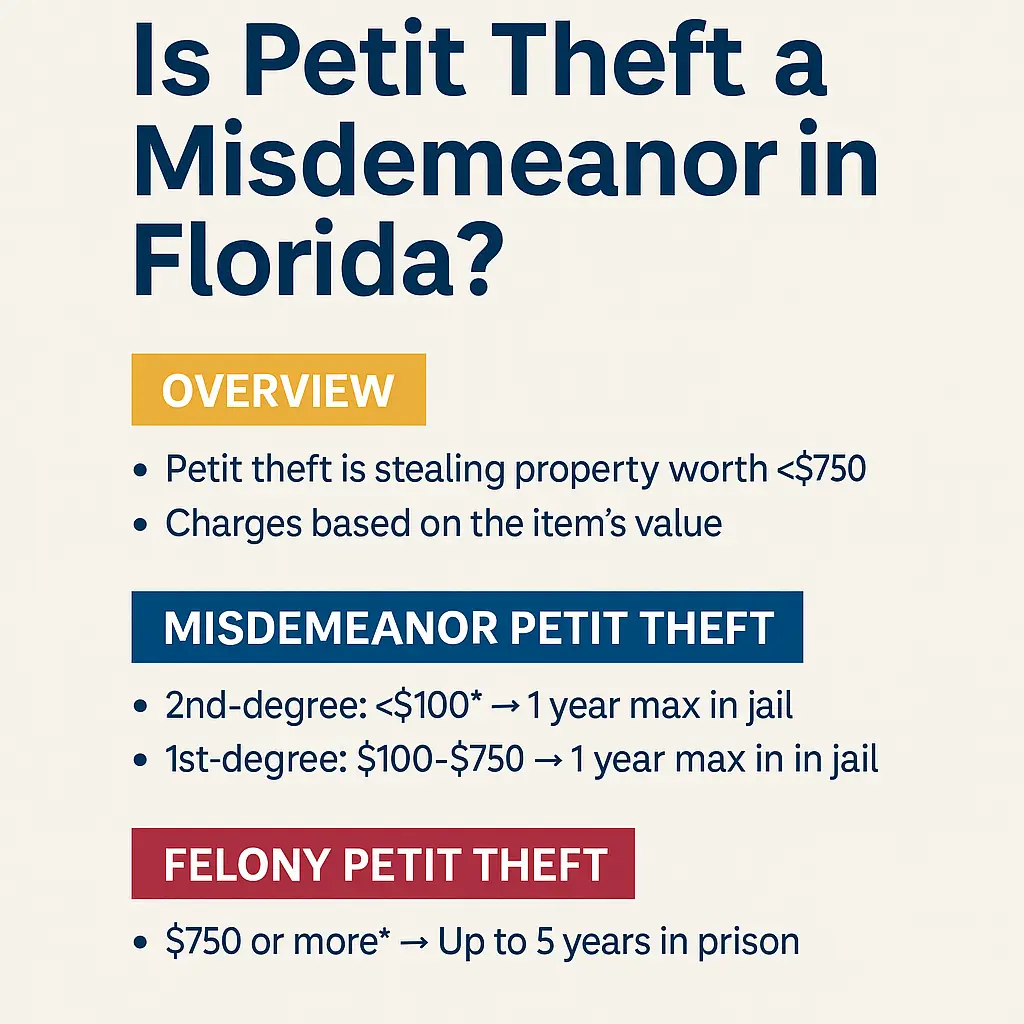
Petit theft applies when the value of the property is less than $750.
Petit theft charges are divided into two misdemeanor levels based on value.
🔹 Second-Degree Misdemeanor Petit Theft
Property Value: Under $100
Maximum Penalties:
Up to 60 days in jail
Up to 6 months of probation
Up to $500 fine
Court costs and restitution
🔸 First-Degree Misdemeanor Petit Theft
Property Value: $100–$749
Maximum Penalties:
Up to 1 year in jail
Up to 1 year of probation
Up to $1,000 fine
Court costs and restitution
Anything valued at $750 or more is charged as grand theft, a felony under Florida law.
For a broader explanation of how theft charges are classified, see theft charges in Florida.
🚨 Why a Petit Theft Charge Is Still Serious
Even though petit theft is a misdemeanor, a conviction can result in:
A permanent criminal record
Difficulty passing background checks
Employment or professional licensing issues
Housing application denials
Civil demand letters from retailers
Immigration consequences for non-citizens
Unlike some other misdemeanors, theft is considered a crime of dishonesty, which makes it especially damaging long-term.
🔍 Common Defenses to Petit Theft Charges
Petit theft cases often turn on intent, ownership, and value. Common defense strategies may include:
Lack of intent to permanently deprive the owner
Mistaken identity or unreliable witness testimony
Ownership or permission disputes
Valuation errors that affect charge level
Illegal searches or improper detention by store security
In many cases, early legal intervention can result in dismissal, diversion, or charge reduction — but those opportunities often disappear once a case progresses.
📞 Arrested for Petit Theft in Florida?
Even a misdemeanor theft charge deserves serious attention. Many people regret underestimating a petit theft case — especially after it shows up on a background check years later.
At Michael White, P.A., we defend petit theft cases throughout Fort Lauderdale and Broward County with the insight of a former prosecutor who understands how these cases are charged — and how they can be resolved without lifelong consequences.
📞 Call (954) 270-0769 to discuss your case confidentially.
❓ Frequently Asked Questions About Petit Theft in Florida
What are the penalties for petit theft?
Property under $100 is a second-degree misdemeanor (up to 60 days jail). Property between $100 and $749 is a first-degree misdemeanor (up to 1 year jail).
Can a petit theft charge be dismissed?
Possibly. Dismissal may be available where there is insufficient evidence, lack of intent, mistaken identity, or eligibility for diversion programs.
Will a petit theft conviction go on my record?
Yes. A conviction creates a permanent criminal record and generally cannot be sealed or expunged.
Can petit theft be reduced or avoided?
In many cases, yes — especially for first-time offenders. Early legal representation increases the chances of diversion, dismissal, or reduction.