
Last updated February 2026
A no contact order in Florida is a criminal court order judges use to protect alleged victims in criminal cases, especially those involving domestic violence, assault, or stalking. If you are subject to one, it’s critical to understand how these orders work — and what options exist for modifying or enforcing them.
If you are dealing with a civil restraining order rather than a criminal bond condition, see our guide to Domestic Violence Injunctions in Florida.
⚖️ What Is a No Contact Order?
A no contact order in Florida is a criminal court order that prohibits a defendant from having any form of communication or interaction with the alleged victim. These orders are most commonly imposed in domestic violence cases, but may also appear in assault or stalking cases.
A no contact order may prohibit:
In-person contact
Phone calls or text messages
Social media interaction
Contact through third parties
Violating this order, even unintentionally, can lead to additional criminal charges.
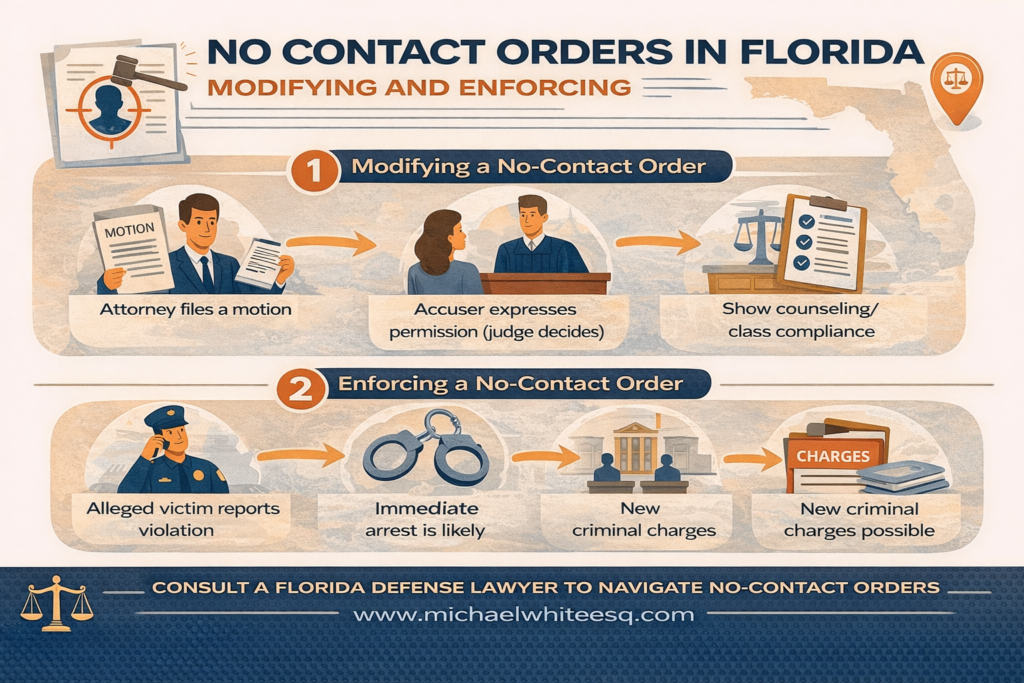
🔄 Modifying a No Contact Order in Florida
While strict, these orders are not always permanent. A defendant may request modification by:
Filing a motion through their attorney
Having the alleged victim express a desire for contact (though the judge decides, not the victim)
Demonstrating compliance with prior conditions (such as completing counseling or classes)
Judges evaluate whether modification poses a risk to the safety of the alleged victim.
🚨 Enforcing a No Contact Order
If a no contact order is violated, the consequences can be severe:
New misdemeanor or felony charges
Revocation of bond and return to jail
Negative impact on the underlying case
Enforcement is strict in Florida, and alleged victims can report even minor violations.
🛡️ Defenses to Alleged No Contact Order Violations
If accused of violating a no contact order, possible defenses include:
Lack of willful intent (accidental contact in public places)
False allegations
Insufficient evidence of communication or contact
📣 Need a No-Contact Order Modified or Enforced in Florida?
These orders move fast—and mistakes can cost you your freedom. Get a strategy session with a former prosecutor who knows Broward courts.
❓ Florida No Contact Order FAQs: Your Questions Answered
❓ What is a no contact order in Florida?
A no contact order is a court directive preventing any communication or contact between the defendant and the alleged victim.
🙋 How can a no contact order be modified?
Your attorney can file a motion; the judge decides based on safety and compliance factors. The alleged victim’s wishes may be considered but are not controlling.
⚖️ What happens if you violate a no contact order?
You can face new charges, revocation of bond, and harsher terms on the underlying case.
🛡️ Can a no contact order ever be dropped?
Yes—if the judge finds it appropriate after reviewing the circumstances. It’s not guaranteed.
🕒 How long does a no contact order last in Florida?
Typically, it remains in effect through the life of the criminal case (and any probation), unless the court modifies or dissolves it by order.