
Last updated February 2026
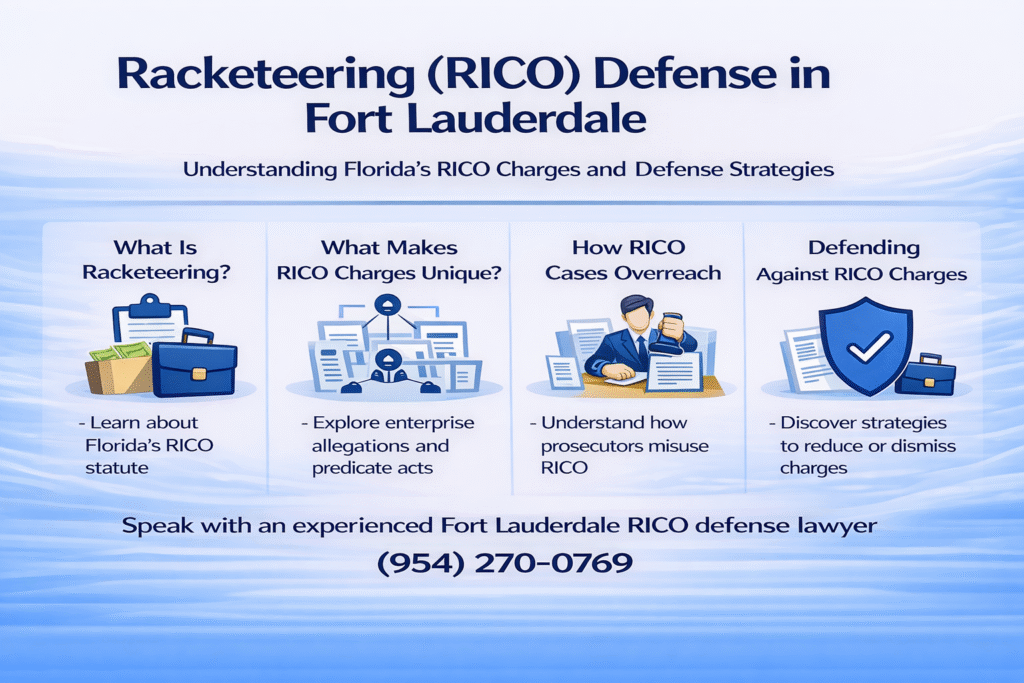
Racketeering charges—often filed under Florida’s RICO statute—are among the most serious and complex allegations a prosecutor can bring. These cases are frequently used to aggregate multiple alleged acts into a single, high-exposure charge, dramatically increasing sentencing risk and leverage against the accused.
In Florida, racketeering is commonly applied to financial, business, and white-collar investigations, not just traditional organized crime. Understanding how RICO works—and how it is defended—is critical before making any decisions in a racketeering case.Racketeering allegations are typically prosecuted within Florida’s broader economic crime framework.
For a comprehensive overview of financial and enterprise-based prosecutions, see our guide to Economic Crimes in Florida.
⚖️ What Is Racketeering Under Florida Law?
Florida’s racketeering law is designed to target patterns of criminal activity carried out through an enterprise. Rather than charging isolated offenses individually, prosecutors may use RICO to combine them into a single case with enhanced penalties.
To sustain a racketeering charge, the State must generally prove:
The existence of an enterprise
A pattern of qualifying criminal acts (predicate acts)
A connection between the defendant, the enterprise, and those acts
In practice, these elements are often hotly disputed—and frequently overstated by prosecutors.
🏢 What Counts as an “Enterprise”?
One of the most contested issues in a RICO case is whether a true enterprise exists.
An enterprise must be more than:
A loose association of individuals
A one-off business transaction
Parallel conduct without coordination
In many Florida cases, prosecutors attempt to label ordinary business relationships or financial activity as a criminal enterprise. Challenging this characterization is often central to an effective RICO defense.
🧾 Predicate Acts and Pattern Allegations
Racketeering charges rely on predicate acts—underlying crimes that the State claims form a pattern of racketeering activity. In white-collar cases, these often include allegations such as:
Fraud-based offenses
Theft-related conduct
Financial misrepresentation
Business or scheme-to-defraud allegations
If the State cannot establish multiple qualifying acts that are properly connected, the entire RICO charge may fail.
🚨 Why Prosecutors Use RICO in Financial and White-Collar Cases
RICO is a powerful tool for prosecutors because it:
Increases sentencing exposure dramatically
Allows broader evidence to be introduced
Creates leverage for plea negotiations
Applies pressure in multi-defendant cases
For these reasons, RICO is often overcharged—filed early and aggressively, even when the legal foundation is shaky. This makes early legal strategy especially important.
Because racketeering allegations frequently arise from complex financial or business investigations, they are typically handled as part of broader white-collar crime prosecutions. You can learn more about how these cases fit into that framework on our White-Collar Crimes defense page.
🛡️ Defending Racketeering (RICO) Charges in Florida
Effective RICO defense focuses on deconstructing the framework of the charge, not just reacting to individual allegations.
Common defense strategies include:
Challenging whether a true enterprise exists
Attacking weak or improperly linked predicate acts
Arguing that alleged conduct does not form a qualifying pattern
Exposing overreach in financial or documentary evidence
Limiting the scope of admissible evidence through motions
Many racketeering cases weaken substantially once these issues are pressed.
🎯 When Racketeering Charges Can Be Dropped or Reduced
Because RICO cases are legally demanding, they are often vulnerable to dismissal or reduction when the State cannot meet its burden.
For a deeper discussion of when and how racketeering charges may be dropped or reduced, see our guide:
👉 Can Racketeering Charges Be Dropped in Florida?
That page focuses specifically on outcome-driven scenarios and real-world defense pressure points.
🤝 Plea Deals and Resolution in RICO Cases
Not every racketeering case goes to trial. In some situations, prosecutors may be willing to negotiate—particularly when:
Enterprise allegations are weak
Predicate acts are questionable
Trials would be lengthy or complex
Defense motions create risk for the State
Whether a plea deal is advisable depends on the evidence, the proposed terms, and long-term consequences.
To understand how plea negotiations work in Florida racketeering cases, see:
👉 Can You Negotiate a Plea Deal in a Fort Lauderdale Racketeering Case?
⚖️ Facing Racketeering Charges in Florida?
Racketeering allegations carry extraordinary risk, but they are also among the most legally fragile charges prosecutors bring—especially in financial and white-collar contexts.
At Michael White, P.A., we defend individuals and professionals throughout South Florida facing racketeering and enterprise-based prosecutions. Our approach focuses on early intervention, strategic pressure, and dismantling overbroad RICO theories before they harden into trial positions.
📞 Call (954) 270-0769 or request a confidential consultation to discuss your situation and protect your future.