
Last updated March 2026
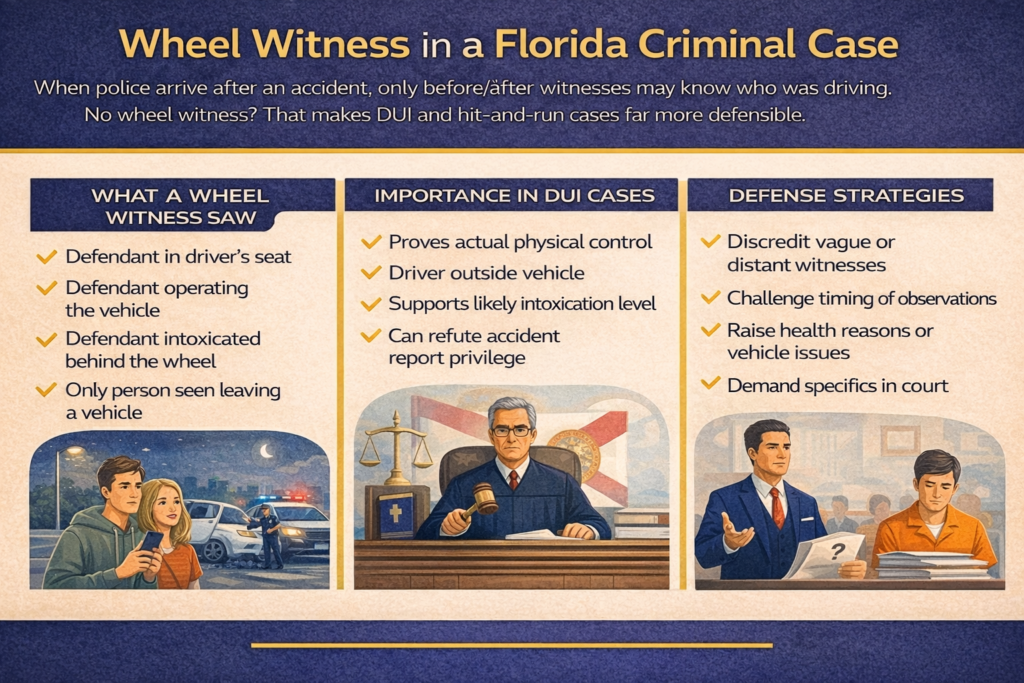
In Florida, if you’re charged with DUI, fleeing and eluding, or any other criminal traffic offense, the prosecution must prove you were the person driving the vehicle. This is where a wheel witness comes in.
In Florida, the State must prove beyond a reasonable doubt that the defendant was the person operating the vehicle. Without a credible wheel witness or admissible substitute evidence, that element may fail — even if impairment is alleged.
Without a wheel witness — or another admissible form of proof identifying the driver — the case may fail entirely.
These issues often arise in the context of suppression and admissibility challenges, which we explain in our guide to Motions to Suppress DUI Evidence in Florida.
🧾 Why a Wheel Witness Matters
To secure a conviction, the State must establish that the defendant was:
- Operating a motor vehicle
- At the time of the alleged offense
This element—actual physical control of the vehicle—often hinges on whether the State has a credible wheel witness who can testify that you were behind the wheel.
👮♂️ Who Can Be a Wheel Witness?
- If a law enforcement officer initiates a traffic stop, they become the wheel witness.
- If police arrive after a crash, they can’t assume who drove—they must rely on other witnesses.
Potential wheel witnesses include:
- Occupants of other vehicles involved in the crash
- Passengers inside your car
- Bystanders who witnessed the incident
Not all witnesses qualify as a wheel witness.
To satisfy the State’s burden, the witness must have personally observed the defendant operating the vehicle at or near the time of the alleged offense.
Statements based on assumption, inference, or post-incident observation — such as seeing someone near a vehicle after a crash — are often insufficient to establish who was driving.
However, there’s one major legal catch…
⚠️ Florida’s Accident Report Privilege
Under Florida law, any statements you make to police during the accident reporting process are privileged and inadmissible in a criminal trial.
That means:
- You cannot be convicted based on your own admission during a crash report.
- Officers must find independent evidence (i.e., a wheel witness) to prove you were the driver.
📌 If no one saw you driving—and your own statements are inadmissible—the State’s case may fall apart.
In some cases, the State attempts to rely on alternative proof — such as video evidence, forensic findings, or circumstantial evidence — but those substitutes must still independently and admissibly establish the identity of the driver beyond a reasonable doubt. In many cases, video evidence becomes critical in establishing (or undermining) who was actually driving, as discussed in our guide to Bodycam Footage in Florida DUI Investigations.
Florida law may limit how statements made during crash investigations can be used, as explained in our guide to Florida’s Accident Report Privilege.
🛑 What Happens If There’s No Wheel Witness?
Without admissible proof identifying the driver:
The State may be unable to establish an essential element of the offense
Charges may be dismissed before trial
Defense counsel may move for a judgment of acquittal
Suppression of protected statements may eliminate the State’s remaining proof
Florida juries are instructed that the State must prove the identity of the driver beyond a reasonable doubt — and that burden cannot be met through speculation or inadmissible statements.
📞 Call Michael White, P.A. — Fort Lauderdale Criminal Defense Attorney
If you’ve been charged with a crime after a crash or incident—and police arrived after the fact—you may be able to challenge the State’s case based on the absence of a wheel witness.
As a former prosecutor, attorney Michael White understands what the State must prove—and how to dismantle a weak case.
📲 Call (954) 270-0769 or schedule your free consultation to discuss your defense strategy today.
💬 Frequently Asked Questions: Wheel Witnesses in Florida Criminal Cases
Q1: What is a wheel witness in a criminal traffic case?
A: A wheel witness is someone who can testify that they personally saw the defendant operating the vehicle—usually an officer, passenger, or bystander.
Q2: Is a wheel witness required to convict someone of DUI or fleeing and eluding?
A: Yes, in many cases. If the State can’t prove who was driving and no wheel witness exists, the case may not meet the burden of proof required for conviction.
Q3: Can police use my own statement to prove I was driving?
A: Not if it was made during an accident investigation. Florida’s Accident Report Privilege makes those statements inadmissible in criminal court.
Q4: What if no one saw me driving, but the car was registered to me?
A: Vehicle ownership alone does not prove who was behind the wheel. The State still needs a witness or evidence placing you in control of the vehicle at the time of the offense.
Q5: Can my case be dismissed if there’s no wheel witness?
A: Possibly. If no admissible evidence proves you were driving, your attorney may file a motion to dismiss or request a judgment of acquittal at trial.