
Last updated April 2026
If the police call and ask you to “come down and give your side of the story,” your first instinct may be to cooperate.
That instinct can cost you.
In most criminal investigations, speaking to law enforcement without a lawyer present creates far more risk than benefit — even if you believe you did nothing wrong.
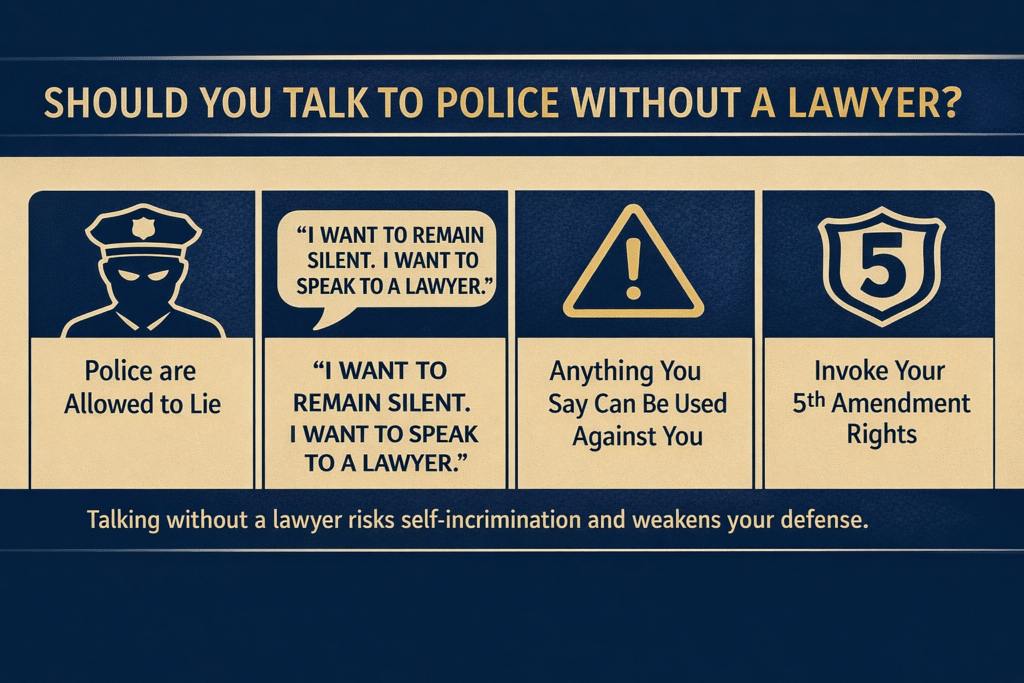
This advice is grounded in your Fifth Amendment right against self-incrimination and the protections recognized in Miranda v. Arizona.
👉 For a full explanation of when Miranda rights apply, see our guide to Miranda rights in Florida.
🎥 Risks of Talking to Police Without a Lawyer
In the video below, Michael White explains how police questioning works in real Florida cases — and why involving counsel before speaking can protect both your rights and your defense.
⚠️ Police Questions Are Rarely Harmless
Law enforcement officers are trained to ask questions that build a case — not clear you.
Even truthful statements can:
Lock you into a timeline
Reveal inconsistencies
Provide admissions prosecutors later characterize as intent
Limit future defense strategies
In many Florida prosecutions, a defendant’s own words become the strongest evidence against them.
Even when warnings are given, statements may still be challenged if a waiver is not valid, as explained in invalid Miranda waivers in Florida.
🧠 Where Police Questioning Becomes Legally Risky
Common issues include:
- conversations that shift from voluntary to custodial
- questioning designed to produce admissions
- statements made before rights are clearly understood
- continued questioning after a request for a lawyer
These situations often determine whether statements can later be challenged in court.
🧠 Why “Clearing Things Up” Can Backfire
Many people believe:
“If I just explain what happened, this will go away.”
In reality:
Investigators are often already building a case
You may not know what evidence they have
Statements are recorded, summarized, or quoted in reports
Innocent explanations can be reframed as incriminating
Police are not required to tell you everything they know before you speak.
👨⚖️ Why You Should Involve a Lawyer First
Before you speak to police, an experienced defense attorney can:
✔ Evaluate whether you are a suspect or a witness
✔ Determine whether questioning may become custodial
✔ Protect your Fifth Amendment rights
✔ Communicate with law enforcement on your behalf
✔ Prevent unnecessary or damaging admissions
Once you clearly request a lawyer, police must stop custodial interrogation. Continued questioning after invocation can create suppression issues.
Learn how statements are challenged through a Motion to suppress in Florida.
🛑 How to Invoke Your Rights Properly
If you choose not to speak, be clear and direct.
Say:
“I am invoking my right to remain silent and I want a lawyer.”
Then stop talking.
Do not explain.
Do not argue.
Do not answer follow-up questions.
Invoking your rights is not a sign of guilt. It is a constitutional protection.
📞 Facing a Criminal Investigation in Florida?
If police are contacting you about a DUI, hit-and-run, domestic violence allegation, drug investigation, or any other charge, do not respond without legal advice.
The earlier a lawyer is involved, the more options you have.
📲 Call (954) 270-0769 to schedule a confidential consultation.
Serving Fort Lauderdale, Broward County, Miami-Dade, Palm Beach County, and South Florida.
💬 Frequently Asked Questions: Talking to Police Without a Lawyer
Q1: Do I have to talk to the police if they call me about an investigation?
A: No. You have the right to remain silent and should exercise it. Politely decline and tell them you’ll speak through your lawyer. Talking without legal counsel can seriously harm your case.
Q2: What if I didn’t do anything wrong—shouldn’t I clear things up?
A: Even innocent people can say things that get misinterpreted or twisted into evidence. Police are trained to extract statements that support their case—not yours.
Q3: Can anything I say to the police be used against me later?
A: Yes. Anything you say can be used in court—even offhand comments or things said before an arrest. That’s why having a lawyer present is essential.
Q4: Will it look bad if I refuse to talk to the police?
A: No. Asserting your right to an attorney is protected by the Constitution and cannot be held against you in court. It shows you’re serious about protecting your legal rights.
Q5: When should I contact a lawyer during a criminal investigation?
A: Immediately. The earlier you involve an attorney, the more they can do to protect your rights, gather favorable evidence, and guide your next moves strategically.