
Last updated March 2026
When police stop a driver for suspected DUI in Florida, they almost always ask the driver to perform field sobriety tests — like walking a straight line or standing on one leg. Officers often present these tests as if they’re required.
They are not.
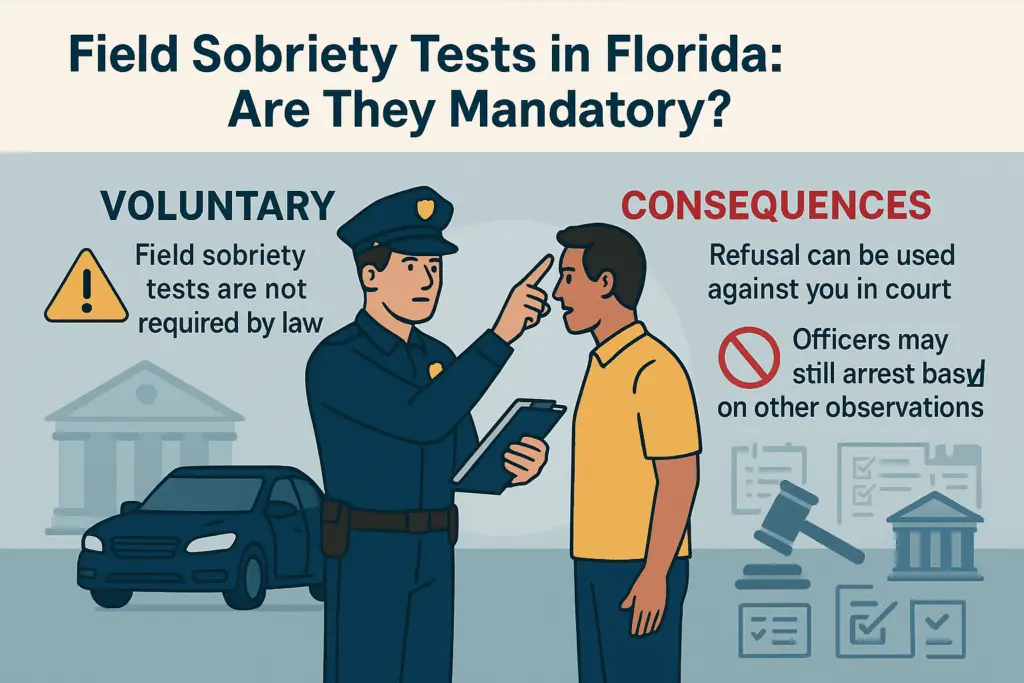
In Florida, field sobriety tests (also called field sobriety exercises or “FSEs”) are completely voluntary. You can legally refuse them — and refusing does not trigger an automatic driver’s license suspension.
Understanding how these tests work, why they’re unreliable, and how they’re challenged in court can make a critical difference in a DUI case.
For a broader breakdown of how DUI evidence is collected and challenged — including chemical testing — see our Florida DUI testing guide.
❗ Are Field Sobriety Tests Mandatory in Florida?
No. Field sobriety tests are not mandatory under Florida law.
Florida’s implied consent statute applies to chemical tests (breath, blood, or urine) — not roadside coordination tests. That means:
You may legally refuse field sobriety tests
Refusal does not result in automatic license suspension
Police are not required to tell you the tests are optional
However, officers may still arrest a driver if they believe they have other indicators of impairment.
🎥 Watch: Can I Refuse a Field Sobriety Test During a Traffic Stop in Florida?
This video explains whether you can legally refuse field sobriety tests during a Florida DUI stop, why officers often don’t tell drivers the tests are optional, and how refusing can limit the evidence used against you in court.
📜 Florida Law and Field Sobriety Tests
Unlike breath or blood testing, field sobriety tests are not governed by statute. They are investigative tools developed by the National Highway Traffic Safety Administration (NHTSA) — not scientific measurements of intoxication.
These tests are subjective, heavily dependent on officer interpretation, and vulnerable to error.
Unlike breath or blood testing, field sobriety tests are not governed by Florida’s implied consent law and are treated very differently from other forms of DUI testing in Florida.
We explain how implied consent applies differently to chemical testing in our guide to Florida’s implied consent law.
👁️ The Standardized Field Sobriety Tests Used in Florida
Florida officers are trained on three so-called “standardized” tests:
Horizontal Gaze Nystagmus (HGN)
The officer moves a pen or light while watching for involuntary eye jerking.
Problems with HGN:
Medical conditions can cause nystagmus
Flashing lights, fatigue, or stress can skew results
The test does not measure blood-alcohol concentration
Walk-and-Turn
The driver walks heel-to-toe, turns, and walks back while counting.
Problems with Walk-and-Turn:
Uneven pavement or poor lighting
Anxiety or unfamiliar instructions
Age, footwear, or prior injuries
One-Leg Stand
The driver stands on one foot while counting for 30 seconds.
Problems with One-Leg Stand:
Balance varies widely among sober people
Inner-ear issues, vertigo, or past injuries
Sloped roads and wind conditions
Even sober drivers frequently “fail” these tests.
⚠️ Non-Standard Field Sobriety Tests Officers Often Use
Officers frequently use non-standardized tests that are not validated by NHTSA:
Finger-to-Nose Test
Drivers touch their nose with alternating hands, eyes closed.
Romberg Balance Test
Drivers estimate 30 seconds while standing with eyes closed and head tilted back.
These tests:
Lack standardized scoring
Are easily misinterpreted
Are often misunderstood by juries
🚫 What Happens If You Refuse Field Sobriety Tests?
Refusing field sobriety tests means:
❌ No automatic license suspension
⚖️ Officers may still arrest you
📄 Refusal may be mentioned in court
However, refusal limits the amount of evidence the State can use against you. Many DUI defenses begin with the absence of unreliable FSE evidence.
This is especially important in drug-related DUI cases, where chemical testing often fails to prove impairment, as explained in our guide to weed DUI in Florida and why testing does not prove impairment.
🛡️ Can Field Sobriety Test Results Be Challenged in Court?
Yes — and they frequently are.
Common challenges include:
Officer failed to follow NHTSA protocol
Poor lighting, uneven ground, or distractions
Medical conditions mimicking impairment
Biased or exaggerated interpretation
In many cases, flawed field sobriety evidence can be suppressed or discredited, weakening the prosecution’s case.
📍 Arrested After Field Sobriety Tests in Florida?
A DUI arrest based on field sobriety tests does not mean a conviction. These tests are subjective, unreliable, and often misused.
A knowledgeable DUI defense attorney can challenge:
The legality of the stop
The administration of the tests
The officer’s conclusions
👉 If you were arrested after field sobriety tests in Fort Lauderdale or anywhere in South Florida, understanding your rights is the first step toward protecting your record.
❓ Frequently Asked Questions: Field Sobriety Tests in Florida
Are field sobriety tests required in Florida?
No. They are voluntary and can be refused without automatic license suspension.
What’s the difference between field sobriety tests and breath tests?
Breath tests fall under implied consent law; field sobriety tests do not.
Can medical issues affect test results?
Yes. Injuries, vertigo, anxiety, fatigue, and neurological conditions can all mimic impairment.
Can these tests be thrown out in court?
Yes. Improper administration or unreliable conditions can render them inadmissible or unpersuasive.
Will refusing field sobriety tests hurt my case?
Not necessarily. Refusal often prevents weak or misleading evidence from being used against you.