
Last updated April 2026
Florida aggressively prosecutes credit card theft, treating stolen cards, card numbers, and account data as felony offenses — even when no purchase is made. In many cases, charges are based on possession or access rather than clear evidence of fraudulent use.
Credit card theft is prosecuted as a felony theft offense, and penalties often track other grand theft felony penalties in Florida, especially when charges are stacked or enhanced.
Simply possessing someone else’s credit or debit card without authorization can lead to arrest and felony charges. These cases often arise from wallet thefts, vehicle break-ins, online transactions, workplace access, or misunderstandings between family members or roommates.
In Broward and Miami-Dade Counties, prosecutors routinely stack credit card theft with additional fraud and theft charges to increase leverage and sentencing exposure.
Here’s how Florida credit card theft laws work — and how these cases are challenged.
⚖️ What Counts as Credit Card Theft in Florida?
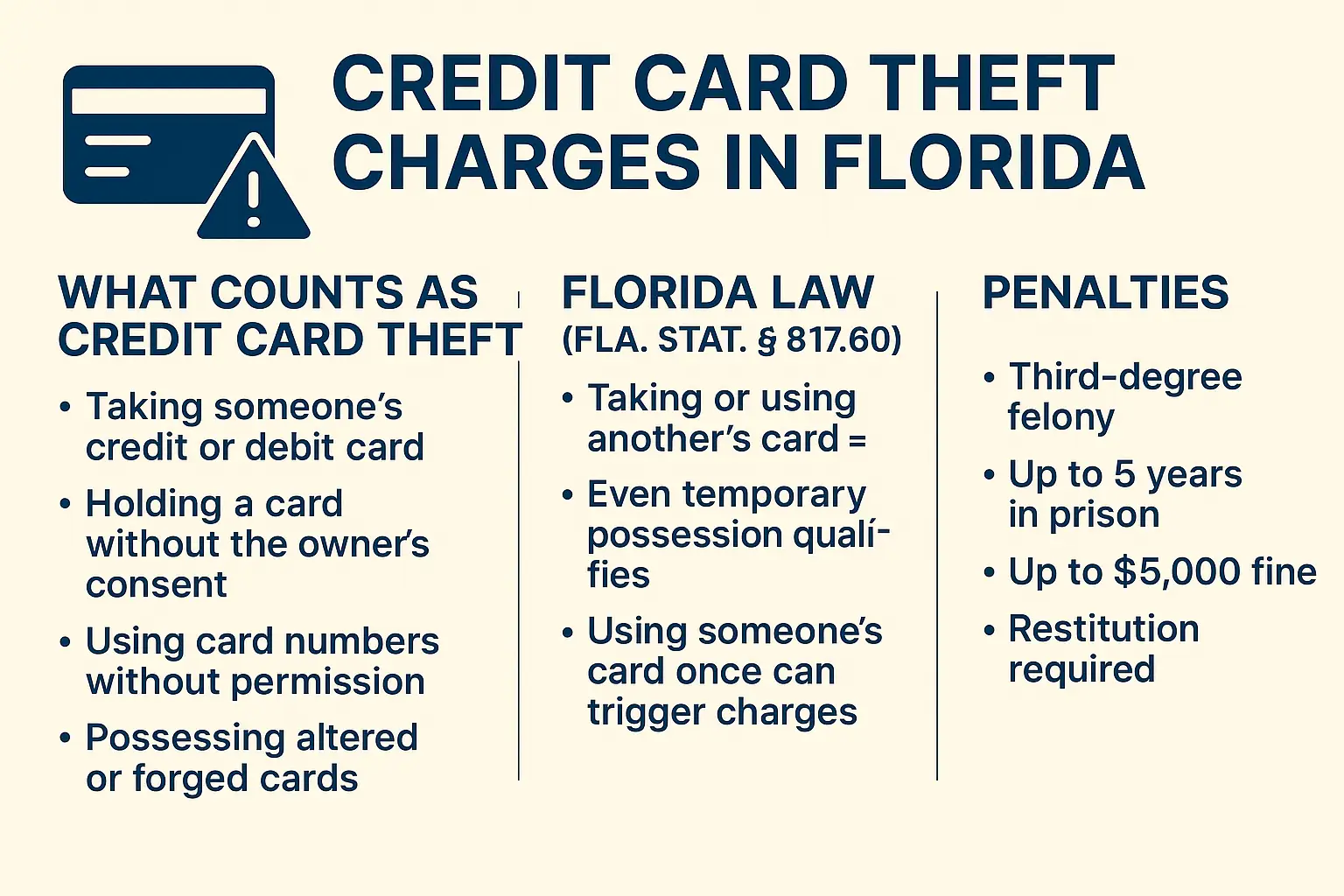
Under Florida Statute § 817.60, credit card theft includes:
✔ Taking a credit or debit card without the cardholder’s consent
✔ Possessing a card you know was lost, misdelivered, or stolen
✔ Possessing or using a credit card number without the physical card
✔ Selling, transferring, or receiving a card without authorization
✔ Possessing multiple cards belonging to different people, which often triggers enhanced fraud allegations
To understand how theft offenses are classified under Florida law, see theft charges in Florida.
Importantly, actual use is not required. Prosecutors only need to allege knowledge and unauthorized possession to file felony charges.
Credit card theft is typically charged as a third-degree felony, punishable by:
-
Up to 5 years in prison
-
Up to 5 years of probation
-
Up to $5,000 in fines
These cases frequently proceed alongside grand theft, fraudulent use of a credit card, identity theft, or scheme-to-defraud charges.
🔗 Common Charge Combinations in Credit Card Theft Cases
Credit card theft rarely appears in isolation. Prosecutors often stack charges to multiply penalties and negotiation pressure.
Common combinations include:
1️⃣ Fraudulent Use of a Credit Card
Using a stolen card — even for a small transaction — is a separate felony.
2️⃣ Scheme to Defraud / Organized Fraud
Multiple transactions, victims, or cards can trigger enhanced felony exposure.
3️⃣ Grand Theft
If unauthorized charges exceed $750, grand theft may be added.
4️⃣ Identity Theft
Accessing or using personal identifying information escalates penalties.
5️⃣ Dealing in Stolen Property
Selling or transferring cards can support additional felony counts.
This stacking pattern mirrors what we see in grand theft combination cases and other complex financial-crime prosecutions.
🚨 How Police Build Credit Card Theft Cases
Investigators often rely on circumstantial and digital evidence, including:
-
Retail surveillance footage
-
Bank and merchant transaction records
-
IP logs tied to online purchases
-
Text messages and digital communications
-
Cell-phone searches (often contested in unlawful search cases)
-
Store-employee statements
-
Fingerprints on recovered cards
-
ATM or self-checkout video
But these cases frequently contain critical weaknesses, including mistaken identity, mixed wallets, shared vehicles, and assumptions about intent — especially in constructive-possession scenarios.
We frequently see cases where access to a card or account is mistaken for criminal intent.
🛑 Common Scenarios That Lead to Wrongful Arrest
People are often charged with credit card theft even when no crime occurred. Common examples include:
-
Picking up a misplaced wallet
-
Holding a friend’s or family member’s card with permission (but no proof)
-
Borrowing a wallet or purse
-
Cards left in a shared vehicle or residence
-
Unaware possession during a police search
-
Online purchases made on someone else’s behalf
-
Cards mixed in with personal property
These cases often hinge on assumptions rather than evidence — particularly regarding knowledge and intent.
These situations often overlap with receiving stolen property charges in Florida.
🛡️ Defenses to Credit Card Theft Charges
Effective defense strategies focus on exposing proof gaps and legal violations. Common defenses include:
✔ Lack of Knowledge
The State must prove you knew the card was stolen.
✔ No Intent to Defraud
Possession alone does not establish criminal intent. This is often a key issue in these cases—see how lack of intent defense in Florida theft cases applies.
✔ Permission or Authorization
Frequent in family, relationship, or roommate disputes.
✔ Constructive Possession Problems
Multiple people may have had access to the card.
✔ Misidentification
Surveillance footage is often unclear or misleading.
✔ Illegal Search or Seizure
Unlawful searches can result in suppression and dismissal.
✔ Insufficient Evidence
The State cannot rely on assumptions to prove felony guilt.
These cases are often won by challenging assumptions about knowledge and intent early in the investigation.
In many cases, these weaknesses support charge reductions or outright dismissal.
🚨 Facing Credit Card Theft Charges in Florida?
Credit card theft charges can escalate quickly — especially when prosecutors stack fraud and theft counts.
But many of these cases collapse when knowledge, intent, or legality is challenged early. In fact, early intervention can prevent charges from proceeding or lead to dismissal—see when theft charges can be dropped in Florida.
What happens early in the case often determines whether it escalates or is resolved before formal charges take hold.
📞 Contact Michael White, P.A. to protect your record and fight back before the case hardens.
❓ Frequently Asked Questions — Credit Card Theft in Florida
Is credit card theft a felony in Florida?
Yes. It is typically charged as a third-degree felony under § 817.60.
Do I have to use the card to be charged?
No. Unauthorized possession alone may be enough if knowledge is alleged.
Can multiple cards lead to multiple charges?
Yes — especially when cards belong to different people.
Can credit card theft be combined with fraud charges?
Yes. Prosecutors frequently add fraudulent use, identity theft, or scheme-to-defraud counts.
Can credit card theft charges be dismissed?
Yes. Many cases fail due to proof, intent, or search-and-seizure problems.