
Last updated February 2026
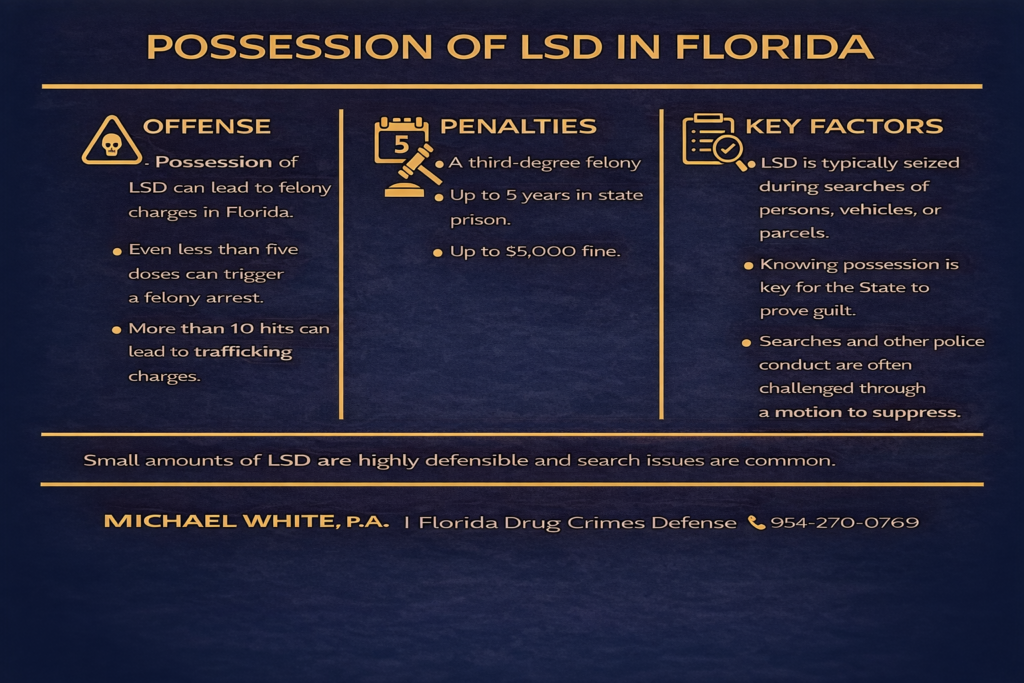
In Florida, possession of LSD is almost always charged as a felony, even when the amount involved appears small. Because LSD is classified as a Schedule I controlled substance, prosecutors treat these cases seriously despite the drug’s low physical volume.
Many people are surprised to learn that tiny quantities, blotter paper, or “hits” of LSD can still result in felony charges.
If you’ve been arrested for possession of LSD in Fort Lauderdale or anywhere in South Florida, understanding how these cases are charged — and how they can be defended — is critical.
For a broader overview of how Florida defines drug possession — including actual vs. constructive possession and common defenses — see Drug Possession in Florida.
📜 How Florida Defines LSD Possession
LSD (lysergic acid diethylamide) is classified as a Schedule I controlled substance under Florida law.
That means:
Possession is typically charged as a felony
The amount does not need to be large
LSD’s form (paper, liquid, tablets) often complicates proof
Unlike substances measured in grams, LSD is often charged based on dosage units, which creates unique defense opportunities.
⚠️ Why LSD Possession Is Treated So Harshly
Florida prosecutors pursue LSD cases aggressively because:
LSD is classified as Schedule I
The drug is associated with distribution networks
Dosage-based charging can inflate severity
Law enforcement often assumes intent beyond simple possession
As a result, even low-level LSD cases can escalate quickly.
📦 Common LSD Possession Scenarios
LSD possession charges frequently arise from:
Blotter paper seized during a search
Liquid LSD found in small containers
Pills or tablets alleged to contain LSD
LSD discovered in shared spaces
Charges based on field testing only
🔑 Key point:
Because LSD is difficult to identify visually, lab testing and handling are critical.
🛡️ Defending an LSD Possession Case
LSD possession cases are highly defensible, particularly due to testing and proof issues.
Common defense strategies include:
Challenging whether the substance is actually LSD
Attacking the reliability of field tests
Demanding confirmatory laboratory analysis
Contesting how dosage units were calculated
Suppressing evidence from unlawful searches
Exposing chain-of-custody failures
Many LSD cases fall apart when the State is forced to prove identity and dosage scientifically.
⚖️ What’s at Stake With an LSD Possession Conviction
A conviction for LSD possession in Florida may result in:
A felony conviction
Prison or extended probation exposure
A permanent criminal record
Loss of employment or housing opportunities
Immigration consequences for non-citizens
Because the charge is a felony by default, early defense action matters.
📍 Charged With LSD Possession in Florida?
LSD possession charges are serious — but they are not automatic convictions.
Police mistakes, unreliable testing, and overcharging occur frequently in LSD cases due to the drug’s unique form and measurement.
At Michael White, P.A., we defend LSD possession cases by challenging searches, testing, dosage calculations, and the State’s assumptions.
👉 Schedule a free consultation to discuss your LSD possession charge and your defense options.
🙋♂️ Frequently Asked Questions
Is possession of LSD always a felony in Florida?
Yes. LSD is a Schedule I controlled substance, and possession is typically charged as a felony regardless of the amount.
Can a small number of “hits” lead to felony charges?
Yes. LSD is often charged based on dosage units, not weight, which can result in felony charges for very small quantities.
Are field tests reliable for LSD cases?
Field tests are frequently challenged. Confirmatory laboratory testing is often necessary to prove LSD possession.
Does LSD possession automatically mean prison?
Not always. Outcomes depend on the evidence, prior history, and whether the defense successfully challenges testing or searches.
Should I hire a lawyer immediately?
Yes. LSD cases often hinge on technical proof issues, and early defense action is critical.