
Last updated March 2026
What the Difference Means for Evidence and Your Defense
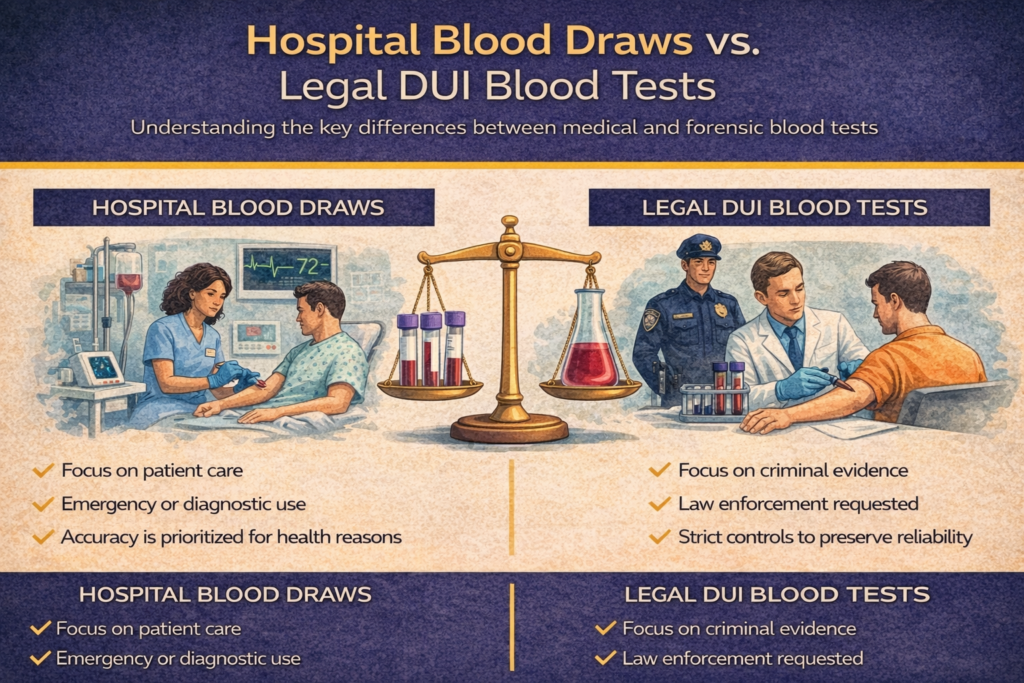
When a DUI arrest involves a crash, injury, or medical treatment, blood evidence often becomes central to the case. But not all blood tests are created equal.
In Florida, there is a critical legal difference between a hospital blood draw taken for medical treatment and a legal DUI blood test taken for law enforcement purposes. Confusing the two is one of the most common — and most consequential — mistakes in DUI prosecutions.
This page explains how hospital blood and legal DUI blood tests differ, when prosecutors can use hospital blood evidence, and why these distinctions frequently create powerful defense opportunities.
For a broader explanation of how chemical testing works — including breath, blood, and urine evidence — see our Florida DUI testing guide.
⚖️ Two Very Different Types of Blood Tests
🏥 Hospital Blood Draws (Medical Purpose)
Hospital blood draws are taken to diagnose or treat a patient. Their purpose is medical care, not criminal investigation.
Key characteristics:
Ordered by doctors or medical staff
Taken for diagnosis, treatment, or monitoring
Not collected under DUI testing protocols
Not designed to preserve forensic evidence
Hospitals are focused on patient care, not evidentiary compliance.
🚓 Legal DUI Blood Tests (Law Enforcement Purpose)
Legal DUI blood tests are taken at the direction of law enforcement to measure alcohol or drug levels for prosecution.
Key characteristics:
Taken with consent or a warrant
Governed by strict legal and procedural rules
Require proper authorization, documentation, and handling
Intended to be used as evidence in court
Because these tests are evidentiary, procedure matters at every step.
🔑 Why the Difference Matters in DUI Cases
Prosecutors often attempt to substitute hospital blood results for a legal DUI blood test — but doing so is not automatic or simple.
These issues are part of Florida’s broader DUI testing framework, which governs how chemical evidence is collected, handled, and evaluated in criminal cases.
The law treats these two types of tests differently because:
One is compelled medical care
The other is compelled evidence collection
Whether hospital blood can be used in a DUI case depends on how it was obtained, accessed, and handled.
🧾 When Can Hospital Blood Be Used in a DUI Case?
Hospital blood results are not automatically admissible in criminal court.
To use hospital blood evidence, the State typically must show:
Lawful access to medical records (often via subpoena)
Compliance with privacy and procedural rules
That the blood draw and testing are reliable for forensic purposes
That chain of custody and documentation support admissibility — issues we break down further in our guide to chain-of-custody errors in Florida DUI blood cases
Defense attorneys frequently challenge hospital blood evidence through:
Motions to quash subpoenas
Motions to suppress improperly obtained records
Reliability and chain-of-custody objections
🚨 Common Problems With Hospital Blood Evidence
Hospital blood evidence often suffers from issues that make it unreliable in criminal court, including:
Timing gaps between driving and blood draw
IV fluids or medications affecting blood composition — an issue we explain in detail in our guide to how IV fluids affect blood alcohol results in Florida DUI cases
Unknown testing methods or equipment
Incomplete documentation
No preserved sample for independent retesting
What works for medical treatment does not always work for criminal proof.
🔒 Legal DUI Blood Tests: Strict Requirements
When police order a legal DUI blood draw, Florida law imposes additional requirements, including:
Valid consent or a properly issued warrant
Qualified personnel performing the draw
Documented chain of custody
Proper labeling, storage, and testing
Compliance with statutory and constitutional protections
Failures in any of these areas can undermine or exclude the evidence.
🧠 Blood Testing After Crashes and Medical Treatment
Many DUI blood cases arise after:
Traffic crashes
Serious injuries
Emergency medical transport
In these situations:
Blood testing is often delayed
Alcohol absorption may still be occurring
BAC at testing may not reflect BAC at driving — a timing issue we explain in detail in our guide to how long after driving police can test your BAC in Florida
Prosecutors may attempt to bridge this gap with assumptions or retrograde analysis, which can be challenged depending on the facts.
🛡️ Defense Strategies in Blood-Based DUI Cases
Effective DUI defense involving blood evidence often focuses on:
Whether the blood test was medical or legal
Whether law enforcement had lawful authority
Whether records were obtained properly
Whether the results reliably reflect impairment at driving
Whether alternative explanations exist (injury, treatment, delay)
In some cases, excluding hospital blood evidence leaves the State without proof of impairment.
🚗 Blood Evidence Is Not Automatic Proof
Blood test results — especially hospital blood results — are evidence, not conclusions.
Courts require that:
Evidence be lawfully obtained
Evidence be reliable
Evidence be properly handled
When those standards are not met, blood evidence can be suppressed, limited, or discredited.
📍 Charged With DUI After a Hospital Blood Draw?
If your DUI case involves hospital blood testing, early legal review is critical. Medical records, treatment notes, and timing details often determine whether blood evidence is admissible — or fatal to the prosecution’s case.
Understanding the difference between hospital blood draws and legal DUI blood tests can change the entire trajectory of a case.
❓ Frequently Asked Questions
Is hospital blood the same as a DUI blood test?
No. Hospital blood is taken for medical purposes and is not automatically admissible as DUI evidence.
Can police use my hospital blood test against me?
Sometimes, but only if they obtain it lawfully and can show it is reliable and admissible.
Do IV fluids affect blood alcohol results?
They can. Fluids, medications, and trauma may impact timing and interpretation.
Does blood testing always prove impairment?
No. Blood tests reflect a point in time, not necessarily the moment of driving.
Can blood evidence be thrown out in court?
Yes. Improper collection, access, or reliability issues may lead to suppression.