
Last updated March 2026
If you are under investigation for a sex crime in Florida, one of the most important questions is:
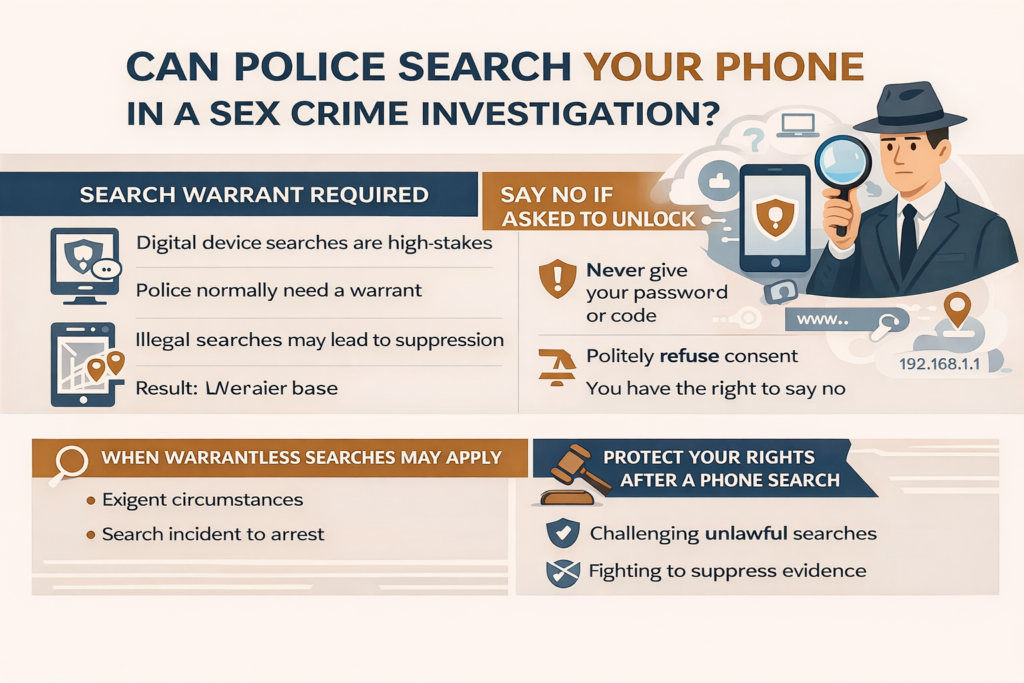
Can police search your phone?
In many modern sex crime investigations, the phone becomes the central piece of evidence. Text messages, social media accounts, photos, search history, and app data can all be targeted.
But the Fourth Amendment places limits on what law enforcement can do.
Digital device searches are governed by strict constitutional rules in cases involving Sex Crimes In Florida.
For a broader explanation of unlawful searches and suppression in Florida, see our guide to Search & Seizure Defense in Florida.
🔎 Do Police Need a Warrant to Search Your Phone?
In most cases, yes.
The U.S. Supreme Court has made clear that cell phones contain vast amounts of private information. As a result:
Police generally must obtain a search warrant before examining the contents of your phone.
The warrant must describe what officers are authorized to search.
The search must stay within the scope of that warrant.
Simply being arrested does not automatically give police unlimited authority to search your digital life.
🚨 What Happens If Police Seize Your Phone?
During a sex crime investigation, officers may:
Take your phone at the time of arrest
Seize it during a search warrant execution at your home
Request it during questioning
Ask you to unlock it
Seizure and search are not the same thing.
Police may temporarily seize a phone to preserve evidence, but they typically still need a valid warrant to examine its contents.
🛑 Should You Consent to a Phone Search?
One of the most common mistakes people make is consenting.
If an officer asks:
“Can we take a look at your phone?”
“Will you unlock it for us?”
“You don’t have anything to hide, right?”
You have the right to refuse consent.
If you voluntarily unlock your phone or hand it over for inspection, you may waive important constitutional protections.
Anything discovered during a consent search can be used against you.
⚖️ Exceptions to the Warrant Requirement
While a warrant is usually required, there are limited exceptions.
1️⃣ Exigent Circumstances
If police reasonably believe that evidence is about to be destroyed or there is an emergency, they may argue a warrantless search was justified.
These situations are narrow and fact-specific.
2️⃣ Search Incident to Arrest (Limited)
Officers may search the physical aspects of a phone (for example, checking for weapons), but they generally cannot examine digital data without a warrant.
3️⃣ Consent
If you give permission — even casually — the warrant requirement may not apply.
📱 What Can a Phone Warrant Actually Cover?
A valid warrant must be specific.
It should describe:
The categories of data to be searched
The time frame
The suspected offense
The device(s) involved
If officers exceed the scope — for example, searching unrelated apps or time periods — suppression may become an issue.
Phone searches in sex crime investigations often involve:
Text messages
Direct messages
Photos and videos
Cloud backups
App metadata
Location history
The scope of the warrant matters.
🔐 Can Police Force You to Unlock Your Phone?
This area of law is evolving.
Courts treat:
Passcodes
Biometric unlock methods (fingerprint or facial recognition)
differently in some situations.
Whether law enforcement can compel unlocking depends on:
How the request is made
Whether a warrant exists
The nature of the authentication method
Fifth Amendment considerations
This is a highly fact-dependent issue.
📉 Suppressing Illegally Obtained Digital Evidence
If your phone was searched unlawfully, your attorney may file a motion to suppress.
Suppression can occur when:
No warrant existed
The warrant lacked probable cause
The search exceeded scope
Consent was coerced
The seizure was unlawful
In sex crime cases, digital evidence is often central to the prosecution’s theory. If that evidence is excluded, the case can weaken significantly. In some cases, the State’s case relies almost entirely on circumstantial or digital evidence rather than physical proof. To understand how those cases are handled, see Sex Crime Charges Without Physical Evidence In Florida.
🎯 Why Phone Evidence Is So Important in Sex Crime Cases
Unlike other offenses, sex crime investigations often rely heavily on:
Online communication
Message timing
Digital photographs
Location tracking
Search history
In some cases, digital evidence may become the State’s most persuasive proof.
That is why early legal intervention matters.
🛑 What You Should Do If Police Ask for Your Phone
If you are approached during an investigation:
Do not consent to a search
Do not unlock your device
Do not attempt to delete anything
Do not explain or justify content
Request an attorney immediately
Statements made during these encounters can also become evidence.
📞 If Your Phone Has Already Been Seized
Even if police have taken your device, it does not mean the search was lawful.
Digital search warrants are complex and often vulnerable to challenge.
If you are under investigation or facing charges in Broward County or South Florida, immediate legal review of the search process can be critical.
📱 FAQs
1️⃣ Can police search my phone just because I was arrested for a sex crime?
No. An arrest alone does not automatically give police authority to search the digital contents of your phone. In most cases, officers must obtain a valid search warrant before reviewing messages, photos, or app data.
2️⃣ What if my phone was unlocked when police took it?
If a phone is already unlocked, officers may argue they could view information in plain view. However, accessing deeper digital data usually still requires a warrant. Whether the search was lawful depends on how and when access occurred.
3️⃣ Can police search my social media accounts without taking my phone?
Yes, but typically through legal process. Investigators may obtain search warrants or subpoenas for account records, message logs, IP data, or stored content directly from service providers.
4️⃣ What happens if the warrant was too broad?
If a search warrant lacks specificity or allows officers to search unrelated data, your attorney may challenge it. Courts can suppress evidence obtained outside the lawful scope of the warrant.
5️⃣ Should I give police my phone password if they ask?
You are not required to consent to a search or voluntarily provide access to your device. Providing a password or unlocking your phone can significantly affect your legal position. If you are under investigation, request an attorney before responding.