
Last updated March 2026
When a child is arrested in Broward County, formal prosecution is not always inevitable. In many cases, Florida law allows eligible juveniles to enter diversion programs that avoid adjudication, protect their record, and keep them out of detention.
For a broader overview of how juvenile cases begin — including arrest, detention hearings, and filing decisions — see our complete guide to Juvenile Crimes in Fort Lauderdale.
Diversion can be the difference between a second chance and a permanent record.
⚖️ What Is a Juvenile Diversion Program?
Juvenile diversion is an alternative to formal prosecution. Instead of filing a delinquency petition and proceeding through juvenile court, prosecutors may allow a minor to complete certain conditions in exchange for the case being dismissed.
Diversion programs focus on:
-
Accountability
-
Education
-
Counseling or treatment
-
Community service
-
Behavioral correction
If successfully completed, diversion typically results in no formal adjudication.
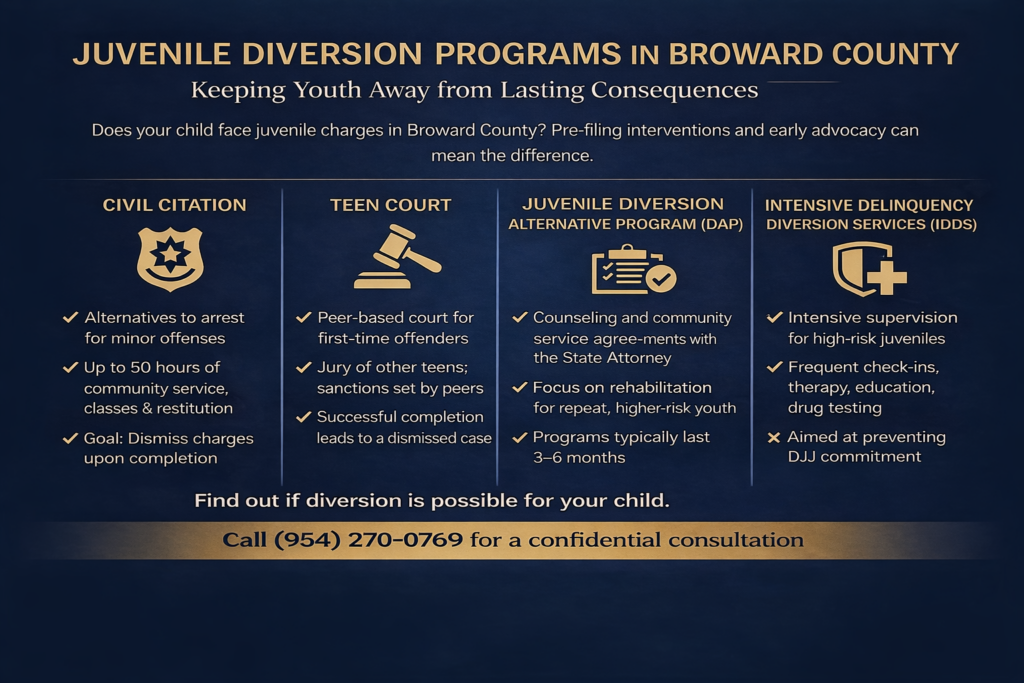
📋 Common Juvenile Diversion Options in Broward County
While programs vary based on the charge and prior history, common diversion options include:
✅ Civil Citation
Civil citation is often used for first-time, low-level offenses such as shoplifting or marijuana possession.
Instead of arrest and prosecution, the minor may be required to:
-
Complete community service
-
Attend counseling
-
Write an apology letter
-
Participate in educational programming
Successful completion usually prevents a formal delinquency filing.
🧑⚖️ Teen Court
Teen Court is a peer-based accountability program where juveniles participate in structured proceedings overseen by volunteers and court officials.
The focus is education and responsibility rather than punishment.
📘 Diversion Alternative Programs (DAP)
More structured diversion programs may include:
-
Behavioral counseling
-
Family intervention
-
Substance abuse evaluation
-
Supervised probation-like conditions
These programs are often used when prosecutors believe additional structure is necessary but formal prosecution is not required.
🧠 Intensive Delinquency Diversion Services (IDDS)
For higher-risk juveniles who still qualify for diversion, more intensive supervision and services may be available through DJJ-based programs.
The goal remains rehabilitation — not incarceration.
🚨 Who Qualifies for Juvenile Diversion?
Eligibility depends on several factors:
-
Nature of the alleged offense
-
Prior juvenile history
-
Cooperation during investigation
-
Willingness to accept responsibility
-
Input from the alleged victim
Not every case qualifies automatically.
In some situations, early legal advocacy can persuade prosecutors to offer diversion when it was not initially proposed.
Statements made during an investigation can also affect eligibility for diversion, especially if a case becomes stronger because of what was said. For more on how these issues arise, see Can Police Question a Minor in Florida?.
🔒 Why Diversion Matters
Successful diversion can:
-
Avoid formal adjudication
-
Preserve eligibility for expungement
-
Protect college and scholarship opportunities
-
Reduce long-term record consequences
-
Prevent escalation to adult court
Without diversion, a juvenile may face probation, detention, or more serious long-term exposure.
⚠️ What Happens If Diversion Is Denied?
If prosecutors decline diversion, they may file a formal delinquency petition.
In more serious cases — especially repeat or violent allegations — prosecutors may even consider transferring the case to adult court through direct file.
To understand when that risk exists, see our breakdown Juvenile Cases Direct-Filed to Adult Court.
The earlier intervention occurs, the more options typically remain available.
🛡 How a Juvenile Defense Attorney Can Help Secure Diversion
Early involvement can significantly increase the likelihood of diversion.
A defense attorney may:
-
Present mitigation before filing decisions
-
Provide proof of school enrollment and academic standing
-
Document counseling or proactive treatment
-
Negotiate structured alternatives to prosecution
-
Challenge weak evidence that reduces prosecutorial leverage
In some cases, legal issues involving searches or evidence collection can weaken a case enough to make diversion more likely. For example, improper phone searches may limit what prosecutors can use. See Can Police Search a Juvenile’s Phone in Florida?.
Proactive advocacy often matters more than families realize.
🔄 What Happens After Successful Diversion?
Once diversion is completed:
-
The case is typically dismissed
-
No adjudication occurs
-
The child avoids formal delinquency status
However, records may still exist unless properly addressed.
Families often explore record-clearing options after diversion. Learn more here about Juvenile Record Expungement in our comprehensive guide.
📞 Exploring Diversion After a Juvenile Arrest in Broward County?
Diversion opportunities can disappear quickly if early decisions are not handled properly.
The first 24–48 hours after a juvenile arrest often determine whether a case stays informal — or proceeds into formal court.
Contact Michael White, P.A. for a confidential consultation with a former prosecutor who works to keep juvenile cases out of court and protect long-term futures.
Frequently Asked Questions
1) What is a juvenile diversion program in Broward County?
A juvenile diversion program is an alternative to formal prosecution where a minor completes requirements such as community service, counseling, or educational classes in exchange for the case being dismissed or not formally filed.
2) Is a civil citation the same as diversion in Florida?
Civil citation is one type of juvenile diversion. It is often used for eligible first-time, low-level offenses and can allow a child to avoid formal court processing if all conditions are completed successfully.
3) Does successful diversion keep a juvenile arrest off the record?
Diversion can prevent an adjudication, but records may still exist unless they are later sealed or expunged. After successful completion, families often explore juvenile record-clearing options to ensure the matter does not reappear in background checks.