
Last updated March 2026
🚨 You Don’t Have to Be Holding a Gun to Be Charged
In Florida, you can be arrested and charged with a firearm offense even if the gun was not in your hands.
This is called constructive possession — and it is one of the most commonly misunderstood (and aggressively prosecuted) theories in gun cases.
Many people are shocked to learn they can face serious felony charges simply because a firearm was found near them, in a vehicle, or inside a shared space.
Understanding how constructive possession works is critical to building a defense.
For a broader overview of how firearm offenses are charged and prosecuted, see our guide to Gun Crime Charges in Florida.
⚖️ What Is Constructive Possession in Florida?
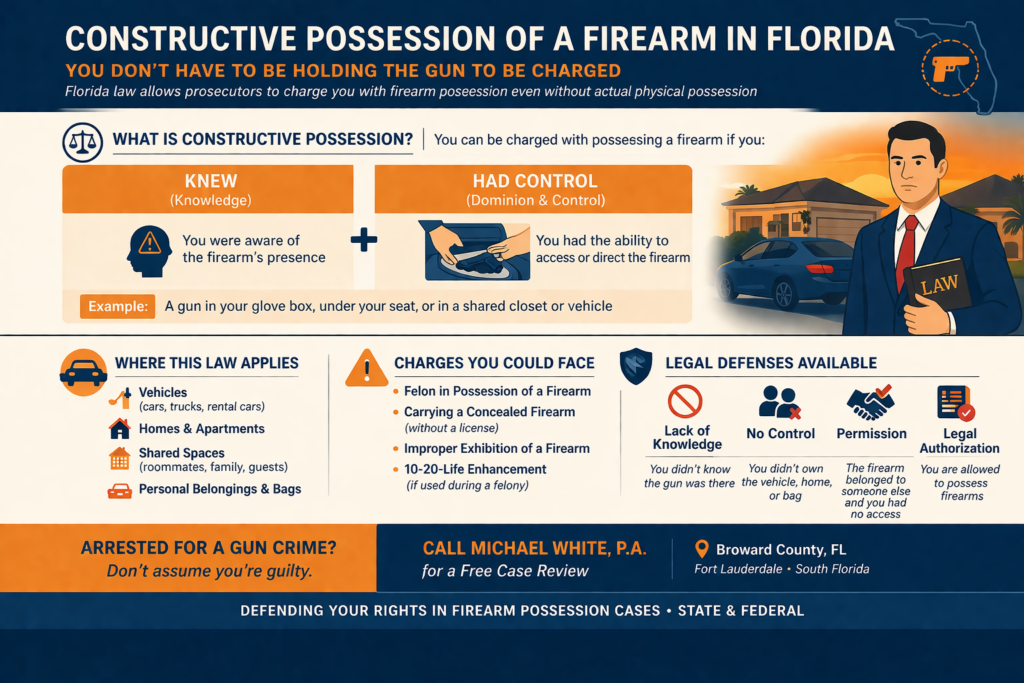
Under Florida law, constructive possession allows prosecutors to charge someone with possession of a firearm without proving actual physical control.
Instead, the State must prove two key elements:
1. Knowledge
You knew the firearm was present
2. Control (Dominion and Control)
You had the ability to exercise control over the firearm
👉 Both elements must be proven beyond a reasonable doubt.
If either is missing, the case may fall apart.
🚗 Common Situations Where Constructive Possession Is Alleged
Constructive possession cases often arise in everyday situations:
- A firearm found in a vehicle during a traffic stop
- A gun discovered in a shared apartment or home
- A weapon located in a bag, backpack, or glove compartment
- Multiple people present near the firearm
These cases frequently overlap with search and seizure issues. For example, if the gun was found during a questionable stop, that may open the door to suppression. Learn more in our guide to Firearm Found During a Traffic Stop.
🔍 What Prosecutors Must Prove (And Where They Fail)
Constructive possession cases are often weaker than they appear because the State must connect you to the firearm beyond mere proximity.
Being near a gun is not enough.
Common weaknesses include:
- The firearm belonged to someone else
- The area was shared or accessible to others
- No fingerprints or DNA linking you to the weapon
- No statements showing knowledge
- Conflicting witness accounts
These cases frequently turn on the same issues that can lead to dismissal. See how cases fall apart in our guide to Can Gun Charges Be Dropped in Florida.
⚠️ Constructive vs. Actual Possession
It’s important to distinguish constructive possession from actual possession.
- Actual possession → the firearm is on your person (in your hand, pocket, or waistband)
- Constructive possession → the firearm is nearby, and prosecutors claim you had knowledge and control
This distinction is often the core battleground in firearm cases.
🔫 Charges Commonly Linked to Constructive Possession
Constructive possession can support a wide range of charges, including:
- Felon in possession of a firearm
- Carrying a concealed firearm without a license
- Improper exhibition of a firearm
- Firearm enhancements under Florida’s 10-20-Life law
For a deeper breakdown of how mandatory sentencing can apply, see our guide to Florida’s 10-20-Life Law.
🛡️ Defenses to Constructive Possession
Because constructive possession relies on inference, it is highly defensible.
Strong defenses often include:
Lack of Knowledge
You did not know the firearm was present
No Control
You had no ability to exercise control over the weapon
Shared Access
Others had equal or greater access to the location
Illegal Search or Seizure
The firearm was discovered through an unconstitutional search
Ownership by Another Person
The gun clearly belonged to someone else
🛡️ Defenses to Constructive Possession
Because constructive possession relies on inference, it is highly defensible.
Strong defenses often include:
Lack of Knowledge
You did not know the firearm was present
No Control
You had no ability to exercise control over the weapon
Shared Access
Others had equal or greater access to the location
Illegal Search or Seizure
The firearm was discovered through an unconstitutional search
Ownership by Another Person
The gun clearly belonged to someone else
🌎 Why These Cases Can Be More Serious Than They Seem
Constructive possession cases often carry significant collateral consequences, especially for non-citizens.
Even without actual possession, a firearm conviction can trigger serious immigration consequences. Learn more in our post addressing Immigration Consequences to Firearms Charges.
📉 Key Takeaway: Proximity Is Not Possession
The most important principle in these cases:
👉 Just because a gun was near you does not mean you possessed it
The State must prove:
- you knew it was there, and
- you had control over it
If they cannot prove both, the charge may not stand.
📞 Charged With a Firearm Offense in Florida?
Constructive possession cases are complex — and often defensible with the right strategy.
At Michael White, P.A., we analyze:
- whether the State can prove knowledge
- whether control actually existed
- whether the search was lawful
- and whether the case can be dismissed or reduced
Don’t assume you’re guilty just because a firearm was nearby.
Contact us today for a strategic case review.
🔍 FAQs
Can you be charged with a gun if it’s not yours in Florida?
Yes. Under constructive possession, you can be charged if prosecutors believe you knew about the firearm and had control over it.
What is the difference between actual and constructive possession?
Actual possession means the firearm is on your person. Constructive possession means it is nearby and you allegedly had knowledge and control.
Is being near a gun enough to be charged?
No. Mere proximity is not enough. The State must prove both knowledge and control.
Can constructive possession charges be dismissed?
Yes. Many cases are dismissed due to lack of evidence, illegal searches, or inability to prove control.