
Last updated April 2026
🚨 Not All Gun Charges Are the Same
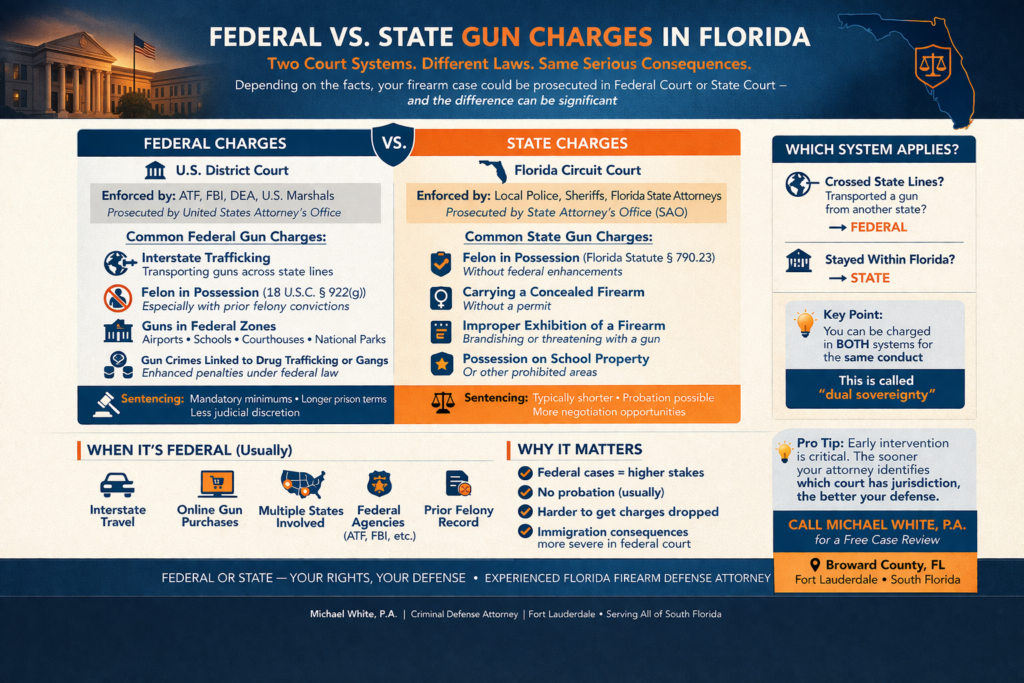
Most firearm charges in Florida are handled in state court — but some cases are prosecuted at the federal level, where the stakes are often much higher.
Understanding the difference between federal and state gun charges can have a major impact on:
- potential penalties
- defense strategy
- how aggressively the case is prosecuted
For a broader overview of how firearm offenses are charged, see our guide to Gun Crime Charges in Florida.
⚖️ State Gun Charges in Florida
Most firearm cases are prosecuted under Florida law, including:
- Carrying a concealed firearm without a license
- Felon in possession of a firearm
- Improper exhibition of a firearm
- Firearm enhancements (such as 10-20-Life)
State cases are typically handled by:
- local law enforcement
- state prosecutors (State Attorney’s Office)
Penalties can still be severe — especially when mandatory minimums apply.
🇺🇸 Federal Gun Charges: When a Case Goes Federal Gun Charges in Florida
A firearm case may be prosecuted federally when it involves:
- Possession of a firearm by a convicted felon (federal statute)
- Firearms connected to drug trafficking or organized crime
- Interstate activity (crossing state lines)
- Federal investigations (ATF involvement)
Federal cases are prosecuted by the United States Attorney’s Office and often involve federal agencies.
🔍 Key Differences Between Federal and State Gun Charges
1. Sentencing Is Often Harsher in Federal Court
Federal sentencing guidelines are strict, and many firearm offenses carry significant prison exposure.
2. Federal Cases Move Differently
Federal prosecutions tend to be:
- more document-heavy
- more investigation-driven
- less reliant on quick arrests
3. Fewer Opportunities for Leniency
Federal court generally offers:
- fewer diversion options
- fewer negotiated outcomes
- more structured sentencing
⚠️ When Jurisdiction Becomes a Fight
In some cases, both state and federal authorities may have jurisdiction.
Factors that influence where a case is prosecuted include:
- severity of the offense
- criminal history
- involvement of federal agencies
- strategic decisions by prosecutors
🔗 How Federal vs State Issues Connect to Your Case
Many firearm cases start at the state level, but certain factors can increase exposure.
For example:
- A case involving questionable possession may still be defensible. Learn how possession is analyzed in our guide to constructive possession of a firearm in Florida.
- If the firearm was discovered during a stop or search, constitutional issues may determine whether the case proceeds at all. See our breakdown of firearm evidence discovered during traffic stops.
- Even serious firearm cases may be challenged or dismissed depending on how the evidence was obtained. Learn more in Can a Gun Charge Be Dropped in Florida?
🔫 Why the Difference Matters
Whether your case is prosecuted in state or federal court affects:
- potential sentencing exposure
- available defenses
- negotiation strategy
- overall case complexity
Federal cases are typically more aggressive and less forgiving.
📉 Key Takeaway: The Same Conduct Can Lead to Very Different Outcomes
Two people charged with similar firearm offenses may face dramatically different consequences depending on:
👉 whether the case stays in state court or moves to federal court
Understanding that distinction is critical.
📞 Facing Gun Charges in Florida?
If you are under investigation or have been charged with a firearm offense, it is critical to understand:
- where your case may be prosecuted
- what penalties you are facing
- what defenses are available
At Michael White, P.A., we evaluate firearm cases from every angle — including jurisdiction, evidence, and constitutional issues.
The sooner you act, the more options you may have.
🔍 FAQs
What makes a gun charge federal in Florida?
Gun charges may become federal when they involve interstate activity, federal investigations, or connections to drug trafficking or organized crime.
Are federal gun charges worse than state charges?
Often yes. Federal cases typically involve stricter sentencing guidelines and fewer opportunities for leniency.
Can a gun case be prosecuted in both state and federal court?
In some situations, both jurisdictions may have authority, but prosecutors typically decide which court will handle the case.
Is felon in possession a federal crime?
Yes. It can be charged under both state and federal law, depending on the circumstances.