
Last updated March 2026
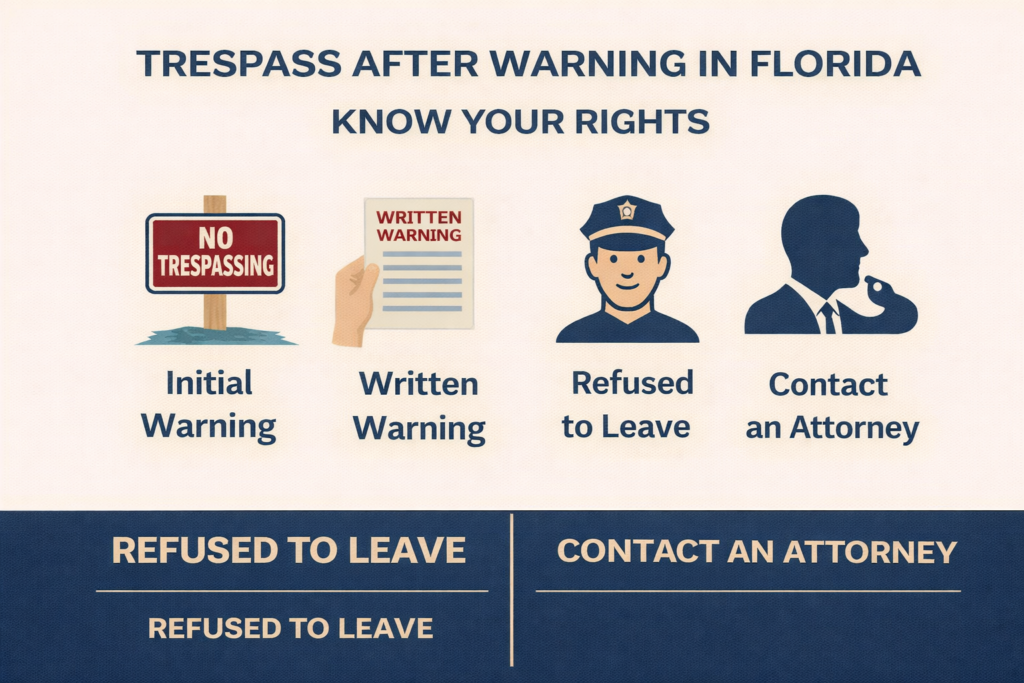
In Florida, many trespassing cases are charged as “trespass after warning.” This means the State claims that a person either entered property after being warned not to — or refused to leave after being told to do so.
These cases often turn on whether proper notice was given and whether the person knowingly remained on the property.
For a full overview of trespassing laws in Florida, see Florida Trespassing Law
⚖️ What Does “After Warning” Mean?
“Trespass after warning” generally requires that:
- The person was given notice not to enter, or
- The person was told to leave and refused
Notice can be given in different ways, including:
- Verbal warnings from an owner or authorized person
- Posted signs
- Fencing or restricted access indicators
The key issue is whether the person knew or should have known they were not allowed to be there.
🔍 What Prosecutors Must Prove
To convict someone of trespass after warning, the State typically must prove:
- The person entered or remained on property
- The property was not open to the public
- Proper notice was given
- The person willfully refused to leave or entered anyway
If the warning element is weak or unclear, the case may be vulnerable.
For situations where charges may be dismissed, see Can Trespassing Charges Be Dropped in Florida?
🚨 Verbal vs. Posted Warning
Trespass warnings can come in two primary forms:
Verbal Warning
A property owner, employee, or law enforcement officer tells someone to leave.
Posted Warning
Signs clearly indicate that entry is not allowed.
Both can satisfy the legal requirement — but the details matter. Issues such as visibility, clarity, and authority often come into play.
🧠 Refusal to Leave vs. Entry After Warning
Trespass after warning can arise in two common ways:
- A person is told to leave and refuses
- A person enters after already being warned not to return
These situations are closely related but factually different.
For a deeper look at refusal-based cases, see Defiant Trespass / Refusal to Leave Property in Florida
⚖️ When These Cases Become More Serious
While most trespass after warning charges are misdemeanors, certain factors can increase the severity:
- Carrying a weapon
- Entering restricted or protected property
- Repeated violations
For example, trespass involving a weapon may lead to felony charges. See Armed Trespass in Florida
🛡️ Common Defense Issues
Trespass after warning cases often turn on:
Was Notice Properly Given?
If the warning was unclear, unauthorized, or not proven, the case may fail.
Did the Person Actually Refuse?
Misunderstandings or delayed compliance can be disputed.
Was the Property Open to the Public?
Some locations complicate the issue of authorization.
Mistaken Identity
Witness identification may be unreliable.
🔑 Why These Cases Are Often Defensible
Because the charge depends heavily on notice and intent, many trespass after warning cases are:
- Fact-specific
- Evidence-dependent
- Open to challenge
Small details — such as who gave the warning or how it was communicated — can significantly affect the outcome.
📍 Charged With Trespass After Warning in South Florida?
Trespass after warning may seem minor, but it can still lead to arrest, jail time, and a criminal record.
If you are under investigation or facing charges, early legal strategy can make a major difference.
Call Michael White, P.A. at (954) 270-0769 for a confidential consultation.
FAQs
Do I have to be told to leave to be charged?
Often yes, but posted signs or restricted access may also qualify as notice.
What if I didn’t hear the warning?
That may be a defense if the State cannot prove you knowingly remained.
Can a business ask me to leave?
Yes. Authorized personnel can issue trespass warnings.
Can these charges be dropped?
Yes. Many cases are dismissed when notice cannot be proven.