
Last updated March 2026
In Florida DUI cases, the breathalyzer is often the State’s strongest piece of evidence. But breath test results are only reliable if the machine was properly calibrated, maintained, and operated in strict compliance with Florida law.
When those safeguards are ignored — or when the paperwork doesn’t support compliance — breath test results may be suppressed, significantly weakening or even destroying the prosecution’s case.
Breathalyzer calibration is just one piece of a larger DUI testing framework — alongside the observation period, operator certification, and breath-card documentation. For a broader overview of how Florida DUI testing works (and where breath, blood, and urine evidence commonly breaks down), see our Florida DUI testing guide.
📜 Florida Law on Breathalyzer Calibration
Florida breath testing is governed by Florida Administrative Code Rule 11D-8, which imposes strict requirements on how breath testing instruments are approved, calibrated, maintained, and documented.
Under these rules:
Breath testing instruments must undergo regular inspection and calibration by a Florida Department of Law Enforcement (FDLE) inspector
Each inspection, repair, or adjustment must be documented
Breath test operators must hold current FDLE certification and follow approved procedures
Instruments that fail accuracy checks must be removed from service
If calibration records, maintenance documentation, or operator compliance is missing or flawed, breath test results may be inadmissible.
⚙️ What “Calibration” Really Means Under Florida Law
In Florida DUI cases, “calibration” does not refer to a single adjustment or one-time accuracy check. It refers to an ongoing compliance process that must be documented over time.
Breath testing instruments are subject to:
Accuracy checks at defined intervals
Use of approved simulator solutions within tolerance limits
Removal from service when tolerance thresholds are exceeded
Re-inspection and documentation before returning to service
Even when calibration appears compliant, external factors can affect breath results, including dental work and breath testing issues in Florida DUI cases and asthma or COPD and breath test accuracy in Florida DUI cases.
A breath test result is only as reliable as the paper trail supporting it. Even when a machine appears to function normally, missing or inconsistent records can undermine the State’s proof.
Approval of a breath testing device does not guarantee accuracy in any individual case.
🚨 Common Calibration & Maintenance Problems in DUI Cases
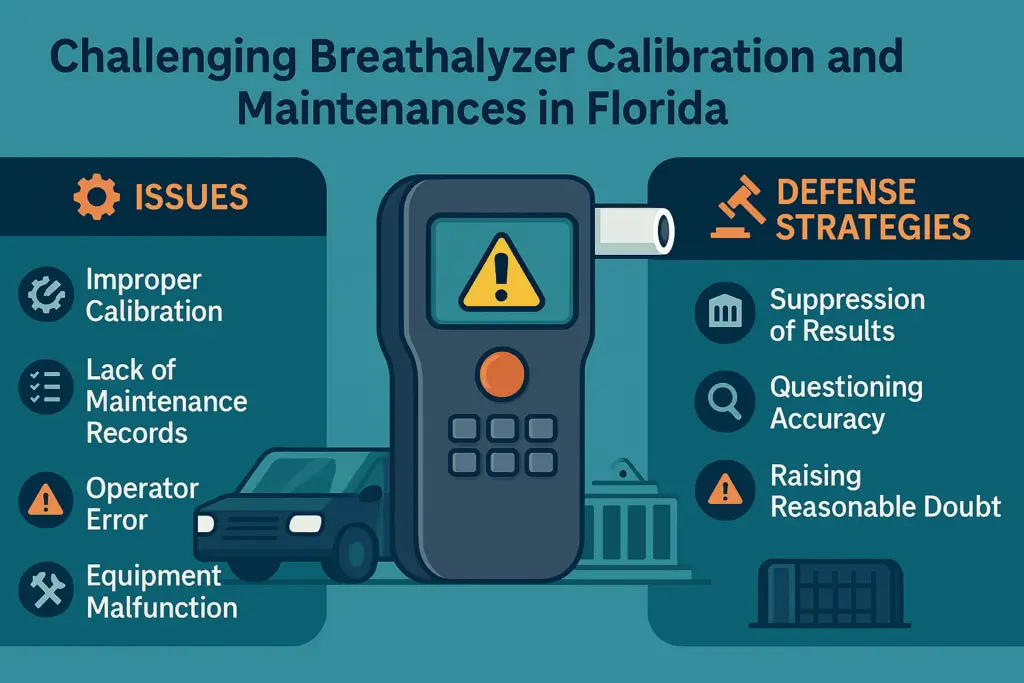
Calibration-related challenges frequently arise from real-world agency practices rather than obvious mechanical failures. Common issues include:
⏱️ Instruments not calibrated within required timeframes
📄 Incomplete, missing, or internally inconsistent maintenance logs
⚠️ Operator deviations from approved testing procedures
🔧 Faulty, expired, or contaminated simulator solutions
🛑 Instruments removed from service but later used without proper clearance
These issues often come to light only after a careful review of FDLE and agency records.
🧾 Calibration Records That Often Decide DUI Cases
Successful breath test challenges frequently turn on documentation rather than the numerical result itself. Depending on the case, critical records may include:
Monthly FDLE inspection reports
Agency maintenance and repair logs
Simulator solution certificates and expiration dates
Records showing when a machine was placed in or removed from service
Error codes, diagnostic reports, or service advisories generated by the instrument
Discrepancies between these records — or gaps where documentation should exist — often form the strongest basis for suppression motions.
⚖️ “Substantial Compliance” Is Not Automatic
Prosecutors often argue that breath test evidence is admissible because the agency substantially complied with FDLE rules. Substantial compliance, however, is not automatic.
Florida courts examine whether deviations affect:
The accuracy of the instrument
The reliability of the test result
The integrity of the testing process
Missing inspections, undocumented repairs, expired simulator solutions, or use of a machine previously removed from service may exceed permissible deviations and defeat admissibility.
This analysis is highly fact-specific and often decisive.
🛡️ How Lawyers Challenge Breath Test Results
Challenging breathalyzer evidence requires early, document-driven investigation. Defense attorneys may:
Request and review FDLE inspection and calibration records
Subpoena agency maintenance and service logs
Examine simulator solution documentation
Cross-examine operators and inspectors on compliance failures
File motions to suppress based on non-compliance with FDLE rules
We explain how these issues are litigated in real cases in our guide to challenging a DUI breath test in Fort Lauderdale.
🌟 Why Calibration Challenges Work
Florida courts have repeatedly recognized that breath test evidence is admissible only if the State proves substantial compliance with FDLE requirements.
Even small procedural deviations can cast doubt on reliability — especially when the breath test is the prosecution’s primary proof of impairment.
When calibration or maintenance problems are uncovered, outcomes often shift quickly.
🔓 How Calibration Failures Create Leverage in DUI Cases
When breath test evidence is weakened or excluded, common outcomes include:
Suppression of breath test results
Reduction of DUI charges (such as DUI to reckless driving)
Dismissal where breath evidence was central to the case
Increased leverage in negotiations
In many cases, the strongest defense is not disputing alcohol consumption — it is demonstrating that the machine and its records cannot be trusted under Florida law.
🚗 How Calibration Issues Fit Into DUI Testing as a Whole
Calibration failures are part of a broader category of DUI testing problems that can undermine the State’s evidence. These issues often intersect with:
Observation period violations — including issues addressed in our guide to Florida’s 20-minute observation rule in DUI cases
Operator certification problems
Improper testing sequence
Delayed or poorly documented testing
❓ FAQs: Breathalyzer Calibration in Florida
❓🧪 How often must breathalyzers be calibrated in Florida?
At least once a month by an FDLE inspector, with records kept.
❓📄 Can I see the maintenance records for my test?
The results may be suppressed, or their weight challenged in court.
❓⚖️ What happens if calibration records are missing?
Yes. Your lawyer can request the machine’s logs through discovery.
❓🛡️ Can operator error affect my breath test?
Absolutely. Improper procedures can make results unreliable.
❓🚨 Can a faulty machine get my DUI dismissed?
Yes, if the breath test evidence is suppressed and the State lacks other proof.
📍 Charged With DUI After a Breath Test?
Breath test results are not self-proving. Their reliability depends on strict compliance with Florida law and accurate documentation.
If your case involves breath testing, calibration and maintenance records should be reviewed immediately.