
Last updated February 2026
A domestic violence arrest can follow you for years—even if the case was dismissed, no-filed, or dropped. Many people are told “DV cases can never be expunged.”
That’s not entirely true.
Short answer: Sometimes yes — but the rules are strict.
Whether a domestic violence arrest can be expunged depends on how the case ended, what charges were filed, and your prior record. Understanding the difference can mean the difference between a clean background check and a permanent stain on your record.
👉 For a full overview of Florida’s sealing and expungement rules, start here: Sealing & Expungement in Florida
👉 For a broader overview of domestic violence charges, injunctions, and long-term consequences in Florida, see our Fort Lauderdale Domestic Violence Defense Lawyer
⚖️ The Big Rule: Convictions Cannot Be Expunged
Under Florida’s expungement statute, (Fla. Stat .§ 943.0585), no conviction for a domestic violence offense can be sealed or expunged.
If you were:
Adjudicated guilty, or
Convicted at trial, or
Pled guilty or no contest with adjudication
👉 Expungement is not available.
This includes convictions for domestic battery, domestic assault, domestic strangulation, violations of domestic violence injunctions, and other qualifying domestic violence offenses.
This restriction applies to convictions — not arrests — which is why dismissed or no-filed DV cases must be analyzed carefully rather than assumed ineligible.
✅ When a Domestic Violence Arrest Can Be Expunged
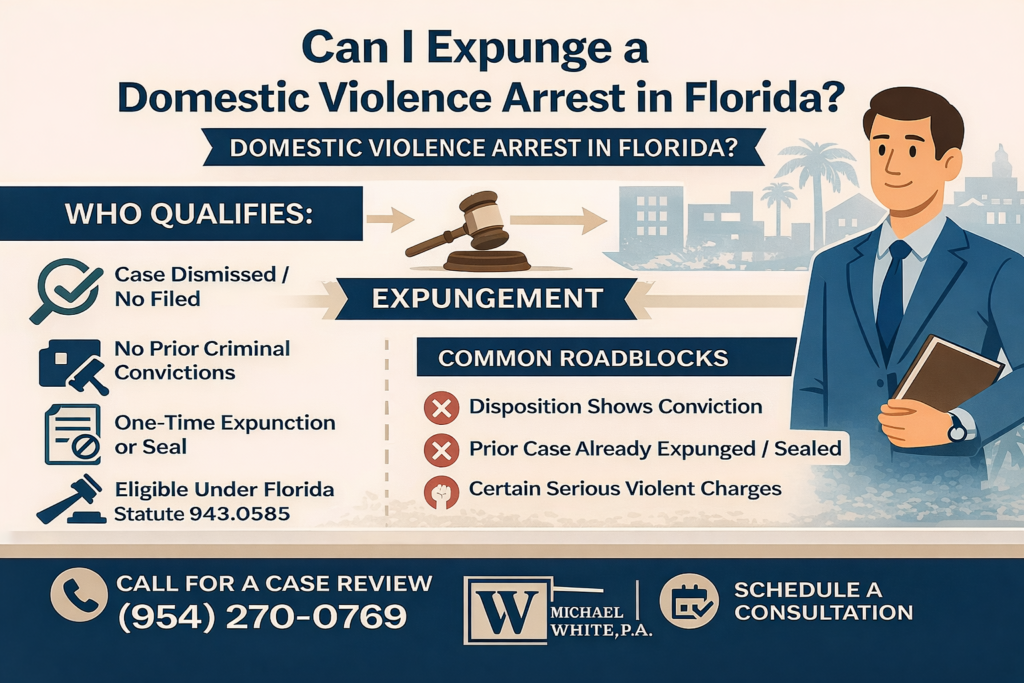
You may be eligible to expunge a DV arrest if all of the following are true:
✔ The case was dismissed, no-filed, or no-actioned
✔ You were never adjudicated guilty
✔ The charge itself is not disqualified by statute
✔ You have not already used your one lifetime expunction/sealing
Common qualifying outcomes include:
Prosecutor declined to file charges
Case dismissed after investigation
Charges dropped when the alleged victim recanted
Insufficient evidence
Successful pre-filing resolution
These scenarios are frequently discussed in cases involving recanting victims and victim credibility issues.
Domestic violence expungement follows Florida’s general record-clearing framework, but eligibility is much narrower.
🚫 When DV Arrests Are Commonly Not Eligible
Even without a conviction, DV arrests are often ineligible if:
You previously sealed or expunged another case
The charge was amended to a disqualifying offense
You violated a no-contact order and picked up additional charges
You pled to a lesser offense with adjudication
The case involved certain disqualifying violent offenses
This is why DV record clearing must be reviewed case-by-case, not assumed.
🧠 Why DV Expungement Is So Often Misunderstood
People are frequently told they’re ineligible when they’re not because:
Clerks confuse dismissal with withhold of adjudication
Old injunction paperwork is mistaken for a conviction
Prior arrests from the same incident are miscounted
Record systems show incomplete dispositions
Attorneys assume “DV = never expunge” (which is wrong)
This confusion overlaps heavily with issues discussed in record restrictions and background checks, where DV arrests appear even without convictions.
🛡️ How We Approach DV Expungement Cases
At Michael White, P.A., we:
✔ Review the exact charge filed
✔ Confirm the final disposition
✔ Analyze whether the DV charge is statutorily eligible
✔ Check prior record-clearing usage
✔ Obtain the FDLE Certificate of Eligibility
✔ Prepare petitions judges are willing to sign
✔ Address companion arrests from the same incident
This is especially important when DV arrests are paired with charges like criminal mischief, disorderly conduct, or violation of pretrial release.
🚨 Speak With a Fort Lauderdale Criminal Defense Lawyer Today
A domestic violence arrest does not have to define your future — but waiting too long can limit your options.
Contact Michael White, P.A. today to determine whether your DV arrest qualifies for expungement and how to proceed correctly.