
Last updated April 2026
🚨 DUI Arrests Often Lead to Illegal Vehicle Searches
After a DUI arrest in Florida, police often search the driver’s vehicle — sometimes claiming it’s “incident to arrest,” sometimes calling it “inventory,” and sometimes relying on vague “probable cause.”
But not every search is legal, and many DUI vehicle searches end up being suppressed.
In Fort Lauderdale and throughout South Florida, DUI stops frequently lead to questionable vehicle searches, especially when officers suspect drugs, weapons, or open containers.
For a broader understanding of how DUI stops and investigations are challenged, see our guide to DUI Traffic Stops & Investigations in Florida.
Knowing when a search is lawful — and when it isn’t — can make or break your case.
⚖️ When Police Can Search Your Car After a DUI Arrest
There are only a few legally recognized exceptions that allow officers to search a vehicle without a warrant.
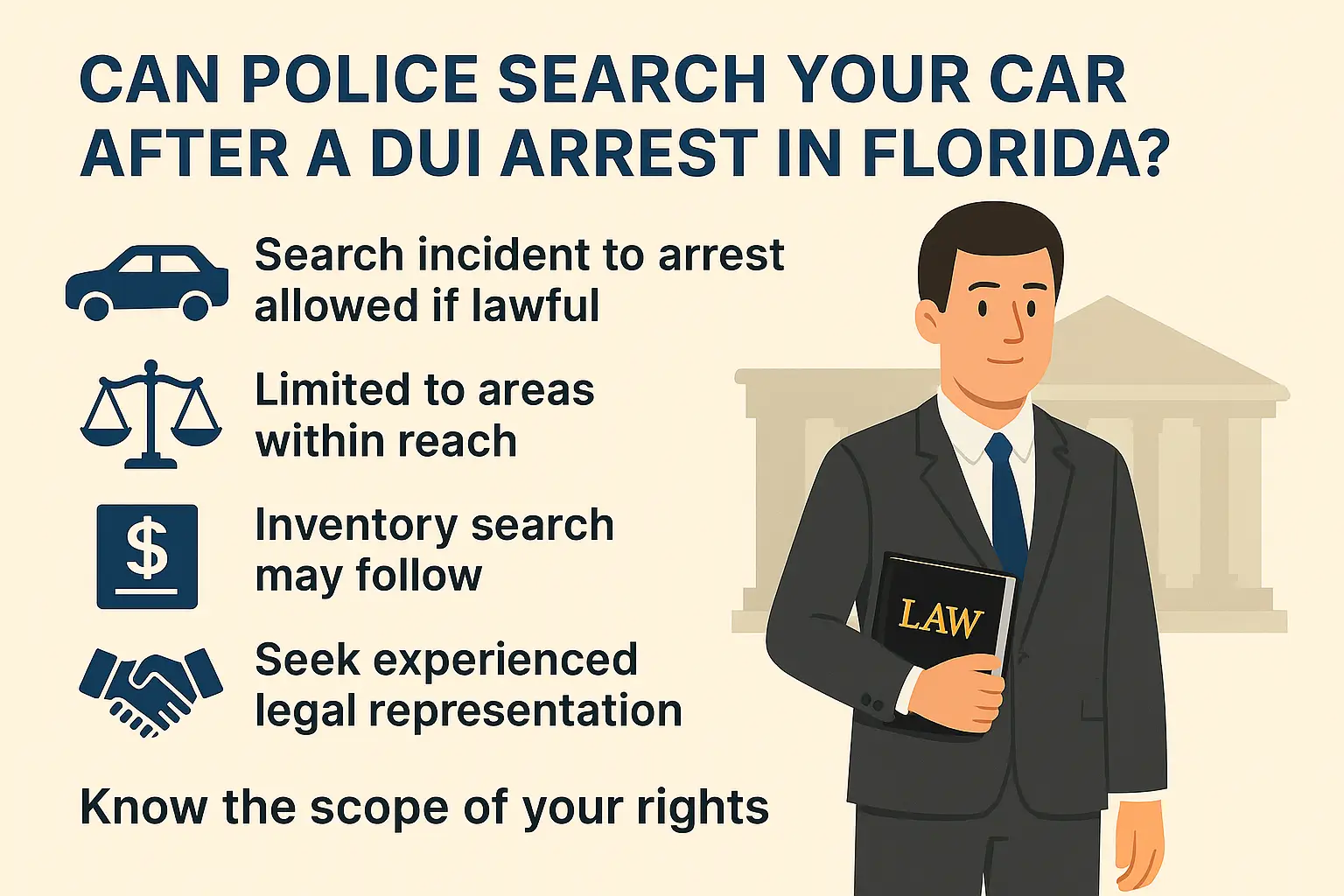
1. Search Incident to Arrest (Limited)
A search “incident to arrest” is not a free-for-all.
Police may only search areas within the arrestee’s immediate reach or when it’s reasonable to believe the vehicle contains evidence of the DUI offense.
This includes:
- Open containers
- Drugs or paraphernalia
- Field sobriety materials
- Alcohol evidence
But this rule is narrow — and is often misapplied.
2. Automobile Exception (Probable Cause)
Police may search the entire vehicle if they have probable cause to believe it contains evidence of a crime.
Examples:
- Smell of burnt or raw marijuana (still heavily litigated)
- Visible open containers
- Contraband in plain view
- Admissions of drugs or alcohol
The presence of an open container is often cited by officers as justification to expand a DUI investigation or conduct a vehicle search. See how these situations arise in Open Container Inside a Parked Vehicle in Florida.
3. Inventory Search (Towed Vehicle)
If your car is lawfully impounded, police may conduct an inventory search — but ONLY if:
- The tow was lawful
- Department policy authorizes it
- Officers follow policy
- The purpose is administrative, not investigatory
If the officer rummages through your vehicle before deciding to tow it, the search is almost certainly illegal.
🚫 When Police Cannot Search Your Car After a DUI Arrest
A search is unlawful when:
- The officer searches before arrest
- The officer calls it “inventory” but doesn’t follow policy
- The officer forces a tow when a licensed driver is present
- The search doesn’t relate to DUI evidence
- The officer relies on a hunch or “routine”
- The legal basis for the stop itself was invalid
Many unlawful searches stem from broader procedural errors or weak investigations, as discussed in DUI Arrest Mistakes in Fort Lauderdale.
These defects form the basis of most motion to suppress wins in DUI cases.
🚧 Real Examples in South Florida
Unlawful DUI-search cases often involve:
- Officers searching the car before reading implied consent
- Searches triggered by refusal
- Bodycam showing officers saying, “Let’s see what’s in here”
- Searches justified only by “smell of alcohol”
- Inventory searches where officers open closed containers without policy support
Video evidence frequently exposes these issues, particularly when it contradicts officer reports. See examples in Broward DUI Bodycam Footage.
We’ve seen countless cases in Broward, Davie, Sunrise, and Pembroke Pines where improper searches led to major reductions — or full dismissals.
🛡️ Defenses to DUI Vehicle Searches
At Michael White, P.A., common defenses include:
✔ Illegal Stop or Arrest
If the DUI stop or arrest was unlawful, the vehicle search collapses.
✔ Search Exceeded Scope
Officers search areas unrelated to DUI evidence.
✔ Policy Violations
Inventory-search policies not followed = suppression.
✔ No Probable Cause
Officer observations fail to justify the auto exception.
✔ Timing Issues
Search conducted before the tow decision or before the arrest.
✔ Lack of Evidentiary Connection
Officer claims DUI, but searches for narcotics or “just looks around.”
🚨 Speak With a Fort Lauderdale DUI Lawyer Today
A DUI arrest doesn’t give police a blank check to search your car.
If officers exceeded their authority, we can challenge the stop, the arrest, and the search — and often suppress the evidence that matters most.
❓ FAQs — DUI Vehicle Searches in Florida
1. Can police search my car automatically after a DUI arrest?
No. They must rely on a recognized exception, like probable cause or a lawful inventory.
2. What if I refused the breath test?
Refusal alone does not justify a vehicle search.
3. Can police search containers inside my car?
Yes — but only if an exception (like probable cause or policy-compliant inventory) applies.
4. Does the smell of alcohol justify a search?
Not usually. Alcohol smell alone is not enough to search a car.
5. Can the evidence be suppressed?
Absolutely — unlawful searches frequently result in suppressed evidence and case reductions.