
Last updated March 2026
One of the most common questions people ask after a sex offense conviction is:
“Can I ever get off the sex offender registry?”
The honest answer is:
Sometimes — but only in limited circumstances.
Florida’s registration system is strict. For many people, registration is long-term or lifetime. However, certain individuals may be eligible to petition for removal under specific statutory provisions.
These issues arise from underlying offenses addressed in Sex Crimes In Florida, where early decisions often determine long-term registration consequences.
For a broader overview of Florida’s registration requirements, classifications, and enforcement rules, see our guide to Sex Offender Registration Requirements in Florida.
⚖️ First: Sex Offender vs. Sexual Predator
Before discussing removal, it is critical to understand the classification.
Florida distinguishes between:
🔹 Sexual Offender
Typically based on conviction for qualifying offenses.
🔹 Sexual Predator
A more serious classification imposed by the court under Fla. Stat. § 775.21.
Removal options are significantly narrower — and sometimes unavailable — for those classified as sexual predators.
The classification matters.
⏳ Is Registration Always for Life?
In many cases, yes.
Florida law requires long-term or lifetime registration for most qualifying convictions.
There is no automatic expiration in most situations.
However, limited statutory relief mechanisms exist in specific cases.
🧾 When Can Someone Petition for Removal?
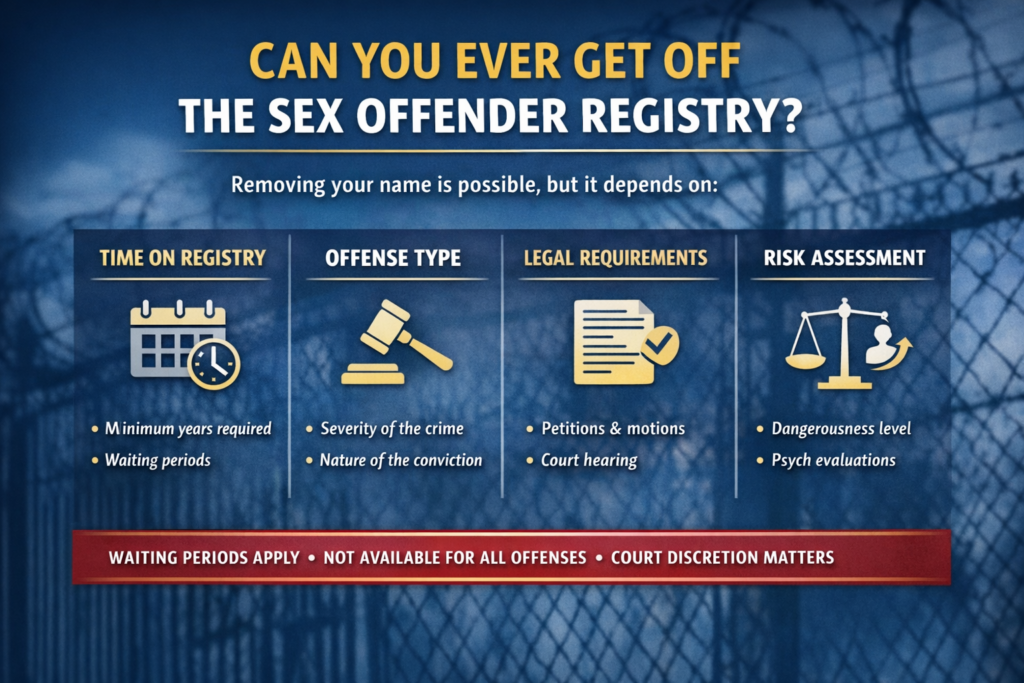
Removal from the registry is not automatic. It requires a petition filed with the court and judicial approval.
Potential avenues for relief may include:
1️⃣ Romeo & Juliet Relief (Age-Gap Cases)
Under Fla. Stat. § 943.04354, certain individuals convicted of qualifying age-gap offenses may petition for removal if:
The age difference was 4 years or less
The victim was between 14 and 17
The offense qualifies under the statute
The petitioner is not otherwise disqualified
This does not apply to all offenses.
2️⃣ Juvenile Dispositions (Limited Scenarios)
In certain juvenile cases, the long-term registration consequences may differ depending on:
The nature of the adjudication
Classification imposed
Specific statutory subsection
However, assumptions about automatic removal at age 18 are often incorrect.
3️⃣ Federal vs. State Differences
Federal law imposes independent registration requirements under SORNA (Sex Offender Registration and Notification Act).
Even if Florida relief is granted, federal obligations may still exist in certain circumstances.
Interstate consequences must be analyzed carefully.
🚨 What Does Not Qualify for Removal?
Many offenses do not qualify for registry removal.
Examples may include:
Sexual predator classifications
Certain force-based offenses
Cases involving younger victims
Repeat or aggravated convictions
Eligibility is entirely statute-driven.
🏛 How the Petition Process Works
If eligible, the process typically involves:
Filing a petition in the appropriate circuit court
Serving notice on the State Attorney
Possible hearing
Judicial review of statutory criteria
Court order granting or denying relief
The burden is on the petitioner to establish eligibility.
Removal is discretionary — not guaranteed.
📉 What Courts Consider
Courts evaluate:
Statutory eligibility
Criminal history
Classification status
Compliance history
Underlying conviction type
Judicial discretion matters.
🧭 Common Misconceptions
“After 10 or 20 years, it automatically drops off.”
Not typically. Florida does not provide automatic expiration for most registrants.
“Moving to another state removes the obligation.”
No. Most states require registration if a person resides, works, or attends school there.
“If I was never sentenced to prison, I don’t have to register.”
Incorrect. Registration is based on conviction and statutory classification — not the length of incarceration.
“A judge can just waive it.”
In most qualifying cases, registration is mandatory unless a specific statutory removal provision applies.
📁 Can Registration Be Reduced Instead of Removed?
Florida does not generally provide tiered reductions like some other states.
Relief is typically:
Full removal (if eligible), or
Continued registration
Strategic planning during the underlying criminal case is often critical to future registry eligibility.
⚖️ Why Early Strategy in the Criminal Case Matters
Registry consequences are often shaped at the plea stage.
Key issues include:
The exact statutory subsection
Degree of offense
Age findings
Predator designation
Plea language
Seemingly small differences in conviction language can determine whether removal is ever possible.
📞 If You Are Seeking Removal
Petitions for removal are technical and statute-specific.
If you believe you may qualify — or if you are facing charges that could lead to registration — careful legal review is essential.
Registry status affects:
Housing
Employment
Reputation
Family life
Interstate movement
These consequences often extend beyond registration itself and can impact professional licensing, employment, and long-term career opportunities. Learn more in Sex Crimes And Professional License Consequences In Florida.
In Broward County and throughout South Florida, experienced counsel can help determine eligibility and navigate the petition process.
❓ FAQs
1️⃣ How long must someone be on the registry before seeking removal?
There is no universal waiting period. Eligibility depends on the specific statute under which the person was convicted.
2️⃣ Can a sexual predator ever be removed from the registry?
Removal options are extremely limited for sexual predators and often unavailable under Florida law.
3️⃣ Does compliance history affect a removal petition?
Yes. Courts may consider whether the individual has complied with all reporting requirements.
4️⃣ Can a conviction be sealed to avoid registration?
Most registry-qualifying sex offenses are not eligible for sealing or expungement.
5️⃣ Does federal law override Florida removal?
In some cases, federal registration requirements may continue even if state relief is granted.