
Last updated February 2026
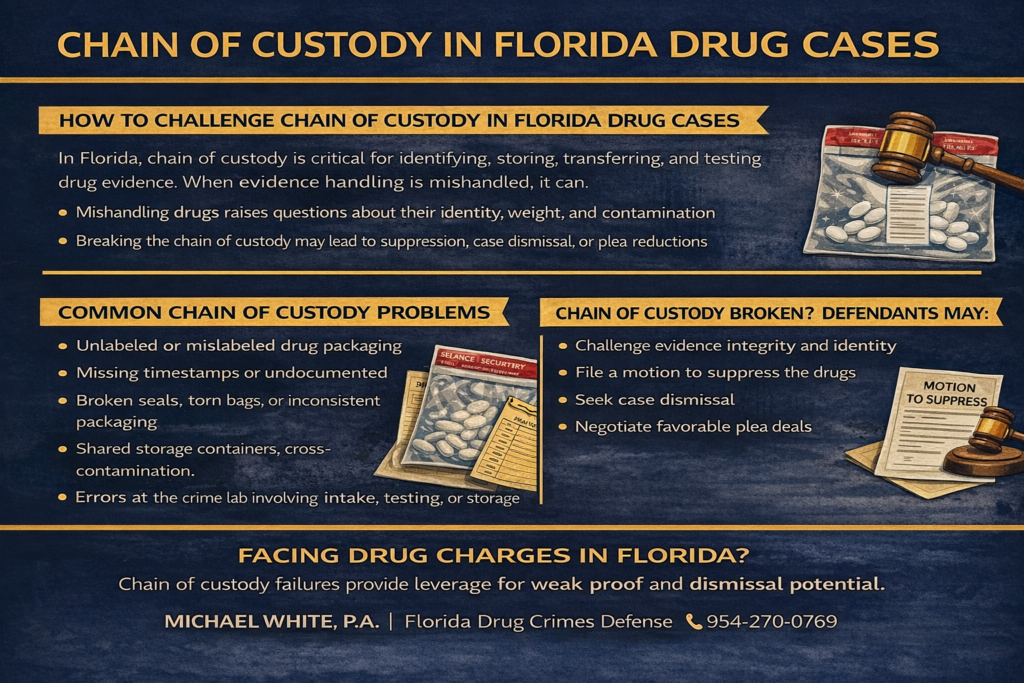
If you’re facing drug charges in Florida, one of the most effective — and often overlooked — defense strategies is challenging the chain of custody. When law enforcement or crime labs mishandle, mislabel, or improperly document drug evidence, the State may not be able to prove the case at all.
If the State can’t prove the drugs were handled properly, you may win.
Chain of custody issues arise across many Florida drug crimes, where the State must prove that seized evidence was properly handled from arrest through trial.
At Michael White, P.A., we regularly expose chain of custody flaws in possession and trafficking cases throughout Fort Lauderdale and South Florida. When the evidence handling breaks down, we move to suppress the drugs — and many cases collapse as a result.
📦 What Is Chain of Custody in a Florida Drug Case?
Chain of custody is the documented timeline showing how physical evidence was handled from start to finish, including:
Collection at the scene
Control by the arresting officer
Transfer to an evidence locker
Submission to a crime lab for testing
Storage and presentation in court
Every transfer must be accounted for. The purpose is to show the evidence is the same item seized, and that it was not altered, contaminated, swapped, or tampered with at any point.
🚨 Where Chain of Custody Breaks Down
In real cases, chain of custody problems are common. We frequently uncover issues such as:
Unlabeled or mislabeled drug packaging
Missing timestamps or signatures
Evidence logged hours after the arrest
Drugs placed into shared or unsecured containers
Transfers between agencies with no documentation
Broken seals or inconsistent packaging
Crime lab intake errors or contamination
Even a small gap can raise serious questions about whether the substance tested is the same substance allegedly seized.
🔍 Common Chain of Custody Failures in Florida Drug Cases
Chain of custody problems arise more often than most people realize. In Florida drug prosecutions, evidence handling failures frequently occur long before a case reaches trial. Common examples include:
Lost or missing evidence
Drugs may be misplaced, destroyed, or never properly logged into the evidence system.Property room and storage errors
Evidence may be mislabeled, stored improperly, or mixed with other items due to clerical or procedural mistakes.Compromised packaging or broken seals
Damaged containers, inconsistent packaging, or broken evidence seals raise serious questions about contamination or tampering.Incomplete or missing documentation
Gaps in evidence logs, missing signatures, or undocumented transfers can break the chain of custody entirely.Destruction before trial
In some cases, drug evidence is destroyed—intentionally or accidentally—before the defense has an opportunity to examine or independently test it.
Even a single unexplained gap can undermine the State’s ability to prove that the substance presented in court is the same item allegedly seized.
⚖️ Legal Standards for Chain of Custody in Florida
Florida law requires the prosecution to show a reasonable probability that the evidence:
Is what the State claims it is
Was not altered or contaminated
Was stored and transported properly
The State does not need a perfect chain — but if the defense raises a legitimate question about handling, identity, or integrity, the judge or jury may reject the evidence.
⚠️ Lost or Destroyed Drug Evidence and Due Process Concerns
When drug evidence is lost or destroyed, the issue goes beyond simple mishandling. Florida courts examine whether the loss of evidence violates a defendant’s due process rights.
Courts typically consider:
whether the missing evidence was material to the defense,
whether the loss prejudiced the accused’s ability to challenge the case, and
whether the State acted negligently or in bad faith.
If missing evidence prevents independent testing, meaningful cross-examination, or verification of the substance’s identity or weight, the defense may seek suppression or dismissal. Each case depends on its specific facts, but lost drug evidence can fundamentally weaken the prosecution’s case.
🛠️ How We Challenge Chain of Custody in Drug Cases
When we evaluate a drug case, we trace the evidence step by step. Our approach often includes:
Subpoenaing evidence logs, lab reports, and property receipts
Comparing officer reports with lab intake documentation
Cross-examining every person who handled the evidence
Identifying broken seals, missing signatures, or timeline gaps
Exposing inconsistencies between reports, videos, and test results
Filing motions to suppress based on mishandled custody
When the State can’t clearly explain how the drugs moved from the street to the courtroom, the case becomes vulnerable.
📉 What Happens If Drug Evidence Is Suppressed?
If the court suppresses the drugs, the prosecution may be left with:
No lab-confirmed controlled substance
No provable weight or identity
No basis for felony charges
Little or no leverage to proceed
In many cases, this leads to dismissal or significant charge reductions, especially where the alleged offense depends entirely on the seized substance.
🧪 How Missing Evidence Affects Proof at Trial
Drug cases depend entirely on physical proof. When evidence is lost, destroyed, or improperly handled, prosecutors may be unable to establish:
that the substance was actually illegal,
that it was tested accurately,
that the alleged weight is reliable, or
that the evidence presented in court is the same item seized at arrest.
Without reliable evidence, the State may lose leverage—or the ability to proceed at all.
📍 Facing Drug Charges in Fort Lauderdale? Evidence Handling Matters.
Chain of custody issues apply to all controlled substances, including:
Cocaine
Fentanyl
MDMA
Marijuana
Prescription pills
Synthetic or laboratory-tested substances
If the State cannot clearly prove who handled the drugs, when, and how, they may not be able to meet their burden of proof.
📘 Florida Drug Defense FAQs: Chain of Custody Issues
What is chain of custody in a drug case?
It is the documented process showing how evidence was collected, stored, transferred, and tested from arrest through trial.
Can drug charges be dropped if the chain of custody is broken?
Yes. If the break creates reasonable doubt about the evidence’s integrity, the court may suppress it, often leading to dismissal.
Do lab tests fix chain of custody problems?
No. Even valid test results can be challenged if there is uncertainty about where the sample came from or how it was handled.
Who has to prove chain of custody?
The prosecution bears the burden of showing a reasonable probability that the evidence is intact and authentic.
Does this defense apply only to illegal drugs?
No. Chain of custody applies to all controlled substances, including prescription medications.
📞 Let’s Examine the Evidence in Your Case
At Michael White, P.A., we don’t take the State’s evidence at face value. We examine every step of how drug evidence was handled — and when we find errors, we file to suppress.
If you’re facing drug charges in Florida, a chain of custody issue could change everything.
👉 Call today for a free consultation and let’s find out whether the evidence in your case can actually hold up.