
Last updated March 2026
Why Causation Is Often the Most Contested Issue in Vehicular Homicide Cases
In Florida vehicular homicide prosecutions, the central dispute is rarely whether a crash occurred. Instead, the key legal question is what actually caused the death.
To obtain a conviction, prosecutors must prove not only that a driver acted recklessly but that the alleged reckless conduct caused the fatality itself.
If another factor caused the crash — or if the death would have occurred regardless of the driver’s conduct — the State may be unable to establish one of the most critical elements of the offense.
Understanding how causation works in vehicular homicide cases is essential for evaluating potential defenses and identifying weaknesses in the prosecution’s theory.
For a broader explanation of how these cases are structured under Florida law, see our overview of Vehicular Homicide in Florida, which explains how recklessness, investigation evidence, and causation interact in fatal crash prosecutions.
What Causation Means Under Florida Vehicular Homicide Law
Under Florida law, vehicular homicide occurs when a person causes the death of another human being through the reckless operation of a motor vehicle likely to cause death or great bodily harm.
This means prosecutors must prove three separate components:
• reckless driving
• a fatal crash
• a direct causal connection between the driving and the death
Even when a crash results in tragedy, criminal liability does not automatically follow.
If another factor becomes the true cause of the fatal outcome, the prosecution’s case may fail.
This legal principle is commonly referred to as causation in criminal law.
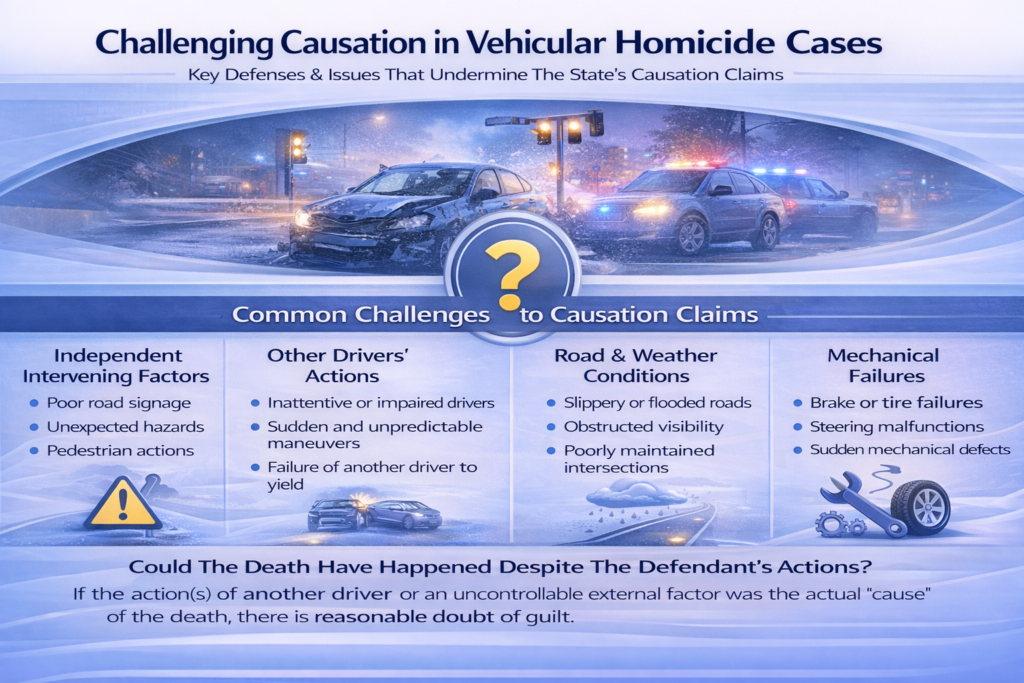
Independent Intervening Causes
One of the most important ways causation can be challenged is through the concept of an intervening cause.
An intervening cause occurs when another event breaks the chain between the driver’s conduct and the fatal outcome.
Examples may include:
• another driver suddenly entering the roadway
• a pedestrian unexpectedly stepping into traffic
• a roadway hazard or obstruction
• unexpected vehicle malfunction
When an independent event becomes the true cause of the fatal crash, criminal responsibility may shift away from the accused driver.
Courts often examine whether the intervening event was reasonably foreseeable or whether it completely altered the sequence of events.
The Role of Other Drivers in Fatal Crash Investigations
Many fatal collisions involve multiple vehicles, which complicates the question of causation.
Investigators must determine:
• which driver initiated the crash sequence
• whether another driver failed to yield
• whether sudden maneuvers created the collision
• whether another driver violated traffic laws
When another driver’s actions trigger the crash, those actions may become the primary cause of death, even if the defendant was also driving improperly.
These issues frequently arise during Traffic Homicide Investigations, where multiple drivers’ conduct must be analyzed.
Road Conditions and Environmental Factors
Environmental conditions can also affect causation.
Investigators must consider whether external factors contributed to the crash, including:
• poor lighting conditions
• wet or slippery roads
• obstructed visibility
• poorly designed intersections
• missing or inadequate signage
If environmental hazards significantly contributed to the collision, prosecutors may struggle to prove that the defendant’s driving caused the fatal injuries beyond a reasonable doubt.
Mechanical Failure and Vehicle Defects
Vehicle malfunctions can also undermine the State’s causation theory.
Mechanical issues that may contribute to crashes include:
• brake system failures
• steering defects
• tire blowouts
• suspension failures
In these cases, investigators may conduct detailed vehicle inspections or engineering analysis to determine whether a mechanical defect played a role in the crash.
When mechanical failure contributes to the incident, the defendant’s driving may not be the legal cause of death.
The Role of Crash Reconstruction Experts
Vehicular homicide cases frequently rely on Crash Reconstruction specialists to analyze how a collision occurred.
These experts examine:
• vehicle damage patterns
• skid marks and debris fields
• scene measurements
• vehicle dynamics
• surveillance or traffic camera footage
However, accident reconstruction is not always definitive.
Investigators must rely on assumptions and calculations, and errors in those assumptions can lead to incorrect conclusions about causation.
We explore these issues further in our analysis of Accident Reconstruction Errors in Vehicular Homicide Cases.
Event Data Recorders and Crash Data Evidence
Modern vehicles often contain Event Data Recorder Evidence, commonly called vehicle “black boxes.”
These systems may record:
• vehicle speed
• braking activity
• throttle position
• steering inputs
• seatbelt status
Investigators often retrieve this information through Crash Data Retrieval tools.
Although this data can be useful, it has limitations.
Event data recorders typically capture only the final seconds before impact and may not account for external factors such as road conditions, driver reactions, or the conduct of other vehicles.
Misinterpretation of this data can lead investigators to inaccurate conclusions about causation.
Why Causation Often Determines the Outcome of the Case
In many vehicular homicide cases, the central dispute is not whether the accident was tragic.
The real question is who or what actually caused the death.
When evidence suggests that:
• another driver initiated the crash
• environmental hazards played a major role
• a mechanical failure occurred
• the crash would have happened regardless of the defendant’s conduct
the prosecution may be unable to prove the causation element required for conviction.
Speak With a Florida Vehicular Homicide Defense Attorney
Fatal crash investigations often move quickly, and early conclusions by investigators can shape how prosecutors evaluate the case.
When causation is disputed, early analysis of crash evidence, vehicle data, and reconstruction findings can be critical.
If you are under investigation or facing vehicular homicide charges in Broward County courts or anywhere in South Florida, speaking with an experienced defense attorney early can help protect your rights and ensure the evidence is carefully examined.
Request a confidential consultation to discuss your situation.
FAQs
What is causation in a vehicular homicide case?
Causation means the prosecution must prove that the defendant’s reckless driving directly caused the death. If another factor caused the fatal crash, the causation element may not be satisfied.
What is an intervening cause in a fatal crash?
An intervening cause is an independent event that breaks the connection between the defendant’s driving and the death. Examples include the actions of another driver, sudden hazards, or mechanical failure.
Can another driver be responsible for a fatal crash?
Yes. If another driver’s conduct triggered the collision, that driver’s actions may be considered the true cause of the crash, which can undermine a vehicular homicide prosecution.
How does accident reconstruction affect vehicular homicide cases?
Accident reconstruction experts analyze crash scenes, vehicle damage, and physical evidence to determine how a collision occurred. Errors in this analysis can lead to incorrect conclusions about causation.