
Last updated February 2026
If you’re facing criminal charges in Florida — especially as a non-citizen or licensed professional — you may hear the term “crime of moral turpitude.”
It is not a specific criminal charge.
Instead, it is a legal classification used by immigration authorities, licensing boards, and government agencies to describe crimes involving dishonesty, fraud, or serious moral wrongdoing.
And the consequences can extend far beyond the courtroom.
In fact, being labeled with a crime of moral turpitude (CIMT) is often one of the most serious collateral consequences in Florida, particularly for non-citizens and professionals.
🧾 What Qualifies as a Crime of Moral Turpitude?
Florida statutes do not define moral turpitude. The concept comes primarily from federal immigration law and administrative regulations.
Courts generally classify a crime as involving moral turpitude if it includes:
Fraud or deceit
Intentional dishonesty
Theft with intent to permanently deprive
Serious violence or morally reprehensible conduct
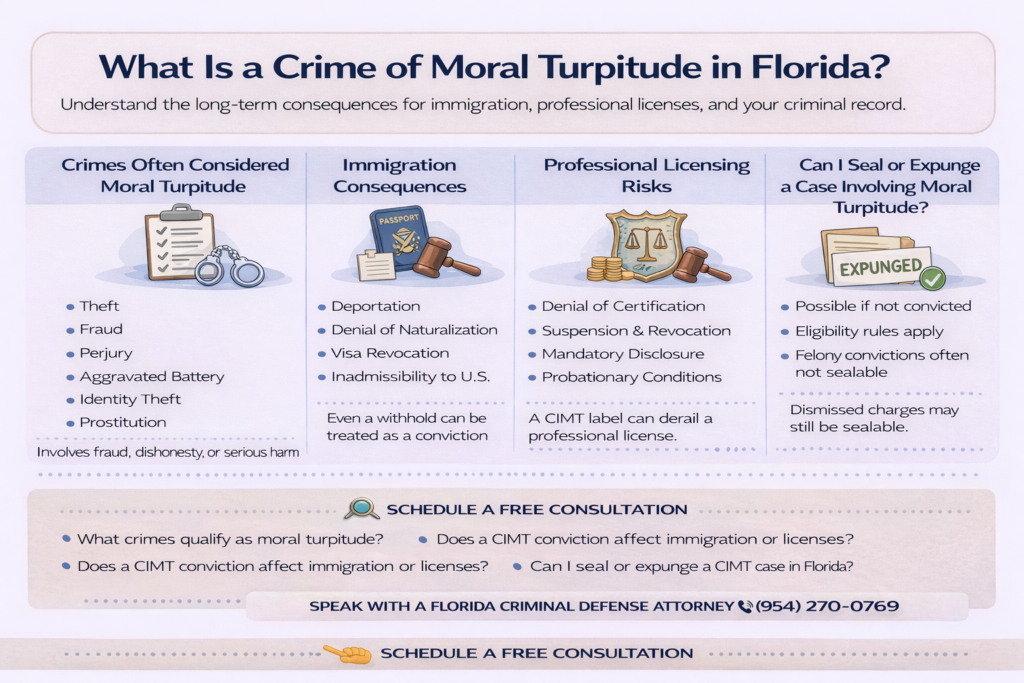
Common Examples of Crimes Often Considered CIMTs:
Theft and grand theft
Fraud (credit card fraud, insurance fraud, identity theft)
Perjury or false statements
Aggravated battery or certain assaults
Domestic violence
Prostitution-related offenses
Animal cruelty
⚠️ Important:
Not every felony is a CIMT.
And some misdemeanors can be.
The classification depends on the statutory elements of the offense — not simply the name of the charge.
🛂 Immigration Consequences of a CIMT
For non-citizens, a conviction for a crime of moral turpitude can trigger serious immigration consequences, including:
Deportation or removal proceedings
Denial of naturalization
Inadmissibility to the United States
Denial of green card adjustment
Visa revocation
Even a withhold of adjudication may be treated as a conviction under federal immigration law if there is an admission of guilt and some form of penalty imposed.
That’s why plea strategy is critical.
A charge that seems minor in state court can have life-altering federal immigration consequences.
📋 Professional Licensing Consequences
Many Florida licensing boards treat crimes of moral turpitude as grounds for:
Denial of certification
Suspension or revocation
Mandatory disclosure during renewal
Probationary conditions
This includes boards governing:
Healthcare professionals
Teachers and educators
Attorneys
Real estate professionals
Financial services
Contractors
Even if the case does not result in jail time, the professional fallout can be severe.
⚖️ Why Moral Turpitude Matters Beyond Sentencing
A jail sentence is temporary.
But a moral turpitude classification can affect:
Employment opportunities
Background checks
Immigration status
Licensing eligibility
Housing applications
These long-term effects are part of what courts call collateral consequences of a criminal conviction — penalties that exist outside the direct sentence.
If you want a broader explanation of how arrests and convictions affect employment, immigration, housing, and licensing, see our full guide on collateral consequences in Florida.
🛡️ How We Defend Clients Accused of CIMTs
At Michael White, P.A., we treat moral turpitude cases strategically — because the label itself can be as damaging as the sentence.
🔹 Charge Reduction or Reclassification
We work to reduce charges to non-turpitudinous offenses when possible — for example, negotiating theft-related allegations to lesser offenses without fraud elements.
🔹 Immigration-Safe Pleas
For non-citizens, we coordinate with immigration counsel to structure plea agreements that avoid triggering removal consequences.
🔹 Withhold of Adjudication Strategy
While a withhold can help in state court, we evaluate how it will be treated under federal immigration rules before recommending it.
🔹 Diversion Programs
In eligible cases, pretrial intervention or deferred prosecution can prevent a conviction entirely.
🔹 Sealing & Expungement
If a case is dismissed or eligible, we pursue record sealing or expungement to reduce long-term reputational damage.
✅ Why Clients Hire Michael White
Former prosecutor with experience in fraud, theft, and violent crime cases
✔ Strategic plea negotiations focused on long-term impact
✔ Coordination with immigration and licensing counsel
✔ Clear communication about real-world consequences
When your immigration status, career, or professional license is at risk, the defense strategy must consider more than just jail time.
📞 Charged With a Crime of Moral Turpitude in Florida? The Label May Matter More Than the Sentence.
Let us help you protect your future — before it’s too late.
❓ Frequently Asked Questions
What is considered a crime of moral turpitude in Florida?
Florida does not define the term by statute. Crimes involving fraud, deceit, theft, or serious violence are commonly labeled as moral turpitude offenses under federal and administrative law.
Can a misdemeanor be a crime of moral turpitude?
Yes. A misdemeanor involving dishonesty or serious harm may still qualify as a CIMT.
Will I be deported for a CIMT conviction?
Possibly. Deportation depends on the type of offense, number of convictions, and immigration status. Some CIMTs trigger removal proceedings.
Does a withhold of adjudication protect me from immigration consequences?
Not necessarily. Immigration law may treat certain withholds as convictions.
Can I seal or expunge a CIMT?
If you were not convicted and meet eligibility requirements, sealing or expungement may be possible. Many felony convictions are not eligible.
What if I already pled guilty?
Post-conviction options may exist, but timing is critical. You should speak with a criminal defense lawyer immediately.