
Last updated April 2026
In Florida, not all “bad driving” is treated the same.
One driver may receive a civil traffic ticket for careless driving.
Another may face a criminal charge for reckless driving — even if both incidents involve speed or aggressive behavior.
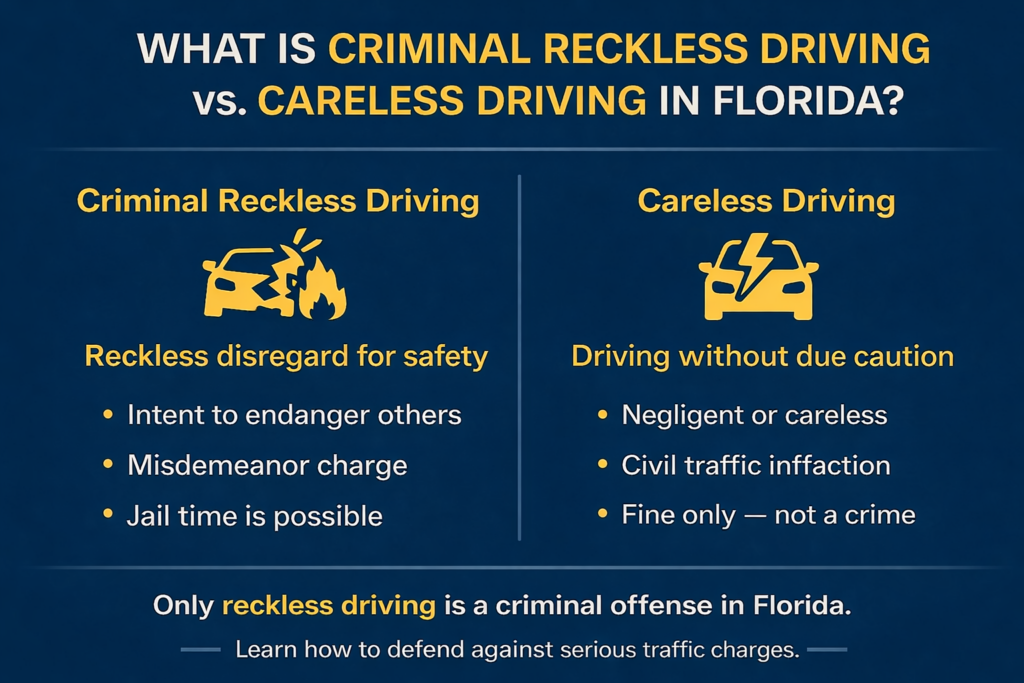
Understanding the difference between criminal reckless driving and careless driving is critical, because the legal consequences are dramatically different.
👉 For a full breakdown of reckless driving penalties and defenses, see our guide to Reckless Driving in Florida.
This page focuses specifically on how the two charges differ.
⚖️ The Legal Difference
🔴 Criminal Reckless Driving (Fla. Stat. § 316.192)
Reckless driving requires proof that the driver acted with:
Willful or wanton disregard for the safety of persons or property.
This is a criminal offense.
The State must prove more than negligence. It must show conscious disregard — not just poor judgment.
Reckless driving is prosecuted in criminal court.
🟡 Careless Driving (Fla. Stat. § 316.1925)
Careless driving is defined as:
Driving in a manner that fails to use due care or attention.
This is a civil traffic infraction, not a crime.
It is handled like a ticket, not a misdemeanor.
🚨 Why the Distinction Matters
The difference between reckless and careless driving can determine:
-
Whether you face jail exposure
-
Whether you receive a criminal record
-
Whether probation is possible
-
Whether sealing eligibility is affected
-
Whether the case is heard in criminal court
Reckless driving creates a criminal record if adjudication is imposed.
Careless driving does not.
In some cases, DUI charges are reduced to reckless driving — commonly referred to as a “wet reckless” — which carries different long-term consequences. Learn more in Wet Reckless in Florida.
🧠 What Prosecutors Must Prove
The difference often comes down to mental state.
For Reckless Driving, the State must show:
-
Intentional or knowing conduct
-
Conscious disregard of risk
-
Behavior beyond mere speeding
Examples may include:
-
High-speed weaving through traffic
-
Intentionally blocking vehicles
-
Racing or competitive driving behavior
-
Ignoring obvious safety hazards
For Careless Driving, the State only needs to show:
-
Lack of due care
-
Inattention
-
Simple negligence
Examples may include:
-
Minor fender benders
-
Failure to signal
-
Brief inattentiveness
-
Accidental unsafe lane changes
Careless driving does not require intent.
In cases involving high-speed or competitive driving, allegations may overlap with racing-related charges — see Reckless Driving and Street Racing in Florida.
📊 When Charges Get Reduced
Many reckless driving cases are reduced to careless driving when:
-
Evidence of intent is weak
-
No actual danger occurred
-
There was no crash or injury
-
Video contradicts officer claims
-
The driver has no prior record
Reduction from reckless to careless can be the difference between:
A criminal conviction
and
A civil infraction
That distinction often shapes defense strategy.
That distinction can also affect long-term record consequences — see Whether a Wet Reckless Can be Sealed in Florida.
🚦 Speed Alone Is Not Always Reckless
Many drivers assume that extreme speed automatically equals reckless driving.
That is not always true.
Speed can be evidence of recklessness — but it must be paired with conduct showing willful or wanton disregard.
Otherwise, the case may support careless driving at most.
👉 Learn more about criminal speeding in Florida.
💥 When Reckless Driving Becomes More Serious
Reckless driving can escalate to felony-level exposure if it causes:
-
Serious bodily injury
-
Significant property damage
-
Death
Careless driving does not carry felony exposure on its own.
🛡️ Defending Reckless Driving Allegations
Because reckless driving is a criminal charge, defense strategies often focus on:
-
Lack of intent
-
Overcharging
-
Video inconsistencies
-
Officer opinion vs. objective facts
-
Downgrading to careless driving
The line between reckless and careless is frequently contested in court.
🧑⚖️ Fort Lauderdale Reckless Driving Defense Lawyer
If you’ve been charged with reckless driving in Fort Lauderdale or anywhere in South Florida, do not assume it is “just a ticket.”
A reckless conviction can follow you long after the case ends.
As a former prosecutor, Michael White understands how these charges are evaluated — and how to challenge the difference between criminal recklessness and simple carelessness.
📞 Call (954) 270-0769 or schedule a confidential consultation today.
Protect your license.
Protect your record.
Protect your future.
❓ FAQs
1️⃣ Is reckless driving always a criminal offense in Florida?
Yes. Reckless driving is prosecuted as a misdemeanor in most cases and can become a felony if serious injury is involved. Careless driving, by contrast, is a civil traffic infraction.
2️⃣ Can reckless driving be reduced to careless driving?
Yes. In many cases where intent or willful disregard is weak, prosecutors may agree to reduce reckless driving to careless driving.
3️⃣ Does careless driving create a criminal record?
No. Careless driving is a civil infraction and does not result in a criminal conviction.