
Last updated February 2026
Drug distribution charges in Florida are serious felony offenses that can carry prison time, permanent criminal records, and long-term professional consequences. Unlike simple possession, prosecutors must prove intent to sell or deliver, not just possession.
If you’re charged with drug distribution in Fort Lauderdale or anywhere in South Florida, early defense strategy is critical.
For a broader overview of possession with intent to sell or deliver charges in Florida — including how prosecutors allege intent and how these cases are defended — see Possession With Intent to Sell or Deliver in Florida.
▶️ Watch the video belowto learn how drug distribution charges are challenged in Florida courts.
⚖️ What Is a Drug Distribution Charge in Florida?
Florida prosecutors often file distribution charges when they believe drugs were intended for sale or delivery. Evidence they rely on may include:
Quantity inconsistent with personal use
Packaging (baggies, wraps, containers)
Scales or measuring tools
Large amounts of cash
Controlled buys or surveillance
Distribution charges are typically felonies and are prosecuted aggressively.
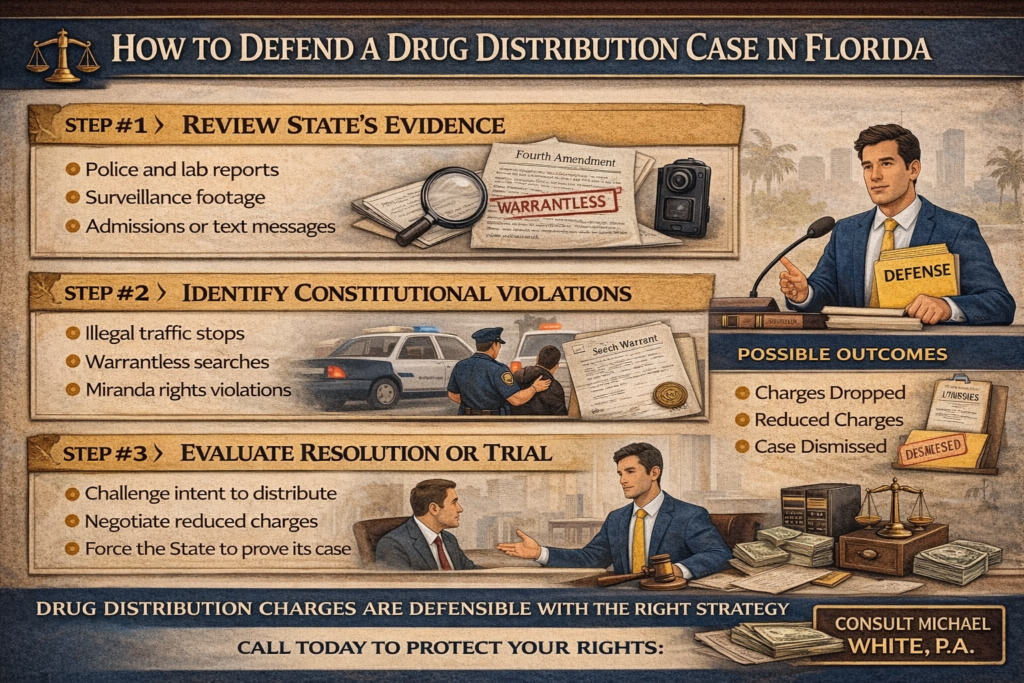
🔍 Step 1: Review the State’s Evidence
The defense process begins with discovery. This includes:
Police reports
Surveillance or body-worn camera footage
Lab testing and weight analysis
Alleged statements or admissions
Understanding what the State claims — and what it cannot actually prove — shapes the defense.
🛑 Step 2: Identify Constitutional Violations
Many distribution cases involve serious Fourth and Fifth Amendment issues, such as:
Illegal traffic stops
Warrantless searches
Improper surveillance
Miranda violations
If evidence is suppressed, the State may lose its ability to proceed.
🤝 Step 3: Evaluate Resolution or Trial Strategy
If suppression is not available, defense strategy may include:
Challenging proof of intent to distribute
Negotiating reduced charges
Exploring diversion or treatment options (when eligible)
Preparing for trial and forcing the State to meet its burden
Intent to distribute is often harder to prove than prosecutors claim.
🛡️ What You Should Do If You’re Charged
Drug distribution charges move fast and carry serious consequences. Early legal representation can mean the difference between:
prison and probation
felony and misdemeanor
conviction and dismissal
📞 Call (954) 270-0769 or request a confidential consultation today.
💬 FAQs — Florida Drug Distribution Charges
What’s the difference between possession and possession with intent to distribute?
Possession is for personal use. Distribution involves evidence suggesting sale or delivery.
Can drug distribution charges be dismissed?
Yes. Charges may be dismissed if evidence is suppressed or intent cannot be proven.
Will I go to jail for drug distribution in Florida?
It depends on the facts, your record, and the strength of the State’s case. Jail can often be avoided with early defense strategy.
Should I talk to police if I’m under investigation?
No. Always speak with a lawyer first.