
Last updated February 2026
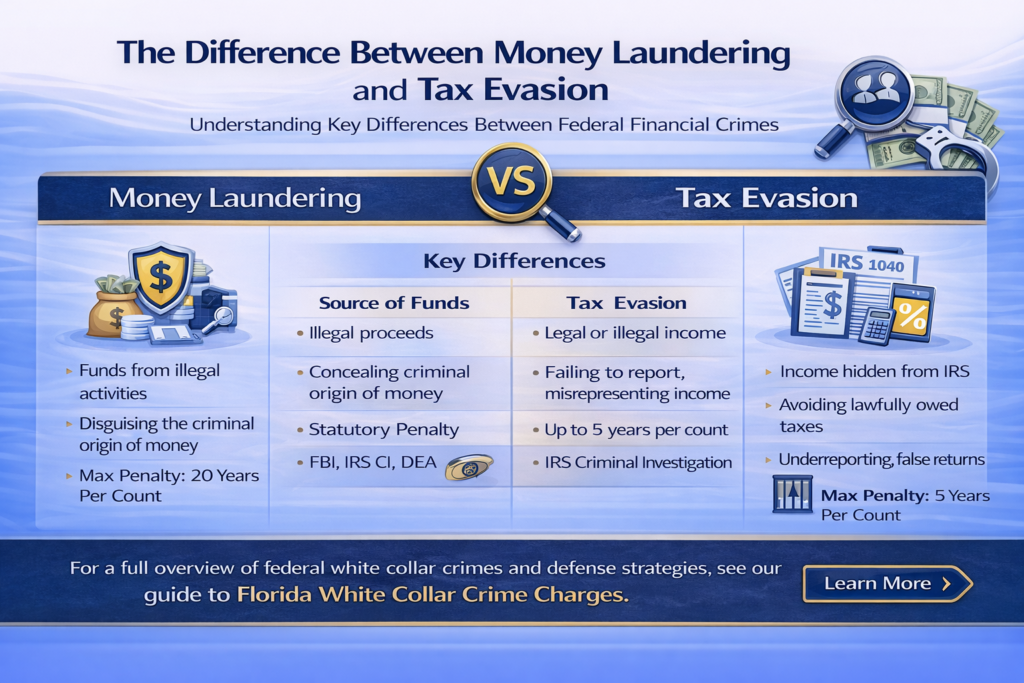
Money laundering and tax evasion are both serious federal financial crimes — but they involve very different conduct, legal elements, and defense strategies.
Both offenses are commonly prosecuted as part of broader white collar investigations. For a comprehensive overview of Florida white collar crime laws and defense strategy, see our guide to Florida White Collar Crime Charges.
Understanding the distinction between these charges is critical when evaluating exposure and defense options.
🧼 Money Laundering: Concealing Criminal Proceeds
Money laundering involves using financial transactions to disguise the illegal origin of funds.
Key characteristics:
The money originates from criminal activity
The goal is concealment or disguise
Financial transactions are central
Federal agencies often coordinate investigations
For a full breakdown of Florida money laundering charges, see our guide to Money Laundering Charges in Florida.
💰 Tax Evasion: Willfully Avoiding Taxes
Tax evasion involves deliberately avoiding taxes owed on income — whether lawfully earned or illegally obtained.
Key characteristics:
Income is not properly reported
The focus is on willful deception of the IRS
Most cases begin as audits
Prosecution requires proof of intent
For more detail, see our guide to IRS Criminal Tax Evasion Charges in Florida.
⚖️ Key Legal Differences
| Issue | Money Laundering | Tax Evasion |
|---|---|---|
| Source of Funds | Illegal proceeds | Income (legal or illegal) |
| Core Conduct | Concealment of origin | Failure to report or pay taxes |
| Statute | 18 U.S.C. §§ 1956/1957 | 26 U.S.C. § 7201 |
| Typical Exposure | Up to 20 years per count | Up to 5 years per count |
| Agencies | FBI, DEA, IRS CI | IRS Criminal Investigation |
🚨 Can Someone Be Charged With Both?
Yes. In complex financial investigations, prosecutors may allege that:
Income was concealed through laundering
Taxes were also willfully evaded
These overlapping charges often increase sentencing exposure and negotiation leverage.
🛡 Defense Considerations
Although both crimes involve financial records, the defense strategy differs significantly.
Money laundering defenses often focus on:
Lack of knowledge of unlawful source
No qualifying financial transaction
Improper tracing of funds
Tax evasion defenses often focus on:
Lack of willfulness
Reliance on tax preparers
Accounting errors rather than fraud
Early legal strategy can influence how charges are structured — and whether escalation occurs.
❓ Frequently Asked Questions
Are both money laundering and tax evasion federal crimes?
Yes. Both are commonly prosecuted in federal court.
Can someone be charged with both?
Yes. Prosecutors sometimes combine both charges in large financial investigations.
Which carries greater penalties?
Money laundering generally carries higher statutory maximums, but sentencing exposure depends heavily on financial loss and other factors.
Can federal financial crime convictions be sealed or expunged?
No. Federal convictions cannot be sealed or expunged.