
Last updated March 2026
Florida treats allegations of battery against a pregnant woman with heightened seriousness. Prosecutors and judges recognize the increased vulnerability of an expectant mother, and these cases are often pursued aggressively — even when the alleged victim does not want charges filed.
A conviction can result in mandatory jail, strict probation, no-contact orders, immigration consequences, and a permanent criminal record. However, these cases frequently involve misunderstandings, disputed facts, and legal defenses that can be raised early by experienced counsel.
This page explains what Florida law requires, the penalties involved, and how these cases are defended.
⚖️ What Florida Law Says About Battery on a Pregnant Woman
Under Fla. Stat. § 784.045(1)(b), a battery may be enhanced when:
A battery occurred (intentional touching or striking, or causing bodily harm),
The alleged victim was pregnant at the time, and
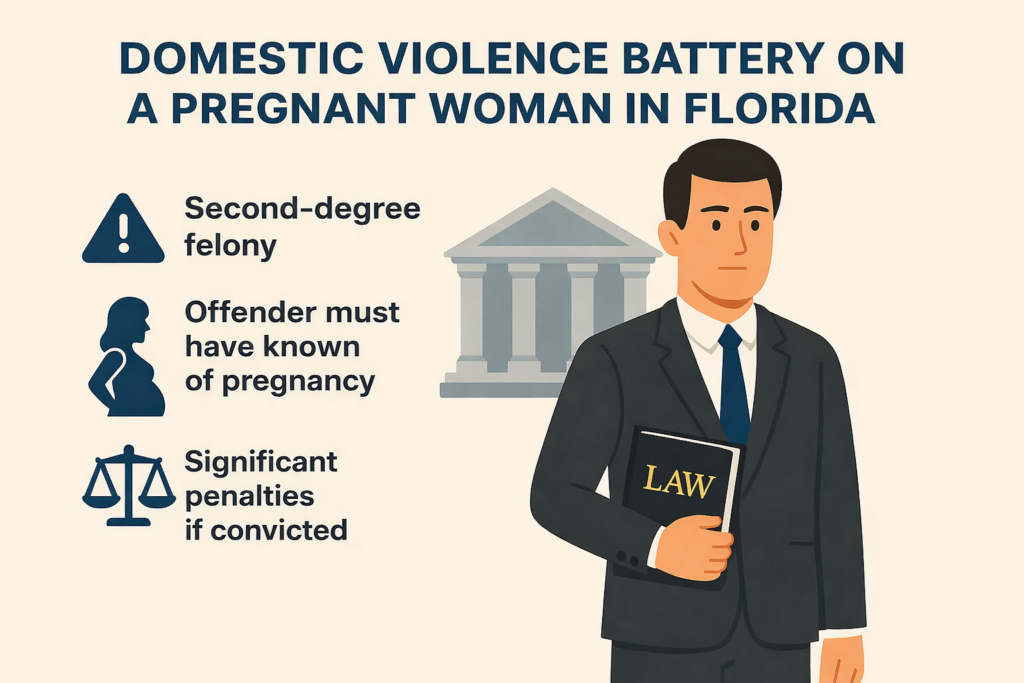
The accused knew or should have known the victim was pregnant.
Battery on a pregnant woman is charged as aggravated battery, which is a second-degree felony, not a misdemeanor. The enhancement is based on pregnancy and knowledge — not automatic injury severity. So even if the case is not domestic in nature, it is still charged as aggravated battery on a pregnant woman.
Knowledge of pregnancy is often the most contested element, particularly when:
The pregnancy was early or not visible,
The accused was never told, or
The alleged victim learned of the pregnancy shortly before or after the incident.
🚨 Penalties for Battery on a Pregnant Woman
A conviction for aggravated battery on a pregnant woman may result in:
Mandatory jail or prison exposure
Up to 15 years in prison (statutory maximum)
Lengthy probation with strict supervision
26-week Batterers’ Intervention Program
No-contact orders, sometimes lasting the entire case
Loss of firearm rights
Permanent felony record, often not sealable or expungeable
Judges in Broward County treat these cases with particular seriousness, and probation conditions are frequently more restrictive than standard DV battery cases.
🧾 What the State Must Prove
To secure a conviction, the State must prove every element beyond a reasonable doubt, including:
That the contact was intentional,
That the alleged victim was pregnant at the time, and
That the defendant knew or reasonably should have known of the pregnancy.
Each element can be challenged. Failure to prove knowledge of pregnancy alone can undermine the charge.
Understanding how domestic violence charges are dismissed in Florida is especially important in enhanced cases where proof requirements are higher.
⚖️ Does Battery on a Pregnant Woman Require a Domestic Relationship?
No. Florida law does not require a domestic or family relationship for the pregnancy enhancement to apply. The charge is based on whether the alleged victim was pregnant and whether the defendant knew or should have known of the pregnancy.
However, most battery-on-a-pregnant-woman cases arise in domestic or intimate-partner situations. When a domestic relationship exists, additional domestic violence procedures apply — including no-contact orders, injunction exposure, and mandatory conditions of release.
🛡️ Defenses to Battery on a Pregnant Woman
These cases are often defensible, particularly when handled early. Common defenses include:
✔ Lack of Knowledge
The State must prove actual or constructive knowledge. Early-stage pregnancies and lack of disclosure frequently weaken this element.
✔ No Intentional Touching
Accidental contact, mutual physical interaction, or defensive movements may not meet the legal definition of battery.
✔ Self-Defense
If the alleged victim was the initial aggressor, reasonable force may be legally justified.
✔ False or Exaggerated Allegations
High-emotion situations, breakups, or custody disputes can lead to exaggerated claims.
✔ Recantation or Non-Cooperation
While the State may proceed anyway, credibility issues can dramatically affect the case.
Early motions, evidence preservation, and strategic negotiation can significantly alter the trajectory of these cases.
🕰️ Why Early Legal Action Matters
Enhanced DV charges move quickly and leave little margin for error. Early legal intervention allows counsel to:
Preserve evidence
Challenge probable cause
Address no-contact orders
Position the case for dismissal or reduction
Protect future sealing or expungement eligibility where possible
Waiting almost always makes these cases harder to resolve favorably.
📞 Accused of Domestic Violence Battery on a Pregnant Woman?
These allegations carry severe legal and personal consequences. A conviction can permanently affect your freedom, your record, and your future.
📞 Contact Michael White, P.A. to learn about your options and how to protect your rights.
❓ Frequently Asked Questions
1. Is battery on a pregnant woman a felony in Florida?
Not automatically. It’s usually a second-degree felony but carries enhanced penalties.
2. Does the State need to prove I knew she was pregnant?
Yes. Knowledge of pregnancy is an essential element of the offense.
3. Can the victim drop the charges?
They can request dismissal, but prosecutors decide whether the case goes forward.
4. Will a conviction appear on my criminal record?
Yes — and DV-related offenses are generally not eligible to be sealed if adjudication is imposed.
5. Do I need a lawyer for this charge?
Absolutely. These cases carry mandatory conditions and long-term consequences.