
Last updated February 2026
If you’ve been arrested for domestic violence in Florida, one question usually comes first:
“Can this case be dropped?”
In many situations, the alleged victim wants the charges dismissed. In others, the evidence is weak. Sometimes both.
But in Florida, domestic violence cases do not work the way most people think they do.
Understanding how prosecutors handle dismissal, reduction, trial decisions, and victim cooperation can make the difference between early resolution and a permanent conviction.
If you were arrested in Fort Lauderdale or Broward County and need immediate representation, speak with a Fort Lauderdale Domestic Violence Defense Lawyer to protect your rights and evaluate your options.
Let’s break down how it actually works.
Who Controls a Domestic Violence Case in Florida?
Under Florida law — including the domestic violence framework defined in Florida Statute 741.28 — the prosecutor controls whether charges are filed, pursued, reduced, or dismissed.
Not the alleged victim.
Once law enforcement makes an arrest, the case becomes:
State of Florida vs. Defendant
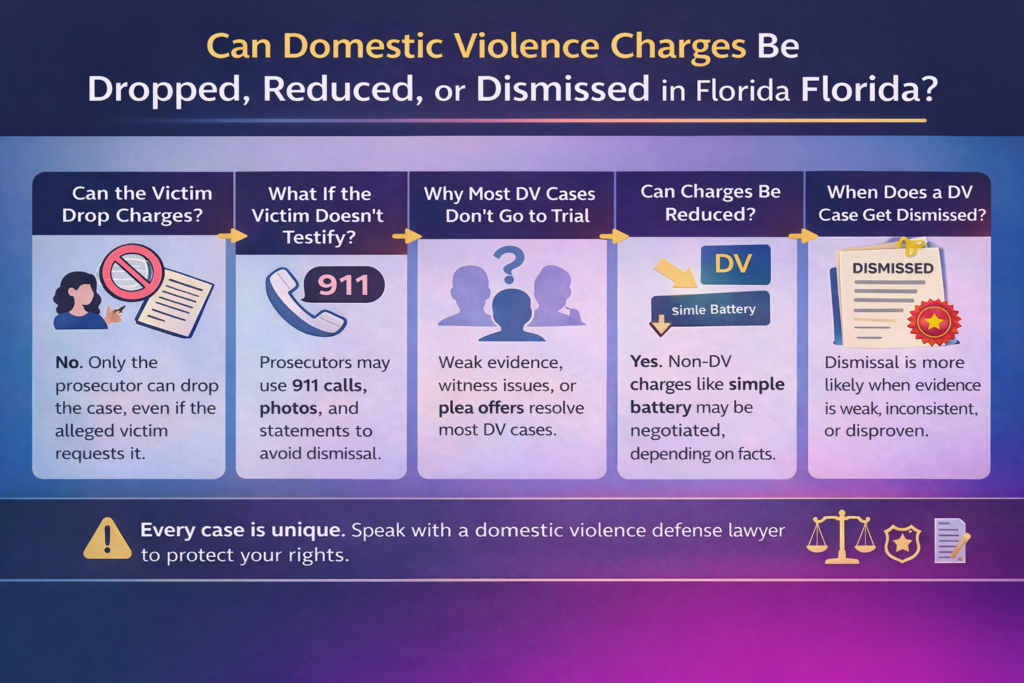
Even if the alleged victim wants the case dropped, only the State Attorney’s Office can dismiss it.
Can the Alleged Victim “Drop the Charges”?
Technically, no.
An alleged victim may:
Request dismissal
Refuse to cooperate
Decline to testify
Submit an affidavit of non-prosecution
But prosecutors are not required to honor that request.
In many Florida jurisdictions — including Broward County — domestic violence units are trained to proceed without victim cooperation when possible.
That leads to the next question.
What Happens If the Victim Doesn’t Testify?
A common misconception is:
“If the victim doesn’t show up, the case goes away.”
Not necessarily.
Prosecutors may attempt to proceed using:
911 recordings
Body-worn camera footage
Photographs of injuries
Medical records
Excited utterance statements
Prior written statements
In some cases, prosecutors may subpoena the alleged victim.
However, if the State cannot prove its case beyond a reasonable doubt without testimony, dismissal becomes more likely.
The strength of the independent evidence determines the outcome.
Why Most Domestic Violence Cases Never Go to Trial
In Florida, the vast majority of domestic violence cases resolve before trial.
That happens for several reasons:
Evidence weaknesses emerge.
Witnesses become unavailable.
Plea negotiations occur.
Diversion options are explored (when available).
Prosecutors determine conviction likelihood is low.
Trial is resource-intensive. Prosecutors evaluate whether a case is worth pursuing to verdict.
If evidentiary problems exist, early resolution is often pursued.
When Do Domestic Violence Charges Get Dismissed?
Dismissal may occur when:
The evidence is legally insufficient.
Witness statements are inconsistent.
Video contradicts the allegations.
Injuries are absent or minimal.
Self-defense evidence is compelling.
Constitutional violations occurred during arrest.
Early defense intervention matters.
In many cases, submitting exculpatory evidence before formal filing can result in a no-file decision.
Can Domestic Violence Charges Be Reduced?
Yes — but reduction depends on the facts.
Common reductions may include:
Simple battery (non-DV designation)
Disorderly conduct
Trespass
Criminal mischief (non-enhanced)
Withhold of adjudication in eligible cases
However, Florida law imposes certain restrictions in domestic violence cases, including mandatory conditions and potential Batterers’ Intervention Program requirements.
Reductions are negotiation-driven and fact-specific.
Does the Victim’s Recantation Guarantee Dismissal?
No.
Prosecutors are trained to view recantations cautiously.
In some cases, recantation can hurt credibility and strengthen the State’s argument that intimidation occurred.
What matters is not whether the story changes — but whether the State can still prove the case beyond a reasonable doubt.
What Increases the Chances of Dismissal or Reduction?
Several factors significantly affect case outcome:
Lack of visible injuries
Inconsistent statements
Surveillance footage
Body-cam contradictions
Self-defense evidence
Clean prior record
Early legal intervention
Weak probable cause for arrest
Cases often turn on small factual details captured within hours of arrest.
How Broward County Prosecutors Handle These Cases
In Broward County, domestic violence cases are handled by a specialized domestic violence unit.
Prosecutors review:
Officer body camera
911 audio
Photographs
Medical records
Prior history between parties
Early defense contact can influence charging decisions before arraignment.
If you were arrested in Fort Lauderdale, timing is critical.
Can a Domestic Violence Case Be Sealed or Expunged Later?
Even if charges are dismissed, the arrest may still appear on background checks.
Eligibility for sealing or expungement depends on:
Case outcome
Adjudication status
Prior criminal history
Early dismissal preserves more options for record clearing.
The Bottom Line
Domestic violence charges in Florida can be:
Dismissed
Reduced
Resolved through plea
Taken to trial (rarely)
But they are not automatically dropped simply because the alleged victim requests it.
The outcome depends on evidence, legal strategy, and how quickly the defense acts.
If you are facing domestic violence charges in Fort Lauderdale or anywhere in South Florida, early intervention can make a measurable difference.
Speak With a Domestic Violence Defense Lawyer Today
Domestic violence cases move quickly and carry serious collateral consequences — including firearm restrictions, no-contact orders, housing exclusion, and immigration impact.
If you’ve been arrested, do not assume the case will simply disappear.
📞 Call Michael White, P.A. at (954) 270-0769 for a free consultation.