
Last updated February 2026
If you’ve been served with a temporary domestic violence injunction in Florida, the next critical step is the final hearing.
This hearing determines whether the court will dismiss the temporary order or issue a final injunction that can last for months, years, or even permanently.
Understanding what happens at a domestic violence injunction hearing — and how to prepare — is essential to protecting your rights, your record, and your future.
🧾 Step 1: The Temporary Injunction (Before the Hearing)
Most domestic violence injunction cases begin with a temporary injunction, often issued ex parte — meaning the judge hears only from the petitioner.
Temporary injunctions may include:
No-contact provisions
Removal from the home
Temporary custody restrictions
Firearm surrender requirements
The final hearing is your first opportunity to present your side of the story.
For a broader overview of how injunctions are issued and enforced, see Domestic Violence Injunctions in Florida.
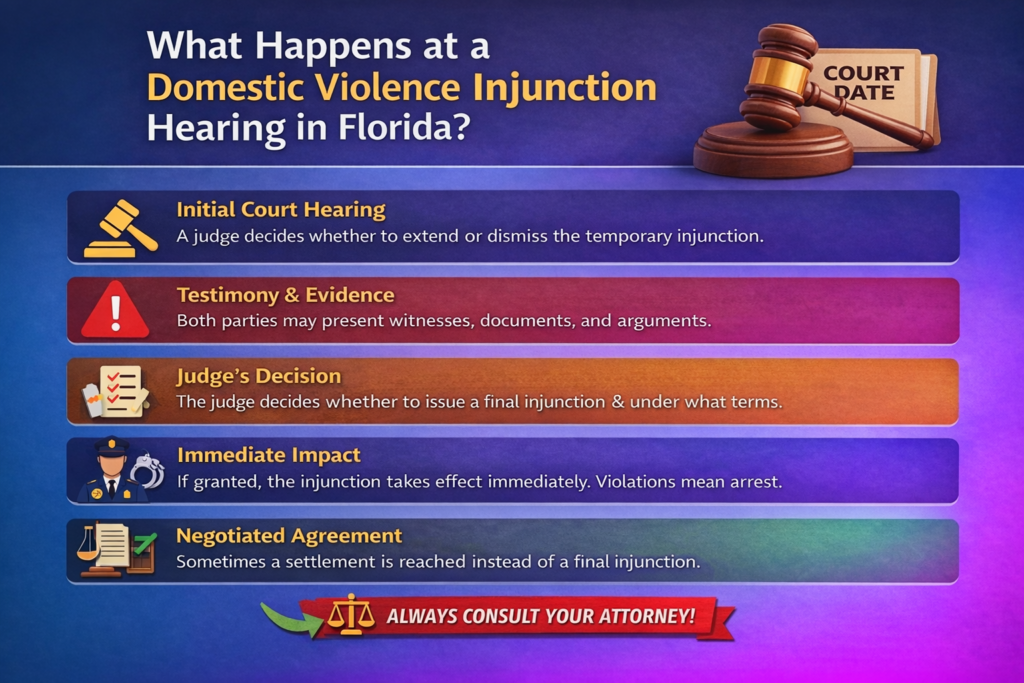
🧑⚖️ Step 2: The Final Hearing (Both Parties Present)
At the final injunction hearing:
Both sides appear before a judge
Each party may testify
Witnesses may be called
Documents, photos, and recordings may be introduced
Cross-examination is permitted
Unlike a criminal trial, there is no jury. The judge decides whether the legal standard for an injunction has been met.
The burden is on the petitioner to prove either:
An act of domestic violence occurred, or
They have reasonable cause to believe they are in imminent danger of becoming a victim of domestic violence
🎤 Step 3: Testimony and Cross-Examination
Each side may present testimony under oath.
Common issues examined include:
Inconsistencies in statements
Lack of physical evidence
Delays in reporting
Motive to fabricate (custody disputes, divorce, etc.)
Prior history between the parties
Cross-examination can significantly affect credibility. Many injunction cases rise or fall on how believable each side appears under questioning.
📂 Step 4: Evidence Presentation
Evidence may include:
Text messages and emails
911 recordings
Body-worn camera footage
Medical records
Photographs
Social media posts
Because injunction hearings move quickly, preparation is critical. Missing documents or unprepared testimony can permanently affect the outcome.
⚖️ Step 5: The Judge’s Decision
After hearing testimony and reviewing evidence, the judge may:
Dismiss the temporary injunction
Extend the injunction for a set period
Issue a permanent injunction
Modify the requested terms
If granted, a final injunction may include:
No-contact or stay-away provisions
Exclusive use of a shared residence
Temporary custody or time-sharing restrictions
Mandatory counseling
Continued firearm prohibitions
Violating a final injunction is a criminal offense and can result in arrest.
🔒 How an Injunction Hearing Affects Criminal Charges
An injunction hearing is separate from a criminal domestic violence case — but what happens in one can affect the other.
Statements made under oath may later be used in criminal proceedings. Evidence introduced at the injunction hearing may also shape how prosecutors evaluate a pending case.
If you are facing both a criminal charge and an injunction, strategy must account for both courtrooms.
🚨 Common Mistakes at Injunction Hearings
Many respondents hurt their case by:
Appearing without legal counsel
Speaking emotionally rather than factually
Interrupting the judge or opposing party
Violating temporary injunction terms before the hearing
Failing to bring supporting evidence
Judges expect order, preparation, and credibility — not confrontation.
🛡️ How a Domestic Violence Defense Lawyer Helps at the Hearing
An experienced attorney can:
Prepare testimony in advance
Organize and introduce admissible evidence
Cross-examine the petitioner effectively
Object to improper evidence
Protect your Fifth Amendment rights if criminal charges are pending
Argue for dismissal or limited terms
Early preparation often determines whether an injunction becomes permanent.
📍 Facing a Domestic Violence Injunction Hearing in Florida?
A final injunction can affect:
Your housing
Your parental rights
Your firearm rights
Your employment background
Your immigration status
If you have been served with a temporary domestic violence injunction in Broward County or anywhere in South Florida, do not wait until the hearing date to seek legal advice.
📞 Contact Michael White, P.A. to discuss your upcoming injunction hearing and how to prepare.
❓ Frequently Asked Questions
What is the standard of proof at an injunction hearing?
The petitioner must prove an act of domestic violence occurred or that they have reasonable cause to fear imminent domestic violence.
Do I need a lawyer for an injunction hearing?
You are not required to have one, but injunction hearings can significantly impact your rights. Legal representation is strongly recommended.
Can an injunction affect my gun rights?
Yes. A final injunction often requires firearm surrender and prohibits possession while it remains active.
What happens if the injunction is dismissed?
If dismissed, the temporary order is dissolved. However, related criminal charges (if any) may still proceed.
How long does a domestic violence injunction last?
It depends on the judge’s order. Some injunctions are time-limited, while others can be permanent unless modified.