
Last updated February 2026
Florida drug trafficking laws are among the harshest in the country. Unlike many other drug offenses, trafficking does not require proof of sales, transportation, or distribution. Instead, trafficking charges — and the prison sentences that follow — are triggered almost entirely by weight.
If you are charged with trafficking in Florida, you are not just facing the possibility of prison. You are facing mandatory minimum sentencing laws that often leave judges with little or no discretion.
For a broader overview of Florida Drug Trafficking charges, defenses, and mandatory minimum laws, see:
👉 Drug Trafficking in Florida
🎥 Watch the video below as I explain how Florida’s mandatory minimum laws work, why they apply even to first-time offenders, and where real defense opportunities exist.
⚖️ What Is Drug Trafficking Under Florida Law?
Under Florida law, a drug trafficking charge is based on possessing, purchasing, selling, delivering, or manufacturing a controlled substance at or above a statutory weight threshold.
There is no requirement that the State prove:
an exchange of money,
an intent to sell, or
actual delivery of drugs.
Once the alleged weight meets the trafficking threshold, mandatory minimum prison sentences apply automatically — even when the drugs were allegedly for personal use.
🧪 How People Get Charged With Trafficking (Even Without Selling)
Many trafficking cases arise from situations people do not expect, including:
Pills or drugs weighed together across multiple containers
Substances found during traffic stops or searches
Medication or powder combined to meet a threshold amount
Allegations based solely on laboratory weight calculations
Because weight controls everything, small factual disputes can carry enormous sentencing consequences.
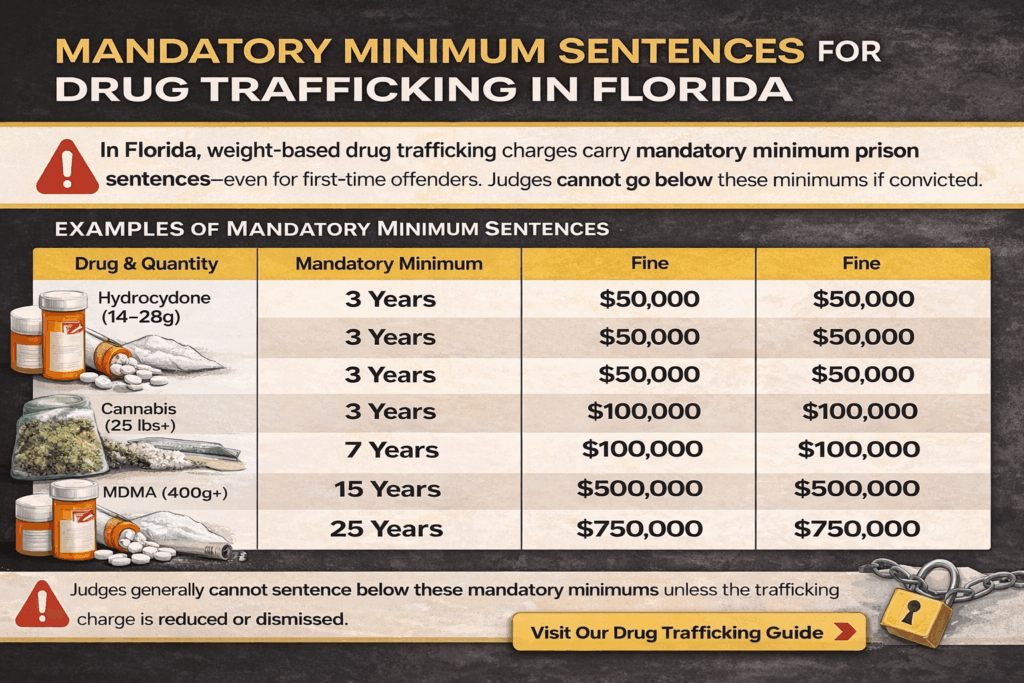
📊 Mandatory Minimum Sentences in Florida Drug Trafficking Cases
Drug trafficking convictions in Florida carry mandatory prison sentences and large fines, even for first-time offenders. The sentence imposed depends on:
📦 the type of drug,
⚖️ the total alleged weight, and
📁 any prior criminal history.
⛓️ Examples of Mandatory Minimum Sentences
| Drug & Quantity | Mandatory Minimum | Fine |
|---|---|---|
| Hydrocodone (14–28g) | 3 years | $50,000 |
| Oxycodone (7–14g) | 3 years | $50,000 |
| Cannabis (25 lbs or 300 plants) | 3 years | $50,000 |
| Cocaine (200–400g) | 7 years | $100,000 |
| MDMA (400g or more) | 15 years | $500,000 |
| LSD (7g or more) | 15 years | $250,000 |
| Hydrocodone (200g or more) | 25 years | $750,000 |
| Oxycodone (100g or more) | 25 years | $750,000 |
Once charged, judges generally cannot sentence below these minimums unless the trafficking charge is reduced or dismissed.
💬 Frequently Asked Questions: Florida Drug Trafficking Laws
Q1: What qualifies as drug trafficking in Florida?
A: In Florida, drug trafficking is based on the weight of the controlled substance—not whether you intended to sell or transport it. Exceeding certain weight thresholds triggers automatic trafficking charges.
Q2: Do all drug trafficking charges carry mandatory prison time in Florida?
A: Yes. Florida law imposes mandatory minimum sentences starting at 3 years and going up to 25 years, depending on the drug and quantity involved.
Q3: Can a drug trafficking charge be reduced to a lesser offense?
A: Yes. A skilled criminal defense attorney may be able to challenge the evidence, file a motion to suppress, or negotiate a reduction to simple possession or another lesser charge.
Q4: What drugs are most commonly charged as trafficking in Florida?
A: Common trafficking substances include cocaine, cannabis, heroin, fentanyl, hydrocodone, oxycodone, MDMA, methamphetamine, and LSD—based on specific weight thresholds.
Q5: What should I do if I’m charged with drug trafficking in Florida?
A: Contact a defense attorney immediately. Mandatory sentencing laws give you little room for error—early legal help can significantly improve your chances.