
Last updated February 2026
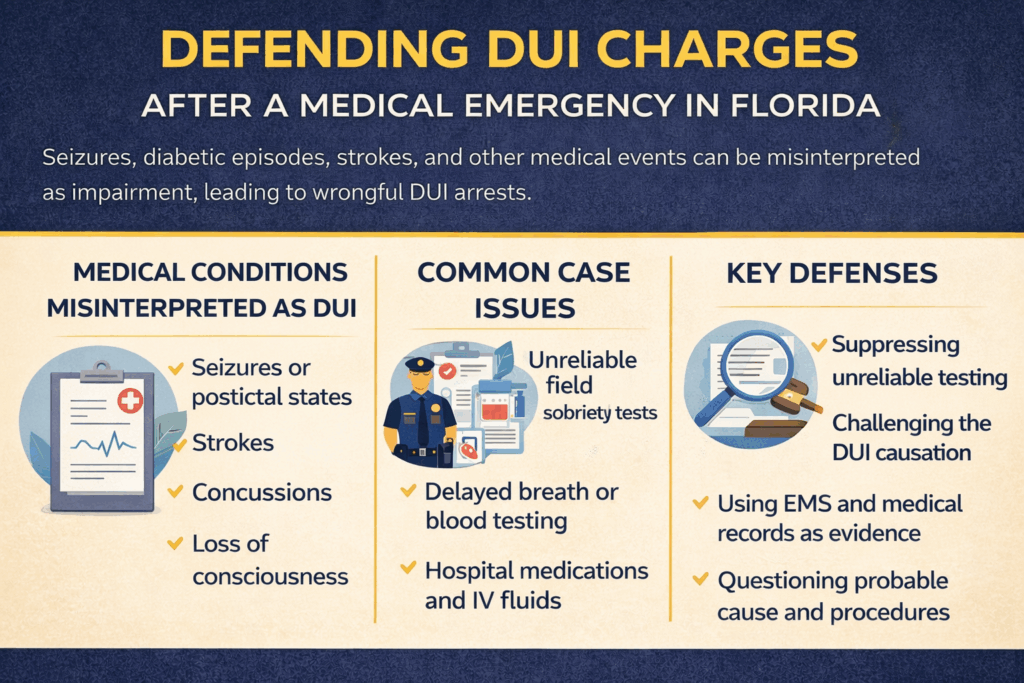
Not every DUI arrest involves alcohol or drugs. In Florida, people are sometimes charged with DUI after experiencing a medical emergency — such as a seizure, diabetic episode, stroke, or loss of consciousness — even when impairment had nothing to do with intoxication.
These cases are often deeply flawed.
Medical emergencies can mimic the signs officers associate with impairment, leading to wrongful arrests, unreliable testing, and serious legal consequences for people who were actually suffering a health crisis.
For a broader overview of the DUI process and what happens next, see our guide on Florida DUI cases from arrest through resolution.
⚖️ Medical Emergencies and Florida DUI Law
Florida DUI law requires proof that a person’s impairment was caused by alcohol, drugs, or a chemical substance.
A medical condition alone is not a crime.
However, officers are trained to look for outward signs of impairment — confusion, slurred speech, unsteady movement — without always distinguishing between intoxication and a medical event.
When that distinction is missed, DUI arrests can follow even though the underlying cause was medical, not chemical.
In many of these cases, the strongest defense focuses on challenging and suppressing the DUI evidence collected after the emergency.
🧠 Medical Conditions Commonly Mistaken for DUI
Several medical emergencies can closely resemble intoxication, including:
seizures or postictal states
diabetic hypoglycemia or hyperglycemia
strokes or transient ischemic attacks (TIAs)
head injuries or concussions
fainting or loss of consciousness
cardiac events
These conditions can cause:
confusion or disorientation,
poor balance,
delayed responses,
abnormal speech,
or difficulty following instructions.
Without proper medical evaluation, these symptoms are often misinterpreted.
🚔 How DUI Arrests After Medical Emergencies Happen
Many medical-emergency DUI cases begin when:
a driver crashes or stops unexpectedly,
police arrive before paramedics,
officers conduct field sobriety exercises,
or testing is requested without medical clearance.
Officers may rely on:
subjective observations,
incomplete statements from someone in distress,
or assumptions based on odor, confusion, or behavior.
Once the investigation turns toward DUI, medical explanations are sometimes ignored.
🧪 Why DUI Testing Is Especially Unreliable After Medical Events
Testing evidence in these cases is frequently problematic.
Issues often include:
testing conducted while the person was still symptomatic,
inability to perform field sobriety exercises due to medical limitations,
delayed breath or blood testing,
contamination or dilution of samples after hospital treatment,
medications administered by emergency personnel.
💉 Hospital Blood Draws and Medical Treatment Complications
Medical emergencies often result in:
IV fluids,
medications,
blood draws for diagnostic purposes,
oxygen or other interventions.
Hospital blood tests are not automatically valid DUI evidence. Questions often arise about:
consent versus medical necessity,
whether law enforcement requested or relied on hospital samples,
chain of custody,
and whether treatment altered alcohol concentrations.
These issues frequently become central to suppression motions.
🚨 Field Sobriety Exercises Are Often Invalid in These Cases
Field sobriety exercises assume:
normal balance,
normal cognition,
normal motor function.
Medical emergencies break those assumptions.
Using field exercises on someone who:
just had a seizure,
is experiencing diabetic shock,
or is suffering neurological impairment
can produce misleading results that do not reflect intoxication.
🧾 Proving the Cause of Impairment Matters
To sustain a DUI conviction, the State must connect impairment to alcohol or drugs — not merely show confusion or poor coordination.
Medical records, EMS reports, hospital notes, and expert testimony often become critical in showing:
when symptoms began,
what treatment was administered,
and whether alcohol played any role at all.
When medical evidence contradicts the DUI theory, cases can collapse.
✅ Key Takeaways
Medical emergencies are not crimes
DUI requires impairment caused by alcohol or drugs
Many medical conditions mimic intoxication
DUI testing is often unreliable after medical events
Suppression and dismissal are common defense paths
For a broader overview of the DUI process and what happens next, see our guide on Florida DUI cases from arrest through resolution.
❓ Frequently Asked Questions
Can police charge you with DUI after a seizure or diabetic episode?
They can make an arrest, but the charge may not hold if the impairment was caused by a medical condition rather than alcohol or drugs.
Do medical records matter in DUI cases?
Yes. EMS and hospital records often provide critical evidence showing the true cause of symptoms and can directly undermine DUI allegations.
Are breath or blood tests reliable after medical treatment?
Not always. IV fluids, medications, and timing delays can affect test reliability and raise suppression issues.
What if officers ignored signs of a medical emergency?
Failure to recognize or respond appropriately to a medical emergency can undermine probable cause and the validity of the DUI investigation.
Are these cases defensible?
Very often. Medical-emergency DUIs frequently involve weak causation evidence, flawed testing, and procedural errors.