
Last updated February 2026
If you’ve been arrested for DUI in Florida, one of the first questions you’re likely asking is:
“What sentence am I actually facing?”
The answer depends on far more than the charge itself. While Florida law sets maximum penalties for DUI, actual sentencing outcomes vary widely based on the facts of the case, your history, and how the case is resolved in court.
This page explains how DUI sentencing works in practice, what judges consider at sentencing, and when DUI charges can be reduced before sentencing ever occurs.
⚖️ DUI Sentencing vs. DUI Penalties: What’s the Difference?
Florida DUI law establishes statutory penalties — including jail exposure, fines, probation, and license consequences. But sentencing is the process by which a judge determines what actually happens in a specific case.
In other words:
Penalties = what the law allows
Sentencing = what the court imposes
For a full breakdown of statutory DUI penalties, see our guide to Florida DUI penalties. This page focuses on how judges sentence DUI cases, not maximum punishment charts.
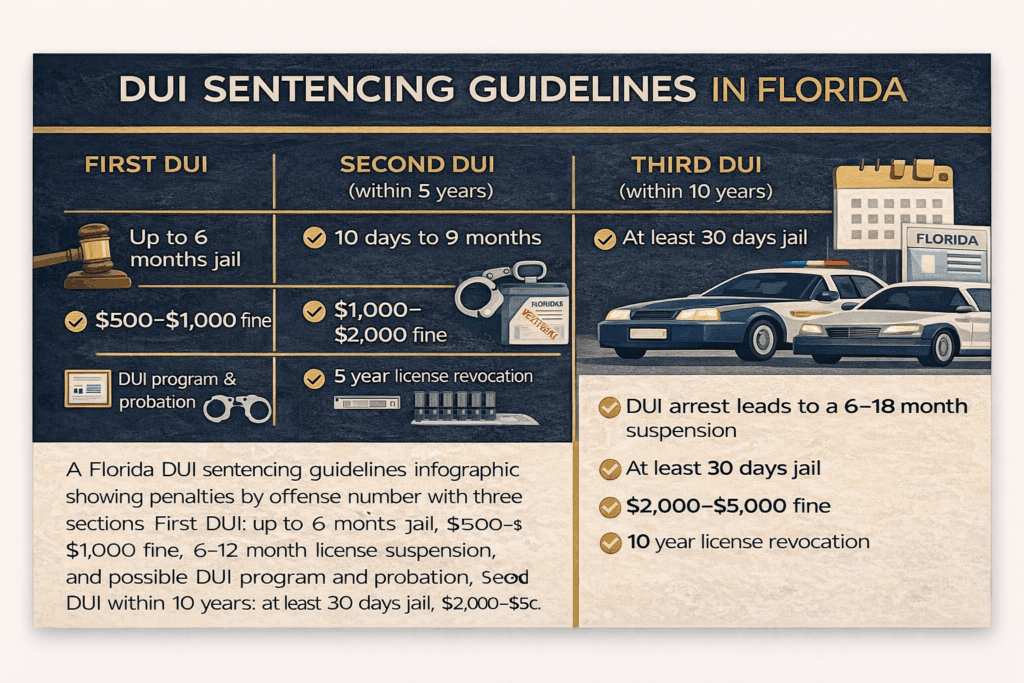
📋 Minimum Sentencing Exposure for Florida DUI Charges
Florida DUI offenses may be charged as misdemeanors or felonies depending on prior history and aggravating factors.
🟢 First-Time DUI (Misdemeanor)
Typical sentencing exposure may include:
$500 fine (or $1,000 if BAC ≥ 0.15 or a minor was present)
Six months of probation
License suspension
DUI school and substance abuse evaluation
Possible community service or ignition interlock device
Jail is legally permitted but not automatic, and many first-time cases resolve without incarceration.
🟡 Second DUI Within 5 Years
A second DUI within five years carries mandatory minimum consequences, including:
$1,000–$2,000 fine
Five-year license suspension
Mandatory 10 days in jail
One year of probation
Ignition interlock requirements
The timing between offenses is a major sentencing factor.
🟠 Third or Subsequent DUI
A third DUI within 10 years is charged as a felony, exposing the defendant to:
State prison time
Long-term or permanent license revocation
Extended probation and supervision
Even DUIs outside statutory lookback periods can still result in enhanced sentencing exposure.
🚨 DUI Cases Involving Injury or Death
Sentencing exposure increases dramatically when a DUI involves an accident:
Property damage or minor injury → misdemeanor DUI
Serious bodily injury → third-degree felony
DUI manslaughter → second-degree felony (or higher if failure to render aid is alleged)
These cases are aggressively prosecuted and often involve:
Mandatory prison exposure
Permanent license revocation
Civil lawsuits alongside criminal sentencing
🧾 What Factors Do Judges Consider at DUI Sentencing?
Judges in Fort Lauderdale and across South Florida typically consider:
Prior DUI or criminal history
Alleged BAC level
Whether an accident, injury, or aggravating factor is present
Compliance with court conditions before sentencing
The procedural posture of the case (trial vs plea)
Sentencing outcomes are rarely mechanical — judicial discretion matters.
🔁 Can a DUI Sentence Be Reduced in Florida?
Yes — but only before sentencing occurs.
Many DUI cases never reach sentencing for DUI because they resolve as:
Reckless driving (“wet reckless”)
Reduced or amended charges
Dismissals based on evidentiary or constitutional issues
Common factors supporting reduction include:
Borderline BAC results
Flawed field sobriety testing
Suppression issues with breath or blood evidence
Weak proof of actual physical control
Once a DUI conviction is entered, sentencing discretion becomes limited — which is why early defense strategy is critical.
🚘 Probation, Jail, and Alternative Sentencing
In appropriate cases, Florida courts may impose:
Probation instead of jail
Community-based penalties
Treatment-based conditions
Ignition interlock in lieu of incarceration
Alternative sentencing is case-specific and depends heavily on how the case is positioned before sentencing.
📍 Facing DUI Sentencing in Fort Lauderdale or South Florida?
A DUI arrest does not automatically determine how a case ends. Sentencing outcomes depend on:
The strength of the State’s evidence
The legal issues raised before trial
How the case is resolved procedurally
Understanding sentencing exposure early allows defendants to make informed decisions before consequences become permanent.
❓ Frequently Asked Questions: DUI Sentencing in Florida
What is the minimum sentence for a first DUI in Florida?
A fine, probation, license suspension, and DUI school. Jail is permitted but often avoidable in first-time cases.
Is jail mandatory for a DUI conviction?
Only in certain repeat-offender scenarios. Most first-time DUIs do not result in jail when properly handled.
Can a DUI be reduced to reckless driving?
Yes. Many DUI cases resolve as reckless driving depending on the evidence and circumstances.
How long does a DUI stay on your record in Florida?
A DUI conviction remains permanently and cannot be sealed or expunged.
What factors influence DUI sentencing the most?
Prior history, alleged BAC, aggravating factors, and how the case resolves before sentencing.