
Last updated February 2026
If you receive a letter from the United States Attorney’s Office identifying you as a “target” of a federal investigation, you must take it seriously.
A federal target letter means prosecutors believe there is substantial evidence linking you to a federal crime. You have not yet been indicted — but the government is signaling that charges are being considered.
What you do next can significantly affect whether you are indicted, negotiate a resolution, or avoid charges altogether.
For a broader overview of how criminal cases are handled in Broward County and throughout South Florida, see our guide to Fort Lauderdale criminal defense.
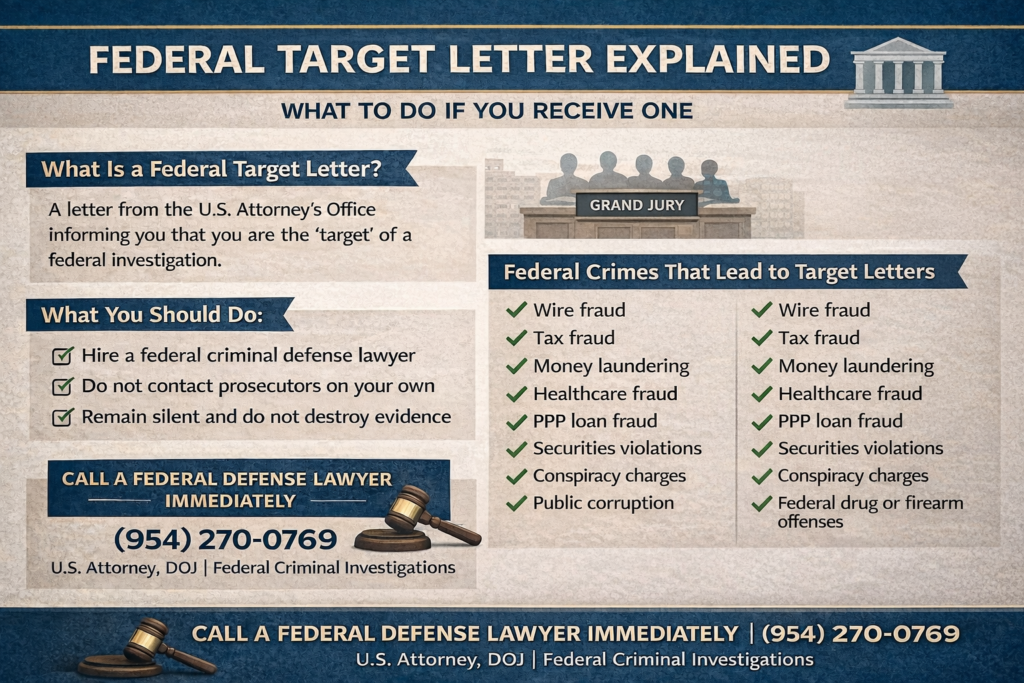
📬 What Is a Federal Target Letter?
A federal target letter is a formal written notice from the U.S. Attorney’s Office stating that:
You are the target of a federal grand jury investigation
The government believes it has substantial evidence of criminal conduct
You may be invited to testify before the grand jury
You have the right to remain silent
You have the right to legal counsel
The letter is not a charge. It is a warning.
In many cases, the investigation has been ongoing for months before a target letter is sent.
🧠 “Target” vs. “Subject” vs. “Witness”
Federal prosecutors use specific terminology:
Target
A person the government believes has committed a crime and is likely to be indicted.
Subject
A person whose conduct is within the scope of the investigation, but against whom charges have not yet been decided.
Witness
A person with information relevant to the investigation, but not suspected of wrongdoing.
Being labeled a target is the most serious designation.
📝 What Is Typically Included in a Target Letter?
Most federal target letters contain:
The statute(s) under investigation
Notice of your Fifth Amendment rights
An invitation to testify before the grand jury
A warning not to destroy documents
Contact information for the Assistant U.S. Attorney
The letter may also suggest that you contact the prosecutor to discuss the matter.
You should not do that without counsel.
⚖️ What Happens After a Target Letter?
Several outcomes are possible:
You testify before the grand jury
You decline to testify and remain silent
Your attorney requests a proffer session
Negotiations begin
You are indicted
The investigation continues
In many cases, the target letter is issued shortly before an indictment decision.
Early intervention is critical.
🔥 What You Should NOT Do
If you receive a federal target letter:
Do not contact the prosecutor yourself
Do not attempt to “explain” the situation
Do not destroy documents or communications
Do not discuss the investigation with others
Anything you say can become evidence.
Federal investigations are often built around statements, digital records, financial trails, and cooperating witnesses.
🛡️ What a Federal Defense Attorney Can Do
An experienced federal defense lawyer can:
Contact the U.S. Attorney’s Office on your behalf
Clarify whether indictment is imminent
Evaluate whether a proffer or cooperation makes sense
Negotiate immunity terms when appropriate
Challenge legal or factual weaknesses
Begin preparing a pre-indictment defense
In some cases, early defense intervention can influence charging decisions.
📊 Crimes That Commonly Lead to Target Letters
Federal target letters often arise in investigations involving:
Wire fraud
Tax fraud
Money laundering
Healthcare fraud
PPP loan fraud
Securities violations
Conspiracy charges
Public corruption
Federal drug trafficking
Federal firearms offenses
Many federal investigations involve multiple defendants and extended timelines.
❓ Does a Target Letter Mean I Will Be Indicted?
Not automatically.
It means the government believes it has substantial evidence and is considering indictment.
Some cases resolve before indictment.
Others move quickly toward a grand jury vote.
The sooner counsel is involved, the more strategic options exist.
🧾 Grand Jury Appearances: What You Should Know
If invited to testify:
You cannot bring your lawyer into the grand jury room
You may step outside to consult with counsel
You retain your Fifth Amendment rights
Your testimony is recorded
Testifying without preparation can significantly harm your position.
⏳ Should I Ignore a Target Letter?
No.
Ignoring a target letter does not stop the investigation. It may simply accelerate indictment without giving your attorney an opportunity to engage prosecutors.
🏛️ Federal Criminal Defense in South Florida
Federal criminal cases are prosecuted in U.S. District Court and handled by Assistant U.S. Attorneys.
They are governed by federal sentencing guidelines and mandatory minimum statutes that differ significantly from Florida state court procedures.
If you are facing a federal investigation in South Florida, early legal guidance matters.
📞 Call (954) 270-0769 to schedule a confidential consultation.