
Last updated February 2026
If you’ve been arrested or charged with a crime in Florida, one of your first concerns may be:
Can I lose my job even if I haven’t been convicted?
In many cases, the answer is yes.
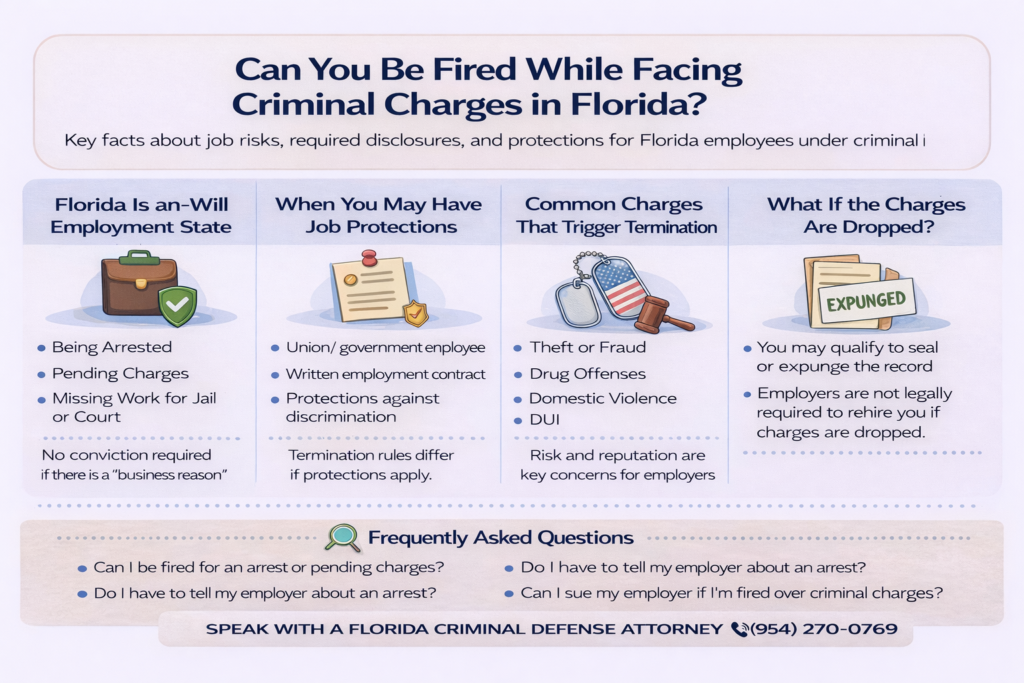
Florida is an at-will employment state, which gives most private employers broad discretion to terminate employees — even while a criminal case is still pending.
Losing a job after an arrest is often just one of several ripple effects that can follow a criminal accusation. To understand the broader impact on employment, licensing, housing, and immigration status, see our full guide on collateral consequences in Florida.
Here’s what that means for you — and what protections may exist.
⚖️ Florida Is an At-Will Employment State
In Florida, most private employment is “at-will.” That means an employer can terminate an employee:
At any time
For almost any reason
Without advance notice
Without waiting for a criminal conviction
An employer does not have to prove you committed a crime. They only need a legitimate business reason — such as reputational risk, trust concerns, or workplace disruption.
This means you can be fired for:
Being arrested
Being formally charged
Having an active warrant
Missing work due to jail or court
Allegations involving dishonesty or violence
Even if your case is later dismissed, the termination itself may still be lawful.
🧾 Do You Have to Tell Your Employer About an Arrest?
Not always — but sometimes yes.
Disclosure obligations depend on:
Your profession
Your employment contract
Your company handbook
Licensing requirements
You are more likely required to report an arrest if you work in:
Law enforcement
Education or childcare
Healthcare
Financial services
Government or civil service
Regulated or licensed professions
Failing to disclose when required could create additional workplace issues beyond the criminal charge itself.
If you’re unsure whether you must report an arrest, review your employment documents carefully and speak with an attorney before making statements to your employer.
🛑 When You May Have Job Protections
Not all employees are treated the same.
You may have additional protections if you are:
A public employee with civil service protections
A union member under a collective bargaining agreement
An employee with a written employment contract
Protected under federal laws such as Title VII or the ADA
In these cases, termination may require:
Formal disciplinary procedures
Notice and an opportunity to respond
Proof of policy violations
Grievance or appeal rights
If discrimination or retaliation is involved, there may be grounds for a legal challenge.
However, even with protections, employers may still take action during pending criminal cases.
💼 Common Charges That Trigger Job Loss
Certain allegations are more likely to result in termination, including:
Theft, fraud, or embezzlement
Drug possession or DUI
Assault or domestic violence
Sex offenses
Gun or violent felony charges
Even if the alleged conduct occurred outside of work, employers often make decisions based on perceived liability and public image.
❓ What If the Charges Are Dropped Later?
If your case is dismissed or never formally filed, you may qualify for:
Record sealing
Expungement
However, Florida law does not require your employer to reinstate you simply because charges were dropped.
This is why early defense strategy matters — preventing formal filing or resolving a case quickly may reduce long-term employment fallout.
🔄 Can You Be Charged After Being Released?
Yes.
Being released from custody does not mean the case is over. Prosecutors may:
File formal charges after release
Issue a summons
Seek an arrest warrant later
If you were “let go” by police, it does not guarantee the case is closed.
If you’re unsure about your status, review your paperwork carefully and consult a criminal defense lawyer immediately.
🧑⚖️ How a Criminal Defense Lawyer Can Help Protect Your Career
When your job is on the line, timing is critical.
At Michael White, P.A., we work to minimize professional fallout by:
Intervening early before formal charges are filed
Negotiating pre-filing resolutions
Seeking diversion options when appropriate
Protecting your record through strategic plea decisions
Advising on employer communication
Coordinating with employment counsel when necessary
A strong legal strategy can sometimes prevent the kind of record that triggers termination.
📍 Facing Criminal Charges in Florida?
A pending criminal case doesn’t just affect your freedom — it can affect your income, your license, and your professional future.
If you’ve been arrested or charged in Fort Lauderdale or anywhere in South Florida, contact Michael White, P.A. immediately to protect both your legal rights and your livelihood.
📲 Call (954) 270-0769 to schedule a consultation.
💬 Frequently Asked Questions
Can I be fired for being arrested in Florida?
Yes. Florida is an at-will employment state. Most private employers may terminate employment while charges are pending, even without a conviction.
Do I have to tell my employer if I’m charged with a crime?
It depends on your profession and employment agreement. Regulated or licensed professionals often must disclose arrests.
Can I sue my employer for firing me after an arrest?
Possibly, but only in limited circumstances — such as discrimination, contract violations, or retaliation.
What if my charges are dismissed?
Dismissal may allow you to seal or expunge your record, but employers are not legally required to rehire you.
Can I be charged after being released by police?
Yes. Release does not necessarily mean charges won’t be filed later.