
Last updated April 2026
After a criminal case moves beyond arrest and pretrial stages, the focus shifts to how it will ultimately be resolved.
In Florida, that resolution may include dismissal, diversion, negotiated plea agreements, or formal sentencing.
Understanding these outcomes early—especially sentencing exposure—can significantly affect the strategy of your case.
For a broader overview, see our complete Florida criminal diversion and sentencing guide.
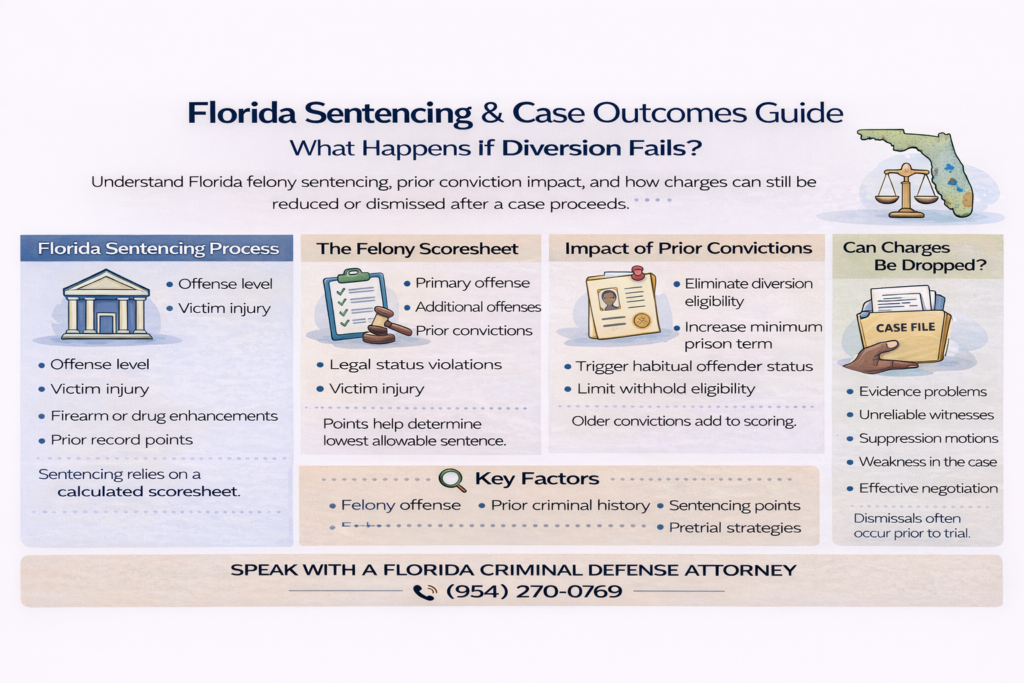
⚖️ How Sentencing Works in Florida
Florida uses the Criminal Punishment Code, which applies primarily to felony offenses.
Sentencing decisions are influenced by:
• Offense level
• Victim injury
• Firearm or drug enhancements
• Prior record points
• Statutory minimums
Felony cases rely on a mathematical scoresheet system to calculate potential prison exposure.
For a detailed breakdown of how sentencing points are calculated, see how the Florida felony sentencing scoresheet is calculated and used.
📊 The Florida Felony Sentencing Scoresheet
The scoresheet assigns numerical values to:
• Primary offense
• Additional offenses
• Prior convictions
• Legal status violations
• Victim injury
The total points determine:
• Whether prison is mandatory
• Whether probation is possible
• The lowest permissible sentence
Small changes in scoring can significantly affect exposure.
🧾 The Impact of Prior Convictions
Prior convictions increase sentencing points and may:
• Eliminate diversion eligibility
• Increase minimum prison exposure
• Trigger habitual offender enhancements
• Limit withhold eligibility
Even older convictions can add substantial points.
Learn how prior convictions affect sentencing and case outcomes in Florida.
🚫 Can Charges Still Be Dropped?
Yes.
Even after formal charges are filed, cases may be dismissed before sentencing when:
• Evidence is insufficient
• Witnesses are unavailable
• Suppression motions succeed
• Prosecutors decline to proceed
• Negotiations result in dismissal
Dismissals are often the result of strategic pretrial positioning — not courtroom theatrics.
For more detail, see when criminal charges can be dropped before trial in Florida
🛑 Plea vs Trial: Strategic Considerations
If diversion is unavailable and dismissal is unlikely, cases may resolve through:
• Negotiated plea agreements
• Reduced charges
• Probationary sentences
• Withhold of adjudication
Every decision should be made with full awareness of sentencing exposure.
In some cases, avoiding sentencing altogether is still possible—especially for defendants who qualify for diversion programs in Florida.
⚖️ Withhold of Adjudication
In some cases, even when a plea is entered, a judge may withhold adjudication instead of entering a formal conviction.
A withhold can:
• Prevent a formal conviction
• Preserve eligibility for certain employment
• Avoid habitual offender enhancements
• Affect future sentencing exposure
Learn how withholds work in our adjudication withheld works in Florida and when it’s available.
🎯 Why Early Sentencing Analysis Matters
Knowing sentencing exposure early allows your attorney to:
• Negotiate from a position of strength
• Identify leverage points
• Assess risk realistically
• Avoid unnecessary plea pressure
• Evaluate trial strategy intelligently
Sentencing analysis is not just about punishment — it shapes strategy.
📞 Speak With a Florida Criminal Defense Attorney
If you are facing felony charges or potential prison exposure, early analysis of sentencing factors can change the trajectory of your case.
Call (954) 270-0769 for a confidential consultation.