
Last updated April 2026
If you’re searching for “larceny” in Florida, the law actually uses a different term — and that difference matters.
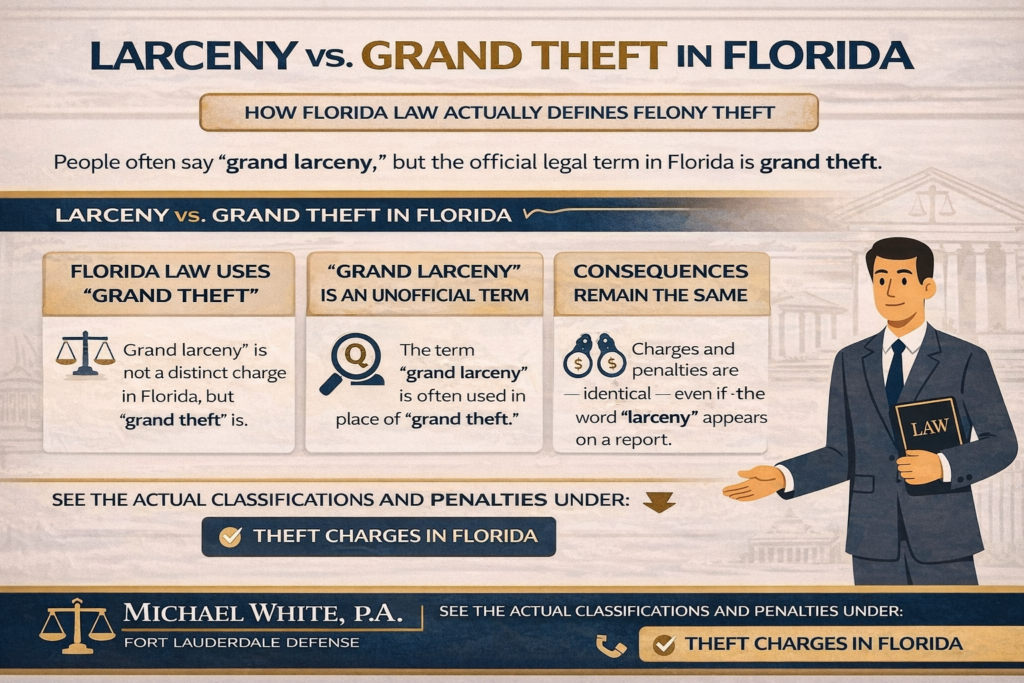
In Florida, the term “grand larceny” is commonly used — but the official legal term is grand theft. While the words are often used interchangeably, Florida statutes classify and punish the offense under grand theft laws. In practice, the terminology used can affect how a case is described in reports, warrants, and early charging decisions.
Still, the terms are often used interchangeably. Whether it’s called grand larceny or grand theft, the consequences are serious — including prison time, felony records, and career damage.
We frequently see confusion about terminology early in cases, especially when clients encounter different terms in police reports or online research.
Here’s what you need to know if you or a loved one is facing grand larceny charges in Florida.
For a broader overview of theft and fraud charges under Florida law, see our guide to theft and fraud crimes in Florida.
⚖️ Is “Grand Larceny” Still a Crime in Florida?
In Florida, “grand larceny” is not a separate criminal charge. The offense is charged as grand theft under Florida law. In South Florida, cases are always prosecuted under theft statutes, even when older terminology like “larceny” is used in reports or conversations.
However, the term “grand larceny” is still commonly used by:
Law enforcement officers
Out-of-state references
Search queries and general conversation
Because of this, many people facing grand theft charges encounter the term “grand larceny” when researching their case.
⚖️ Why “Grand Larceny” Is Called Grand Theft in Florida
Although many people search for “grand larceny,” Florida law actually charges this offense as grand theft under § 812.014.
The term “larceny” is commonly used in other states and in everyday language, but in Florida, the classification and penalties are based on theft statutes.
If you’re trying to understand how these terms relate, see our guide on the difference between theft, larceny, and fraud, or our breakdown of what larceny means in Florida.
📜 Grand Larceny vs. Grand Theft Under Florida Law
Under Florida Statute § 812.014, theft becomes a felony — or “grand” — based on the value or nature of the property taken. To understand how theft offenses are classified under Florida law, see theft charges in Florida.
You can be charged with grand theft (a.k.a. grand larceny) if the item allegedly stolen is worth:
-
🔹 $750 or more (3rd degree felony)
-
🔹 $20,000 or more (2nd degree felony)
-
🔹 $100,000 or more (1st degree felony)
Other factors — like whether the property was taken from a dwelling, was a firearm or vehicle, or involved emergency or law enforcement equipment — can also trigger a felony classification.
Florida law classifies theft offenses based on value and the type of property involved.
👉 For a broader comparison of theft-related offenses, see the difference between theft, larceny, and fraud.
⚖️ What Are the Penalties for Grand Larceny in Florida?
3rd Degree Grand Theft (most common)
-
Up to 5 years in prison
-
Up to $5,000 in fines
-
Felony conviction on your record
2nd and 1st Degree charges carry even more severe consequences — including mandatory minimums in some cases.
Regardless of terminology, felony theft penalties depend on degree and value. For a breakdown of sentencing exposure, see a full breakdown of grand theft felony penalties in Florida.
🧠 Common Defenses Raised in Felony Theft Cases
A skilled criminal defense lawyer can raise defenses such as:
-
🚫 Lack of Intent — No proof you intended to permanently deprive
-
📉 Mistaken Value — Value doesn’t rise to felony level
-
🧾 Ownership Disputes — Property rights unclear
-
🕵️ Lack of Evidence — No video, no witness, no recovery
-
🗣️ Consent — You were allowed to take or use the item
At Michael White, P.A., we move fast to investigate the facts, challenge the evidence, and negotiate with prosecutors to get the charges dropped or reduced. In many cases, early intervention can prevent charges from proceeding or lead to dismissal—see when theft charges can be dropped in Florida.
📞 Charged with Grand Larceny? Call Before It’s Too Late.
The sooner you act, the more options you have. What happens early in a felony theft case often determines whether it is reduced, dismissed, or prosecuted as a serious felony.
❓ Frequently Asked Questions
📄 What is grand larceny in Florida?
Grand larceny is another term for grand theft, a felony offense under Florida law involving the theft of property valued at $750 or more.
📜 Is grand larceny the same as grand theft in Florida?
Yes. Florida law uses the term “grand theft,” but “grand larceny” is often used interchangeably, especially by law enforcement or in other states.
💰 What is the threshold for grand larceny in Florida?
The minimum threshold is $750. Anything below that is typically charged as petit theft (a misdemeanor).
🧑⚖️ What are the penalties for grand larceny?
Grand larceny can result in up to 5 years in prison for a third-degree felony, with higher penalties for second- or first-degree charges.
🛡️ Can grand larceny charges be dropped?
Yes — especially if the evidence is weak, the value of the property is miscalculated, or you qualify for diversion or restitution-based resolution.