
Last updated February 2026
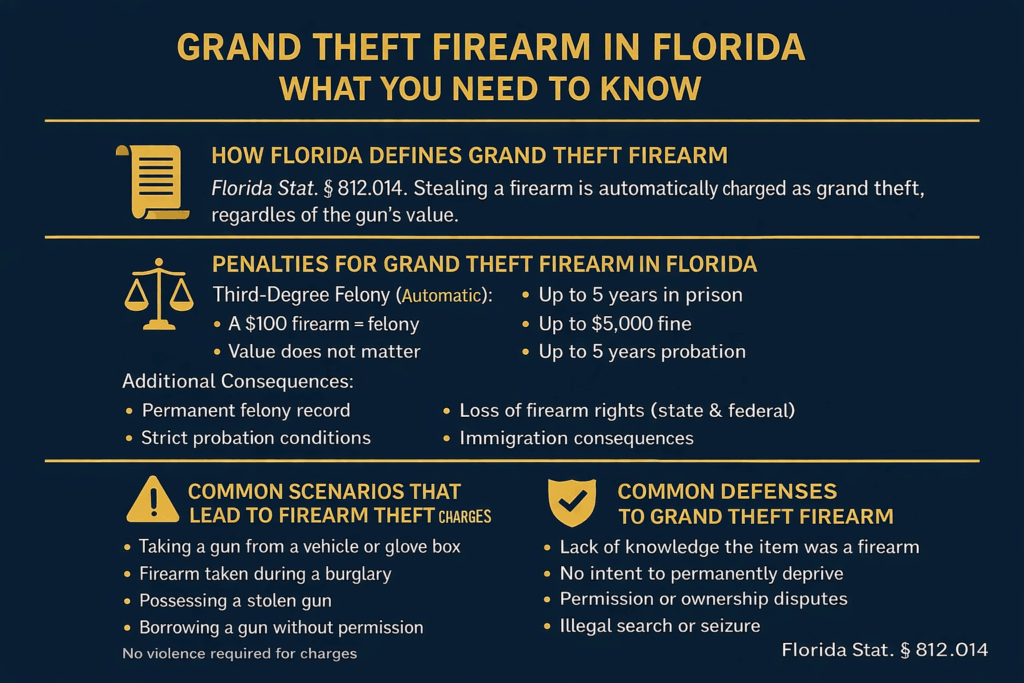
In Florida, stealing a firearm is automatically charged as grand theft — regardless of the gun’s value. Even a low-value handgun can result in a felony conviction, prison exposure, and the permanent loss of firearm rights.
If you’ve been accused of firearm theft in Fort Lauderdale or anywhere in South Florida, understanding how these cases are charged — and how they are defended — is critical.
Grand theft firearm is one of several felony theft classifications under Florida law. For a broader breakdown of felony theft degrees and sentencing exposure, see Grand Theft Felony Penalties in Florida.
📜 How Florida Defines Grand Theft Firearm
Under Fla. Stat. § 812.014(2)(c)5, the theft of a firearm is classified as third-degree grand theft, no matter the weapon’s value.
That means:
A $100 firearm = felony
Prosecutors do not need to prove value
Firearm theft automatically bypasses misdemeanor petit theft
Unlike most theft offenses, value plays no role in determining whether the charge is a felony when a firearm is involved.
⚠️ Why Firearm Value Does Not Matter
Florida law treats firearms differently from other types of property because of public safety concerns. Lawmakers removed value thresholds to prevent stolen guns from circulating — even when the firearm itself is inexpensive or inoperable.
As a result, arguments that would reduce other theft charges to misdemeanors simply do not apply when a firearm is involved.
⚖️ Penalties & Collateral Consequences for Grand Theft Firearm
Although grand theft firearm is technically a third-degree felony, these cases are treated far more seriously than ordinary theft offenses.
Statutory penalties include:
Up to 5 years in prison
Up to $5,000 in fines
Up to 5 years of probation
Additional collateral consequences may include:
Permanent felony criminal record
Loss of firearm rights under state and federal law
Strict probation conditions and firearm prohibitions
Immigration consequences for non-citizens
Use of the conviction to enhance future charges
Because firearm theft is viewed as a public-safety offense, judges and prosecutors rarely treat these cases like routine property crimes.
Grand theft firearm charges may be further enhanced if the allegation involves a probation violation, burglary, or possession by a prohibited person.
🔎 Why Firearm Theft Cases Are Prosecuted Aggressively
Firearm theft cases receive heightened scrutiny because prosecutors view stolen weapons as potential tools for violent crime — even when no violence is alleged.
As a result:
Diversion options are often limited
Prosecutors are less willing to reduce charges
Probation conditions are typically more restrictive
Early legal intervention can make a critical difference, especially before formal charges are filed.
🔫 Knowledge & Possession Issues in Firearm Theft Cases
Many grand theft firearm cases turn on knowledge and possession, not just physical control.
This commonly arises when firearms are discovered:
Inside bags or containers
In vehicles shared by multiple occupants
Among mixed or unrelated property
During unrelated police encounters
The State must prove more than mere proximity. Lack of knowledge, accidental handling, or momentary possession can significantly weaken the prosecution’s case — particularly when there are no fingerprints, admissions, or direct evidence linking the accused to the alleged theft.
🚨 Common Scenarios That Lead to Gun Theft Charges
Firearm theft charges often arise from situations such as:
Taking a gun from a vehicle or glove box
Removing a firearm from a friend or relative’s home
Possessing a gun reported stolen by someone else
Taking a weapon during a burglary or dispute
Buying or receiving a firearm later alleged to be stolen
Even if the firearm was never used, loaded, or displayed, possession alone can lead to arrest and prosecution.
🛡️ Common Defenses to Grand Theft Firearm Charges
A skilled Florida defense attorney may raise defenses such as:
Lack of knowledge that the item was a firearm
No intent to permanently deprive the owner
Permission or ownership disputes
Illegal search or seizure of the weapon
Mistaken identity or lack of forensic evidence
Suppression issues based on Miranda violations or unlawful stops
Firearm theft cases often rise or fall on constitutional issues and proof gaps, not assumptions.
❓ Frequently Asked Questions About Grand Theft Firearm in Florida
Is stealing a gun always a felony in Florida?
Yes. Theft of a firearm is automatically charged as grand theft, regardless of value.
Does the State have to prove how much the gun is worth?
No. Unlike most theft cases, firearm value is irrelevant under Florida law.
Can I be charged if I didn’t know it was a gun?
Possibly — but lack of knowledge is a strong defense in cases involving bags, containers, or mixed items.
What if I unknowingly bought a stolen firearm?
You may still be arrested, but a strong defense can show lack of knowledge and intent.
Will a conviction affect my gun rights?
Yes. A felony conviction for grand theft firearm can permanently strip firearm rights under federal law.
📍 Accused of Grand Theft Firearm in Florida?
Firearm theft charges carry serious, lifelong consequences. These cases are prosecuted aggressively, especially when tied to probation violations or other pending charges.
At Michael White, P.A., we defend firearm theft cases with the insight of a former prosecutor who understands how these charges are built — and how to dismantle them.
📞 Call (954) 270-0769 or request a confidential consultation today.