
Last updated March 2026
In Florida, you can be charged with possession with intent to sell or deliver even if no actual drug sale ever occurred.
Unlike trafficking, which is based on weight alone, possession with intent cases depend on circumstantial evidence. Prosecutors attempt to show that the surrounding facts indicate a plan to distribute drugs — not merely possess them.
For a broader overview of the charge itself, see our guide to Possession With Intent to Sell or Deliver in Florida.
🚨 Do Prosecutors Have to Prove a Sale?
No.
Florida law does not require proof that:
A transaction occurred
Money changed hands
An undercover buy happened
A confidential informant completed a purchase
Instead, the State relies on evidence suggesting intent to distribute.
That intent is usually inferred from the surrounding circumstances.
🔎 Common Evidence Used to Prove Intent
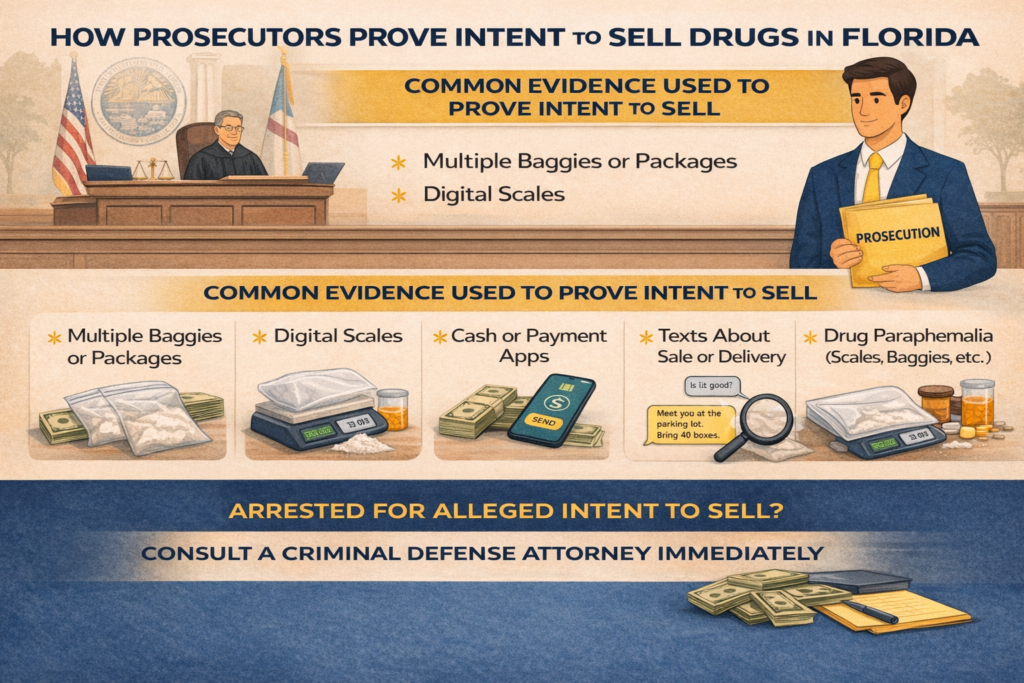
Prosecutors often rely on combinations of the following:
1️⃣ Quantity of Drugs
While trafficking is strictly weight-based, larger quantities in possession cases can suggest intent to sell — especially when the amount exceeds typical personal-use levels.
However, quantity alone does not automatically prove intent.
2️⃣ Multiple Baggies or Packaging Materials
If drugs are divided into:
Small individual baggies
Pre-packaged quantities
Separate containers
Prosecutors may argue that the packaging indicates resale rather than personal consumption.
Defense perspective: Packaging alone does not equal intent.
3️⃣ Digital Scales
The presence of digital scales is frequently cited as evidence of distribution.
But scales can also be used by individuals who:
Purchase in bulk
Monitor dosage
Weigh substances for personal reasons
Context matters.
4️⃣ Cash
Large amounts of cash — especially in small denominations — may be presented as evidence of sales activity.
However:
Cash is not illegal
There is no set “amount” that proves intent
The State must link the cash to drug activity
5️⃣ Text Messages or Phone Data
Digital evidence is increasingly common.
Prosecutors may use:
Text messages referencing quantities
Payment app transfers
Contact names suggesting sales
Photos of drugs
But context, timing, and interpretation are critical.
Messages must clearly show intent to sell — not speculation.
6️⃣ Confidential Informants or Surveillance
In some cases, law enforcement relies on:
Controlled buys
Recorded calls
Observed short-term traffic
Informant statements
These cases often turn on credibility and reliability of witnesses.
⚖️ The Legal Standard
To convict someone of possession with intent to sell, the State must prove:
You knowingly possessed the controlled substance
You intended to sell, manufacture, or deliver it
Intent can be inferred — but it must be supported by competent evidence.
Mere suspicion is not enough.
🔥 Trafficking vs. Possession With Intent
Intent-based charges differ significantly from trafficking:
Trafficking → Based on weight thresholds
Possession with Intent → Based on circumstantial evidence of distribution
In some cases, if weight falls below trafficking levels, prosecutors pursue possession with intent instead.
The defense strategy changes accordingly.
🛡 Common Defenses in Intent Cases
Intent cases are highly fact-driven. Common defense strategies include:
1️⃣ Challenging the Search
If drugs were found during:
An invalid search warrant
An illegal prolonged detention
The evidence may be suppressed.
2️⃣ Innocent Explanations for Circumstantial Evidence
Cash from employment
Packaging for storage
Scales for lawful use
Ambiguous text messages
Circumstantial evidence can have multiple interpretations.
3️⃣ Lack of Quantity Evidence
Small amounts may support simple possession — not intent.
4️⃣ Constructive Possession Challenges
If drugs were found in a shared location, prosecutors must prove:
Knowledge
Control
Intent
That is often difficult in multi-occupant settings.
⚠️ Penalties for Possession With Intent
Possession with intent is typically charged as:
A second-degree or third-degree felony
Punishable by prison or probation
Carrying heavy fines
Resulting in a permanent felony record
Unlike trafficking, there may not be mandatory minimum prison — but sentencing exposure is still serious.
📱 Digital Evidence Is Becoming Central
Modern intent cases increasingly revolve around:
Cell phone extractions
Social media messages
Encrypted messaging apps
Payment applications
Search warrant validity and scope often become major issues.
🏛 Can Intent Charges Be Reduced?
In some cases, yes.
Possible outcomes may include:
Reduction to simple possession
Suppression of digital evidence
Diversion eligibility
Negotiated plea resolutions
Early case analysis is critical.
📍 Intent-to-Sell Defense in Fort Lauderdale & South Florida
If you are charged with possession with intent in:
Fort Lauderdale
Broward County
Miami-Dade
Palm Beach County
Your defense should focus on:
Evidence analysis
Context of packaging or cash
Digital forensic review
Search legality
Sentencing exposure
These cases are rarely as simple as the police report suggests.
🛡 Protect Your Future
Possession with intent charges often rely on interpretation rather than direct proof of a sale. Challenging the State’s narrative early can significantly affect the outcome.
If you are facing intent-to-sell allegations in Florida, consult a criminal defense attorney immediately to protect your rights and your future.