
Last updated February 2026
A domestic violence arrest in Florida does not mean a conviction. Under Florida domestic violence law, these cases are governed by strict statutes and procedures that create real opportunities to fight back when handled correctly.
This page focuses specifically on defense strategy — not the full scope of domestic violence charges, penalties, or court process. For a complete overview of domestic violence law in Florida, see our Domestic Violence Defense guide.
Although Florida’s domestic violence laws are tough, they are also highly procedural, evidence-dependent, and full of opportunities for strategic defense.
Many domestic violence cases are dismissed, reduced, or resolved without a conviction when handled correctly. The key is how early and how strategically the defense is approached.
Whether the charge is a misdemeanor or a felony, you are not guilty simply because you were arrested. With the right legal strategy, domestic violence charges in Florida can often be beaten.
⚖️ How Prosecutorial Decision-Making Creates Defense Opportunities
Florida prosecutes domestic violence cases aggressively, but not always carefully.
Law enforcement operates under a preferred arrest culture, meaning officers are encouraged to make arrests even when evidence is limited or conflicting. Prosecutors then review cases after the fact, often relying on assumptions rather than proof.
Many domestic violence cases are built primarily on:
911 calls made during emotional moments
Photographs without medical context
Officer observations rather than firsthand evidence
Statements taken before legal counsel is involved
This creates significant weaknesses — especially when the defense acts early.
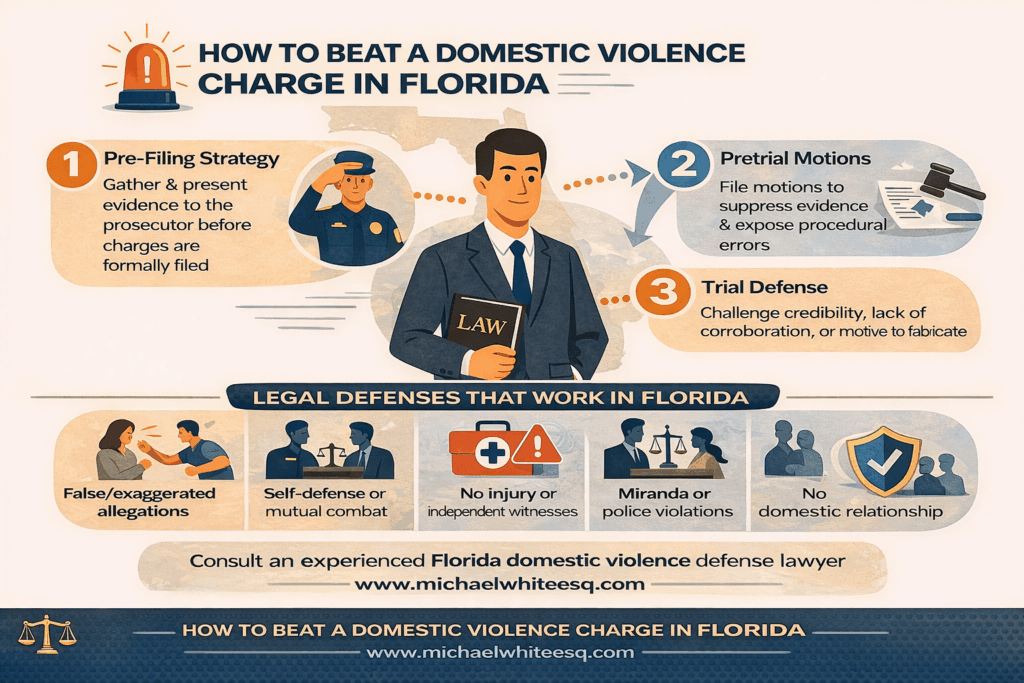
🧠 The Three Stages Where Domestic Violence Charges Are Beaten
Domestic violence cases are most successfully beaten at specific stages. Understanding these stages is critical.
1️⃣ Pre-Filing (Best Outcomes)
The strongest results occur before charges are formally filed.
At this stage, a defense attorney can:
Present exculpatory evidence to prosecutors
Highlight witness inconsistencies or lack of injuries
Address recantations or credibility issues
Argue legal deficiencies before the case gains momentum
Many cases are rejected or never filed when prosecutors see the full picture early.
2️⃣ Pretrial Litigation
If charges are filed, the next opportunity is pretrial litigation.
Defense attorneys may file motions to:
Suppress illegally obtained statements
Exclude evidence gathered after unlawful entry
Challenge Miranda violations
Expose inconsistencies between body-worn cameras, reports, and witness statements
Strong pretrial motions often force dismissals or favorable plea negotiations.
3️⃣ Trial (Least Common, Still Winnable)
While most domestic violence cases never reach trial, some do. When they do, the State often struggles with:
Witness credibility
Motive to fabricate
Lack of corroborating evidence
Emotional bias replacing proof
Well-prepared defenses frequently result in acquittals when prosecutors cannot meet their burden.
🛡️ Legal Defenses That Actually Work in Florida Domestic Violence Cases
Domestic violence defenses are fact-specific, but the following strategies regularly lead to dismissals or reductions:
False or Exaggerated Allegations
Domestic violence accusations often arise during breakups, divorces, or custody disputes. Evidence of motive, timing, or prior threats to call police can undermine the State’s case.
Self-Defense or Mutual Combat
Florida law permits reasonable force in self-defense. When both parties have injuries or conflicting stories, self-defense becomes a powerful defense.
Lack of Injury or Corroboration
The State must prove actual harm or a credible threat. Cases based solely on accusations without medical evidence or independent witnesses are vulnerable.
Recanting or Uncooperative Accuser
While prosecutors claim the alleged victim “doesn’t control the case,” lack of cooperation often weakens the prosecution significantly.
Miranda and Custodial Statement Violations
Statements taken without proper warnings or after a suspect invoked their rights may be suppressed.
Illegal Entry or Exigent Circumstances Abuse
Police frequently rely on claimed “emergencies” to enter homes. If exigent circumstances are not legally justified, resulting evidence can be excluded.
No Qualifying Domestic Relationship
If the parties do not meet Florida’s statutory definition of a domestic relationship, the charge itself may be improper.
🔍 Why the Alleged Victim’s Wishes Still Matter — Even When Prosecutors Say They Don’t
Prosecutors often state that alleged victims have no control over domestic violence cases. Legally, that’s true — but practically, cooperation still matters.
Victim cooperation affects:
Trial viability
Subpoena enforcement
Credibility before a jury
Prosecutorial discretion
Effective defense strategies account for this reality without relying solely on it.
🚫 No-Contact Orders: How They Are Used — and How They Are Undone
No-contact orders are imposed automatically in most Florida domestic violence cases, often before a judge hears both sides.
These orders:
Remove defendants from their homes
Prevent contact with children or partners
Create pressure that favors quick pleas
Defense attorneys can seek modifications when:
Both parties consent
Counseling or safeguards are in place
Continued restrictions are unnecessary
Successful modification often improves the criminal case outcome as well.
🏆 What “Winning” Really Looks Like in a Florida Domestic Violence Case
Winning does not always mean trial.
Successful outcomes may include:
Pre-filing rejection of charges
Diversion or counseling programs
Reduction to non-domestic offenses
Withhold of adjudication to preserve sealing eligibility
Complete dismissal
Avoiding a conviction protects firearm rights, employment opportunities, and long-term reputation.
⚠️ Common Mistakes That Make Domestic Violence Cases Harder to Beat
Many cases become harder to defend because of avoidable mistakes, including:
Talking to police “to explain”
Contacting the accuser
Posting on social media
Making recorded jail calls
Violating no-contact orders
Early legal guidance prevents these errors and preserves defenses.
🕰️ Why Early Legal Strategy Changes Everything
Timing matters in domestic violence cases.
Early intervention allows defense counsel to:
Preserve evidence
Control the narrative
Influence prosecutorial discretion
Prevent irreversible damage
Former prosecutors understand how cases are evaluated internally — and how to disrupt weak cases before they solidify.
❓ Frequently Asked Questions
🧑⚖️ Can domestic violence charges be dismissed in Florida?
Yes — especially when there’s weak evidence or constitutional issues. Many cases are dropped pre-filing or resolved through diversion.
🧠 Do I have to go to trial to beat a domestic violence charge?
Not always. Strong pretrial motions, negotiations, or procedural issues often lead to dismissals or reductions without a trial.
⚖️ What if the alleged victim lied?
We investigate inconsistencies, past incidents, and motivations to challenge the credibility of the accusation.
🚓 Will I still have a criminal record if charges are dropped?
If charges are dismissed, you may be eligible to seal your record. A withhold of adjudication also preserves sealing in many cases.
📄 How long does a domestic violence case take in Florida?
Anywhere from a few weeks to several months, depending on whether charges are filed, motions are litigated, or trial is pursued.
Need a South Florida Domestic Violence Lawyer?
Domestic violence charges do not have to define your future. If your case is pending in South Florida, speaking with a Fort Lauderdale domestic violence defense lawyer early can significantly improve your chances of dismissal or reduction.
📞 Contact Michael White, P.A. to discuss how domestic violence charges are beaten in Florida and what steps matter most right now.