
Last updated March 2026
Charged With Hydrocodone Possession in Florida?
Hydrocodone is one of the most widely prescribed opioid medications in the United States. It is commonly used to treat moderate to severe pain, but under Florida law it is also classified as a controlled substance. Possessing hydrocodone without a valid prescription can lead to felony criminal charges, possible jail time, and a permanent criminal record.
Many hydrocodone arrests occur during traffic stops, vehicle searches, or investigations involving pill bottles and loose tablets. Even when the medication originally belonged to someone else in a household, police may still make an arrest if they believe the pills were possessed unlawfully.
If you are facing allegations involving hydrocodone or other prescription medications, understanding how these cases are prosecuted is critical. For a broader overview of how these offenses work, see our guide to Prescription Drug & Controlled Substance Charges in Florida.
Why Hydrocodone Is a Controlled Substance
Hydrocodone is an opioid pain medication found in a number of commonly prescribed drugs. Because of its potential for misuse and dependency, under Florida Statute § 893.03.
Common medications that contain hydrocodone include:
-
Vicodin
-
Norco
-
Lortab
-
Zohydro
Although these medications are legally dispensed by pharmacies, possession becomes illegal when the medication is not prescribed to the person who possesses it.
Hydrocodone is a powerful opioid pain medication classified as a Schedule II controlled substance under Florida law because of its potential for abuse and dependency. Similar felony charges often arise in cases involving oxycodone, another opioid medication that is heavily regulated under Florida’s controlled substance laws. Learn more about how these cases are prosecuted in our guide to Possession of Oxycodone Without a Prescription in Florida.
Combination medications containing oxycodone—such as Percocet—can also lead to felony possession charges when possessed without a valid prescription. See our explanation of Possession of Percocet Without a Prescription in Florida.
When Hydrocodone Possession Becomes a Crime
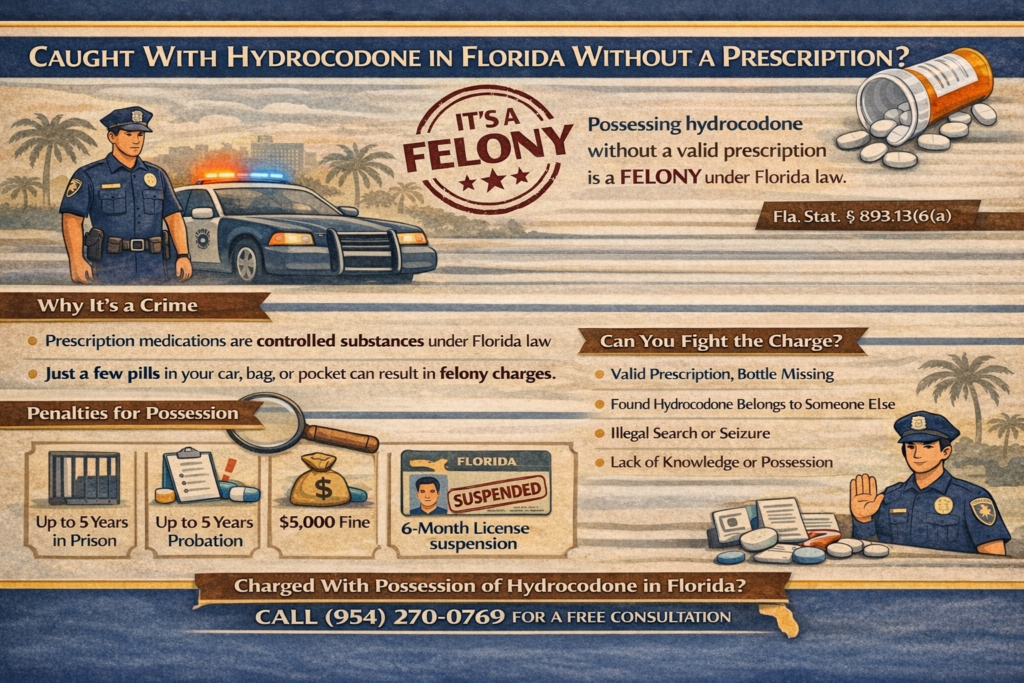
Possessing hydrocodone without a valid prescription is usually charged as possession of a controlled substance, which is a third-degree felony in Florida.
Situations that frequently lead to arrest include:
pills discovered during a traffic stop
medication carried outside the original prescription bottle
pills belonging to another person’s prescription
tablets found in a shared vehicle, purse, or residence
allegations that pills were unlawfully obtained
Even a small number of hydrocodone tablets can lead to felony charges if prosecutors believe the medication was possessed illegally.
Penalties for Hydrocodone Possession in Florida
Simple possession of hydrocodone without a prescription is typically charged as a third-degree felony.
Possible penalties include:
Up to 5 years in prison
Up to 5 years of probation
Up to a $5,000 fine
Possible driver’s license suspension
A permanent felony criminal record
These penalties can have lasting consequences for employment opportunities, housing applications, and professional licensing.
However, many prescription drug cases involve legal and evidentiary issues that may weaken the prosecution’s case.
How Prosecutors Try to Prove Hydrocodone Possession
To obtain a conviction, prosecutors must prove several elements beyond a reasonable doubt.
The State must establish that the accused:
knew the pills were present
exercised control over them
did not have a valid prescription
When pills are not found directly on a person, prosecutors often rely on constructive possession, arguing that the defendant knew about the medication and controlled it.
Constructive possession cases frequently become vulnerable when multiple people had access to the location where the pills were found.
Common Defenses to Hydrocodone Possession Charges
Prescription drug cases often turn on small factual and legal details. When these cases are examined closely, several defenses may arise.
Valid Prescription
In some situations, the medication was legally prescribed but documentation was not available during the police encounter. Pharmacy records and prescription histories may help confirm lawful possession.
Lack of Knowledge
Prosecutors must prove the accused knew the pills were present and understood their nature. When medication is discovered in a shared space, proving knowledge can be difficult.
Illegal Search or Traffic Stop
Many hydrocodone arrests arise from vehicle searches. If police lacked probable cause, valid consent, or a lawful warrant, the evidence may be suppressed.
Constructive Possession Issues
When pills are found in a location accessible to multiple people, prosecutors must prove the accused had exclusive knowledge and control of the drugs. This requirement often becomes the weakest part of the prosecution’s case.
Hydrocodone Possession vs. Trafficking
The quantity of hydrocodone involved can dramatically affect the charge.
Larger quantities of controlled substances may lead prosecutors to file drug trafficking charges, which carry mandatory minimum prison sentences. Smaller quantities are typically charged as simple possession.
Understanding this distinction is critical because trafficking charges carry far more severe penalties.
Possible Outcomes in Prescription Drug Cases
Not every hydrocodone arrest results in a conviction. Depending on the facts of the case, possible outcomes may include:
dismissal of charges
reduction to a lesser offense
entry into pretrial diversion programs
a withhold of adjudication that avoids a formal conviction
Early legal intervention often plays a major role in determining how a prescription drug case resolves.
Arrested for Hydrocodone Possession in South Florida?
Prescription drug cases often appear straightforward at first glance, but many involve search issues, constructive possession problems, or weak evidence that can be challenged.
At Michael White, P.A., we defend clients facing prescription drug and controlled substance charges throughout Fort Lauderdale, Broward County, and South Florida.
If you have been arrested for hydrocodone possession or another prescription drug offense, early legal guidance can make a critical difference.
Call (954) 270-0769 or schedule a free consultation today.
Frequently Asked Questions
Is hydrocodone possession a felony in Florida?
Yes. Possessing hydrocodone without a valid prescription is typically charged as possession of a controlled substance, a third-degree felony under Florida law.
Can you be arrested for carrying someone else’s hydrocodone prescription?
Yes. Possessing medication prescribed to another person can lead to criminal charges if prosecutors believe the pills were possessed unlawfully.
Do prescription pills have to stay in the original bottle?
Florida law does not specifically require prescription medication to remain in its original container, but carrying loose pills often leads to suspicion during police encounters.
Can hydrocodone possession charges be dismissed?
Yes. Cases involving illegal searches, lack of proof of knowledge, or constructive possession issues are often challenged and may result in dismissal or reduction of the charges.