
Last updated March 2026
Drug charges in Florida often rise or fall based on one critical question: how the evidence was obtained.
If police find drugs during a search that violates the Fourth Amendment, the evidence may be suppressed. When that happens, prosecutors often cannot proceed with the case.
In many situations, that means drug charges can be dismissed because of an illegal search.
Illegal search issues are one of the most powerful legal tools available in drug cases. For a broader overview of these legal defenses, see our post on Drug Defense Strategies in Florida.
The Fourth Amendment and Drug Searches
The Fourth Amendment to the United States Constitution protects people from unreasonable searches and seizures. In most situations, police must have either:
A search warrant, or
A legally recognized exception to the warrant requirement
before searching a person, vehicle, home, or personal property.
If officers conduct a search without a warrant and without a valid legal exception, the search may be unconstitutional.
When that happens, the evidence discovered during the search — including drugs — may be excluded from court.
The Exclusionary Rule in Florida Drug Cases
The legal doctrine that prevents illegally obtained evidence from being used in court is called the exclusionary rule.
Under this rule, evidence obtained through a constitutional violation generally cannot be introduced at trial.
In drug cases, this can be case-ending.
For example, if police illegally search a vehicle and find cocaine in the glove box, the court may suppress the cocaine as evidence. Without that evidence, the State may have no proof that a crime occurred.
When suppression removes the key evidence, prosecutors often drop the charges entirely.
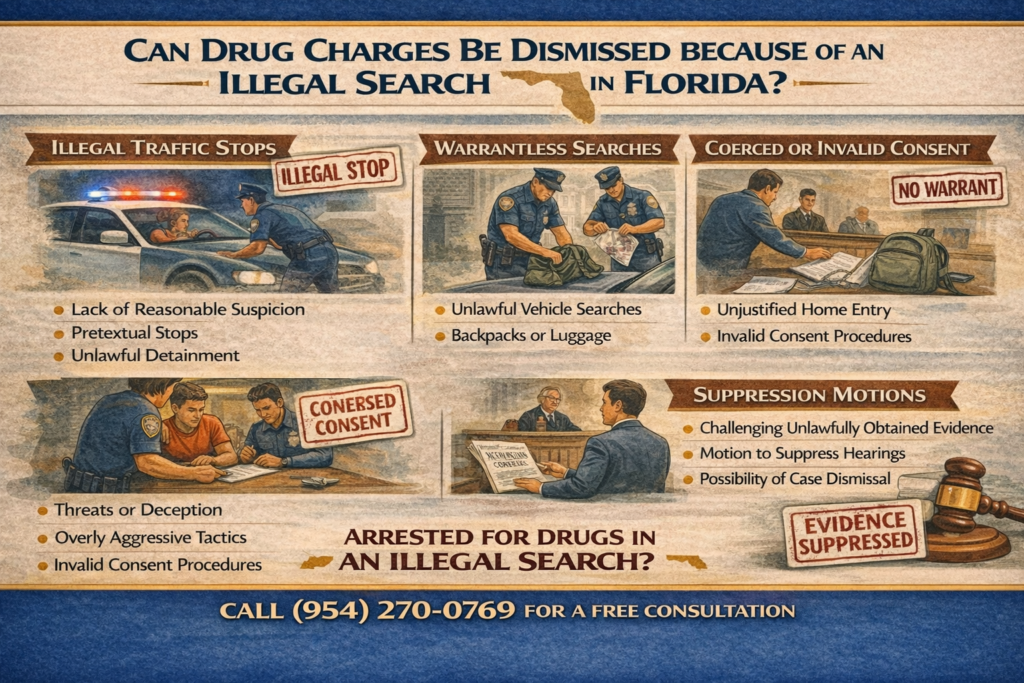
Common Illegal Search Issues in Florida Drug Cases
Illegal search issues appear in many types of drug investigations. Some of the most common include:
Illegal Vehicle Searches
Traffic stops are one of the most common ways drug arrests occur.
Police may stop a vehicle for a traffic violation, but they cannot automatically search the car without legal justification.
Vehicle searches may be illegal when:
Officers prolong the stop without reasonable suspicion
A K-9 search occurs after the lawful duration of the stop
Officers search containers without probable cause
The search occurs before probable cause exists
If drugs are discovered during an unlawful vehicle search, the evidence may be suppressed.
Unlawful Searches of Backpacks or Bags
Police frequently search backpacks, purses, or other containers during drug investigations.
However, personal containers often receive strong Fourth Amendment protection.
If officers open a bag without:
Consent
Probable cause
A warrant
A valid search-incident-to-arrest justification
the search may be unconstitutional.
Searches Based on Invalid Consent
Officers often ask suspects for permission to search.
But consent must be voluntary and knowing. Courts examine several factors when deciding whether consent was valid, including:
Whether the person felt free to refuse
Whether officers used intimidation or coercion
Whether multiple officers were present
Whether the individual was detained or restrained
If consent was not truly voluntary, the search may be invalid.
Warrantless Home Searches
Homes receive the highest level of Fourth Amendment protection.
Police generally must obtain a warrant before entering a residence.
Exceptions exist — such as emergencies or valid consent — but when officers enter a home without a warrant or valid exception, any evidence discovered inside may be suppressed.
This can include drugs found in:
Bedrooms
Closets
Kitchen cabinets
Safes or containers
What Happens After Evidence Is Suppressed?
When a defense attorney identifies an illegal search, they typically file a Motion to Suppress Evidence.
This motion asks the court to exclude the illegally obtained evidence from the case.
If the judge grants the motion:
The drug evidence cannot be used at trial
The prosecution may lose the ability to prove possession
Charges may be dismissed or reduced
Many drug cases in Florida are resolved after suppression hearings, not trials.
Illegal Searches Are Often Fact-Specific
Not every questionable search automatically results in dismissal.
Courts examine issues such as:
The timeline of the encounter
Officer testimony and body camera footage
Dispatch records
The location of the search
Whether probable cause existed at the time
Small details — such as how long a traffic stop lasted or when a K-9 unit arrived — can determine whether a search was lawful.
That is why careful investigation and case analysis are critical.
Fighting Drug Charges in South Florida
Drug arrests frequently occur during traffic stops, street encounters, or home investigations. In many cases, the legality of the search becomes the central issue in the defense.
If law enforcement violated the Fourth Amendment, the evidence may not be allowed in court — and the case against you may collapse.
If you are facing charges, it is important to review the circumstances of the search with an experienced defense attorney.
Attorney Michael White, a former prosecutor, represents clients charged with drug offenses throughout Fort Lauderdale, Broward County, Miami-Dade, and Palm Beach County.
Early investigation can identify constitutional issues that may lead to suppression of evidence or dismissal of charges.
☎ Free Consultation: (954) 270-0769
FAQs
Can drug charges really be dismissed because of an illegal search in Florida?
Yes. If drugs are discovered during a search that violates the Fourth Amendment, the court may suppress the evidence. Without that evidence, prosecutors may not be able to prove the case, which can lead to dismissal.
What is a motion to suppress in a drug case?
A motion to suppress is a legal request asking the court to exclude evidence obtained through an illegal search or seizure. If the motion is granted, the suppressed evidence cannot be used at trial.
Do police always need a warrant to search for drugs?
No. Police may search without a warrant if an exception applies, such as consent, probable cause involving a vehicle, or a search incident to arrest. If no valid exception exists, the search may be illegal.
Can drugs found during a traffic stop be thrown out?
Yes. If officers unlawfully extend a traffic stop, conduct an improper vehicle search, or violate Fourth Amendment rules, any drugs discovered during that search may be suppressed.