
Last updated February 2026
Many people assume that a gun crime requires a shot to be fired.
Under Florida law, that’s not true.
Simply pointing a firearm at another person can be charged as aggravated assault, even if the gun is never fired and no one is injured. These cases often arise from fast-moving arguments, road rage incidents, or domestic disputes—and they carry serious felony consequences.
Below is how Florida law treats these cases, when an arrest is likely, and how these charges are defended.
⚖️ What Florida Law Says About Pointing a Gun
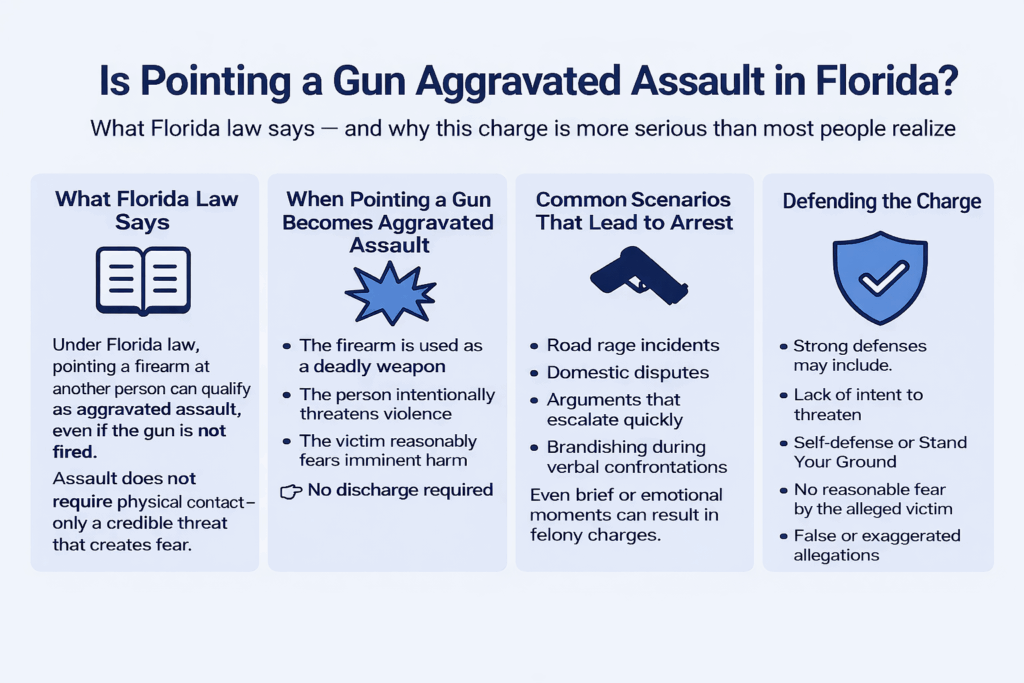
Florida defines assault as an intentional, unlawful threat—by word or act—that creates a well-founded fear of imminent violence. No physical contact is required.
When a deadly weapon is involved, that assault may be elevated to aggravated assault.
A firearm is automatically considered a deadly weapon under Florida law. As a result, pointing a gun at someone may satisfy the elements of aggravated assault if the surrounding facts support it.
Importantly, the law focuses on threat and fear, not injury.
Because a firearm is considered a deadly weapon, these cases are typically prosecuted as aggravated assault under Florida law.
For a full breakdown of felony assault charges — including penalties, firearm enhancements, and defense strategies — see aggravated assault charges in Florida
🚨 When Pointing a Gun Becomes Aggravated Assault
Pointing a firearm may be charged as aggravated assault when prosecutors believe they can prove:
The firearm was used or displayed as a deadly weapon
The accused intentionally threatened violence
The alleged victim reasonably feared imminent harm
There is no requirement that:
The gun be fired
The gun be loaded
Anyone be physically harmed
If police believe the act created an immediate threat, an arrest often follows.
🚔 Common Scenarios That Lead to Arrest
Aggravated assault with a firearm charges frequently arise from situations such as:
Road rage incidents involving brandishing or pointing a gun
Domestic arguments where a firearm is displayed
Verbal disputes that escalate quickly
Confrontations outside bars, homes, or vehicles
In many cases, the firearm is pointed only briefly—but that moment can still lead to a felony arrest.
🛡️ How These Charges Are Defended
Every aggravated assault case is fact-specific. Common defense strategies may include:
Lack of intent to threaten or intimidate
Self-defense or Stand Your Ground protections — in some cases, pointing a firearm may be legally justified if it was done to prevent imminent harm. Learn how immunity works under Florida law in Self-Defense and Stand Your Ground in Florida.
The alleged victim did not reasonably fear imminent harm
False, exaggerated, or inconsistent allegations
Video, witness, or physical evidence contradicting the accusation
Early legal intervention is critical, especially when firearms are involved. These cases often hinge on credibility, context, and how the encounter is framed by law enforcement.
📌 Why This Charge Is So Serious
Aggravated assault with a firearm is a felony offense in Florida. A conviction can carry:
Prison exposure
A permanent felony record
Loss of firearm rights
Immigration consequences
Long-term employment barriers
Even cases that seem minor at first can escalate quickly once a gun is alleged to be involved.
❓ Frequently Asked Questions
Is pointing a gun always aggravated assault in Florida?
No. Prosecutors must still prove intent and reasonable fear. However, pointing a firearm often provides the basis for an aggravated assault charge.
Does the gun have to be loaded?
No. The gun does not need to be loaded for aggravated assault charges to apply.
What if I never pulled the trigger?
Discharging the firearm is not required. The threat and fear created by pointing the gun may be enough.
Can this charge be dropped or reduced?
Yes. Depending on the evidence, charges may be reduced, dismissed, or resolved through negotiation or pretrial motions.
Is this different from brandishing a firearm?
Brandishing is not a standalone Florida charge, but similar conduct is often charged as aggravated assault when a firearm is involved.