
Last updated February 2026
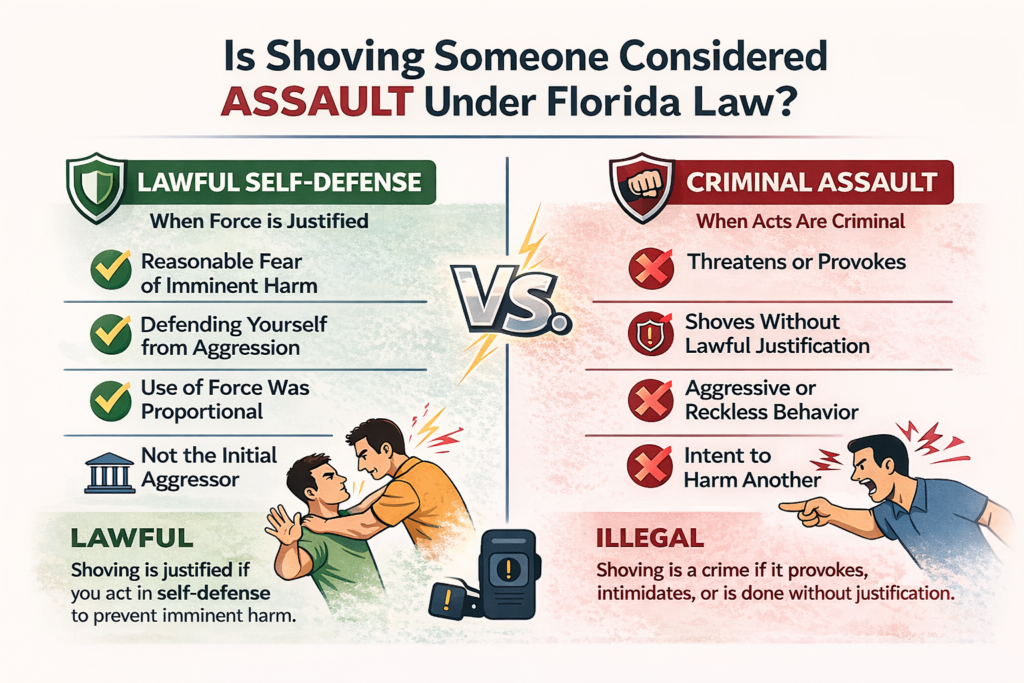
Shoving someone during an argument might seem minor—but in Florida, it could land you in jail.
Even a small push may be considered assault or battery, depending on the circumstances.
Here’s what you need to know if you’re facing charges after a physical altercation—even if no one was seriously hurt.
⚖️ What the Law Says: Assault vs. Battery in Florida
Under Florida law, the difference between assault and battery is important:
Assault = threat of harm (words + actions) that creates fear
Battery = actual physical contact—even if minor
Shoving someone during an argument may seem minor, but under Florida law it can still lead to criminal cahrge.
So if you shove someone, you’re likely to be charged with battery, not assault.
✅ A shove is enough—even if the person wasn’t injured.
If your case involves a threat without physical contact, you may be facing an assault charge instead—learn more about Florida assault charges and how they’re defended.
🚓 Can You Be Arrested for Just a Push?
Yes. Florida police officers are trained to treat unwanted physical contact as potential battery—even if it didn’t result in injury.
You can be arrested if:
The other person claims they were shoved or touched aggressively
There’s video or witness evidence
You admit to making contact, even “lightly”
The officer sees any physical reaction, no matter how minor
📸 What Evidence Do Prosecutors Use?
To pursue a battery conviction, the State typically relies on:
Victim and witness statements
Surveillance or cellphone footage
911 call audio
Bodycam video
Defendant’s own admission
If any of that supports the claim that you intentionally touched someone against their will, you may face charges.
🧠 Defenses to a Simple Battery Charge
At Michael White, P.A., we’ve helped many clients accused of minor physical confrontations avoid serious consequences.
Because shoving usually leads to a battery charge, it’s important to understand Florida battery laws, potential penalties, and available defenses.
We may argue:
Self-defense – you acted to protect yourself
Mutual combat – both parties were equally engaged
Lack of intent – accidental contact, not criminal
False accusation – no contact happened, or the facts were exaggerated
❌ Penalties for Battery in Florida
Simple battery is a first-degree misdemeanor, punishable by:
Up to 1 year in jail
Up to 1 year of probation
Up to $1,000 in fines
Penalties increase if:
You have a prior battery conviction
The alleged victim was a protected person (e.g., elderly, law enforcement)
It occurred in a domestic context
👨⚖️ Fort Lauderdale Violent Crime Defense Lawyer
Even minor physical altercations can spiral into criminal charges in Florida.
At Michael White, P.A., we act fast to challenge weak accusations, uncover inconsistencies, and pursue dismissal or diversion.
🔍 More Answers About Florida Battery Laws and Physical Contact
❓ Is pushing someone considered battery in Florida?
Yes. Any unwanted physical contact, even a shove, can lead to a misdemeanor battery charge.
❓ What if no one was hurt?
Injury is not required. The act of touching someone against their will is enough for a charge.
❓ Can I be arrested based only on a claim?
Yes. Florida law allows arrests based on a victim’s statement if officers find it credible.
❓ Can a shove ever be justified?
Possibly. Self-defense or mutual combat are recognized defenses if supported by facts.
❓ Can a battery charge be expunged?
Only if the charge is dropped, dismissed, or you complete a diversion program. A conviction usually cannot be sealed or expunged.