
Last updated March 2026
When a child is arrested in Florida, one of the most important questions a family can face is whether the case will remain in juvenile court — or move to adult criminal court.
For a broader overview of how juvenile cases begin, detention decisions are made, and diversion works in Broward County, see our complete guide to Juvenile Crimes in Fort Lauderdale.
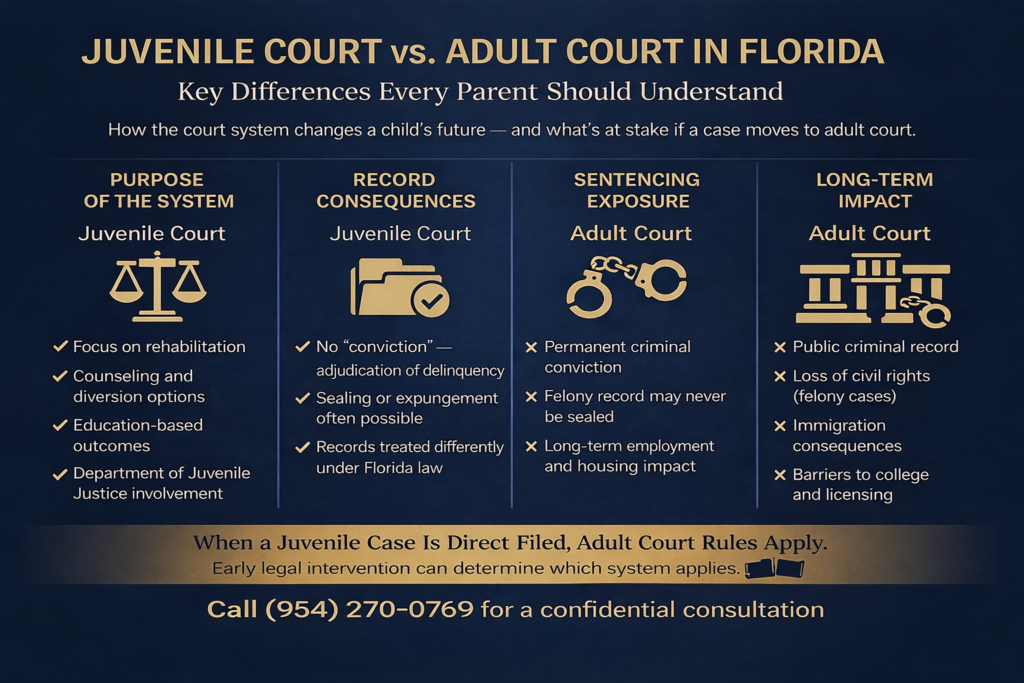
The difference between juvenile court and adult court is dramatic. It affects sentencing exposure, criminal records, long-term rights, and future opportunities. Understanding those differences early can determine whether a child receives rehabilitation — or a permanent felony conviction.
⚖️ Purpose of the Court System
Juvenile Court: Rehabilitation-Focused
Florida’s juvenile justice system is designed around rehabilitation rather than punishment. The system emphasizes:
Counseling and treatment
Community-based supervision
Education and behavioral programs
Department of Juvenile Justice (DJJ) recommendations
Juveniles are not technically “convicted.” Instead, they may be adjudicated delinquent.
The goal is to correct behavior while protecting long-term opportunities.
Adult Court: Punishment-Focused
Adult criminal court operates under a very different philosophy:
Sentencing guidelines
Mandatory minimums in certain cases
Jail or state prison exposure
Permanent convictions
Once a case enters adult court, rehabilitation becomes secondary to punishment.
📄 Criminal Record Consequences
In Juvenile Court
No formal criminal conviction label
Greater privacy protections
Many cases eligible for sealing or expungement
Records treated differently under Florida law
Even so, juvenile records are not automatically erased. Strategic handling is critical to preserve eligibility for record clearing. Learn more about protecting records in our guide to Juvenile Record Expungement in Florida.
In Adult Court
Permanent criminal conviction
Felony record may never be sealed
Public record accessible in background checks
Long-term barriers to employment and housing
An adult conviction can follow a child for life.
⛓ Sentencing Exposure
Juvenile Court Penalties May Include:
Diversion programs
Probation with counseling requirements
Community service
DJJ residential commitment
While detention is possible, the system is structured to avoid long-term incarceration when appropriate.
Adult Court Penalties May Include:
Adult probation
County jail
State prison
Mandatory minimum sentences
Habitual offender enhancements
In adult court, sentencing exposure increases significantly — and the consequences escalate quickly.
🚨 How Cases Move from Juvenile Court to Adult Court
In Florida, prosecutors can transfer certain juvenile cases into adult court through a process known as direct file.
Direct file allows the State to bypass juvenile court entirely and prosecute a minor as an adult.
Once a case is direct filed, it is extremely difficult to reverse.
Preventing adult prosecution is often one of the most critical goals of early juvenile defense.
🔒 Long-Term Impact Differences
Juvenile Court Outcomes
Greater opportunity for second chances
Higher likelihood of diversion
Better odds of preserving educational and career opportunities
Potential eligibility for sealing or expungement
Adult Court Outcomes
Public felony record
Loss of civil rights (in felony cases)
Immigration consequences
Professional licensing barriers
Long-term stigma
The same underlying allegation can produce dramatically different futures depending on which court handles the case.
🛡 Why Early Intervention Matters
The window to influence whether a case remains in juvenile court can be short.
Early advocacy may:
Prevent direct file
Secure diversion before formal charges
Present mitigation to prosecutors
Challenge unlawful searches or interrogations
Protect expungement eligibility
Delay reduces options.
📞 Facing a Juvenile Arrest in Fort Lauderdale?
Whether your child remains in juvenile court or faces adult prosecution can define their future.
If a juvenile case is even at risk of adult court transfer, immediate legal intervention is critical.
Contact Michael White, P.A. for a confidential consultation with a former prosecutor who defends juveniles across Broward County with one goal: protecting the future.