
Last updated March 2026
Keying a car is one of the most common fact patterns behind criminal mischief charges in Florida. What may start as a moment of frustration can quickly turn into a criminal case, especially when the damage is visible and repair costs are significant.
For a broader explanation of the law, see Criminal Mischief in Florida.
Is Keying a Car a Crime in Florida?
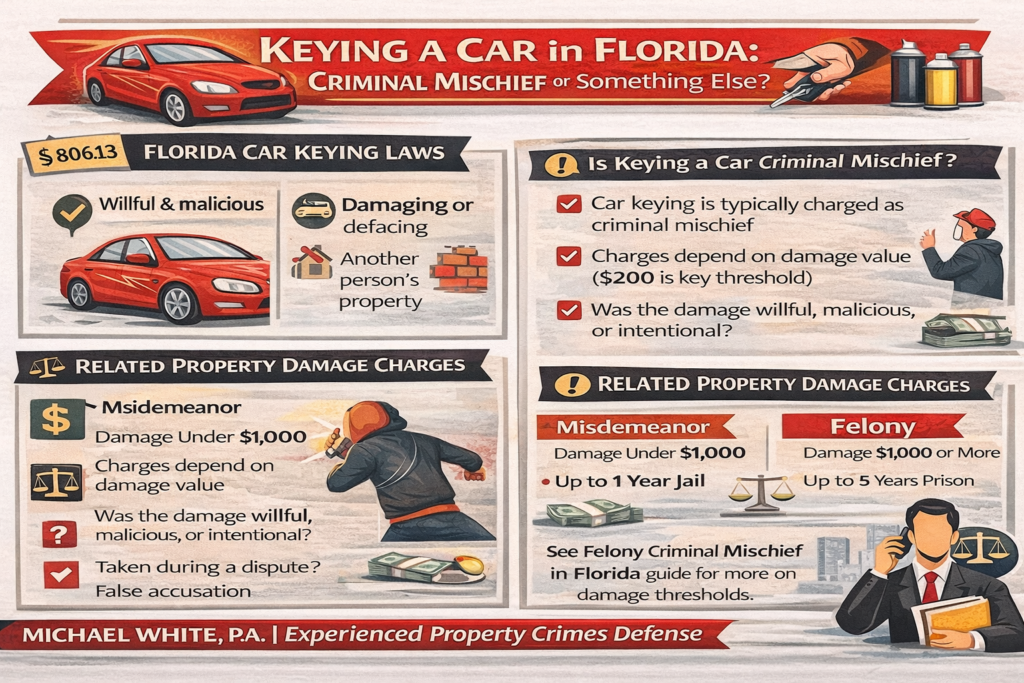
Yes — in most situations, intentionally scratching or damaging another person’s vehicle is charged as criminal mischief.
To prove the charge, the State must show:
- intentional conduct
- damage to property
- property belonging to another person
Even a single scratch can qualify if it was done willfully and maliciously.
Why Car Keying Cases Matter More Than People Think
Vehicle damage cases often become serious quickly because:
- repair costs for paint damage can be high
- entire panels may need repainting
- estimates can exceed expectations
- disputes arise over how the damage occurred
In many cases, the dollar amount becomes the most important issue.
For lower-value allegations, see Criminal Mischief Under $200 in Florida.
How Damage Value Affects the Charge
Car keying cases are heavily driven by damage valuation.
A shallow scratch might suggest minor damage — but repair estimates can include:
- repainting entire panels
- blending adjacent panels
- labor and materials
- dealership or specialty shop pricing
That means even a small scratch can lead to a much higher claimed damage amount.
This is where disputes often arise. For a deeper breakdown of how costs are calculated, see Restitution in Florida Criminal Mischief Cases.
Common Evidence in Car Keying Cases
These cases are often built on circumstantial or partial evidence.
Typical evidence includes:
- surveillance footage (parking lots, residences, businesses)
- witness statements
- photographs of damage
- repair estimates
However, video footage is not always as clear as it seems. Identification, timing, and context are frequently disputed.
For more on that issue, see Can Video Evidence Prove Criminal Mischief in Florida?.
Common Defenses to Car Keying Charges
Lack of Intent
Not every scratch is intentional. Accidental contact, tight parking spaces, or incidental damage may not meet the legal standard for criminal mischief.
Mistaken Identity
Many cases rely on unclear video or assumptions about who was present. If identification is weak, the case may not hold up.
Disputed Damage Value
Repair costs are often inflated or based on full repainting rather than actual damage. Challenging those numbers can significantly impact the case.
False Accusations
Car keying allegations sometimes arise out of personal disputes, including neighbor conflicts, workplace issues, or relationship problems.
Can a Car Keying Charge Be Dropped?
Yes — depending on the facts, possible outcomes may include:
- dismissal
- diversion
- restitution-based resolution
- reduced charges
Early intervention is often critical, especially before formal charges are filed.
Fort Lauderdale Criminal Mischief Defense Attorney
Car keying cases are often more complex than they appear. The outcome frequently depends on:
- whether intent can be proven
- whether identification is reliable
- how damage is calculated
- how early the case is addressed
At Michael White, P.A., we focus on breaking down these issues early to position cases for the best possible outcome.
FAQs
Is keying a car always criminal mischief in Florida?
In most cases, yes — if the damage is intentional and without permission, it is typically charged as criminal mischief.
How much damage does it take to be charged?
Any intentional damage can lead to a charge, but the amount of damage affects how serious the charge becomes.
Can a small scratch lead to serious charges?
Yes. Repair costs — not just the appearance of the damage — often determine the severity of the charge.
What if I didn’t key the car?
Mistaken identity is a common defense, especially in cases based on unclear video or assumptions.