
Last updated March 2026
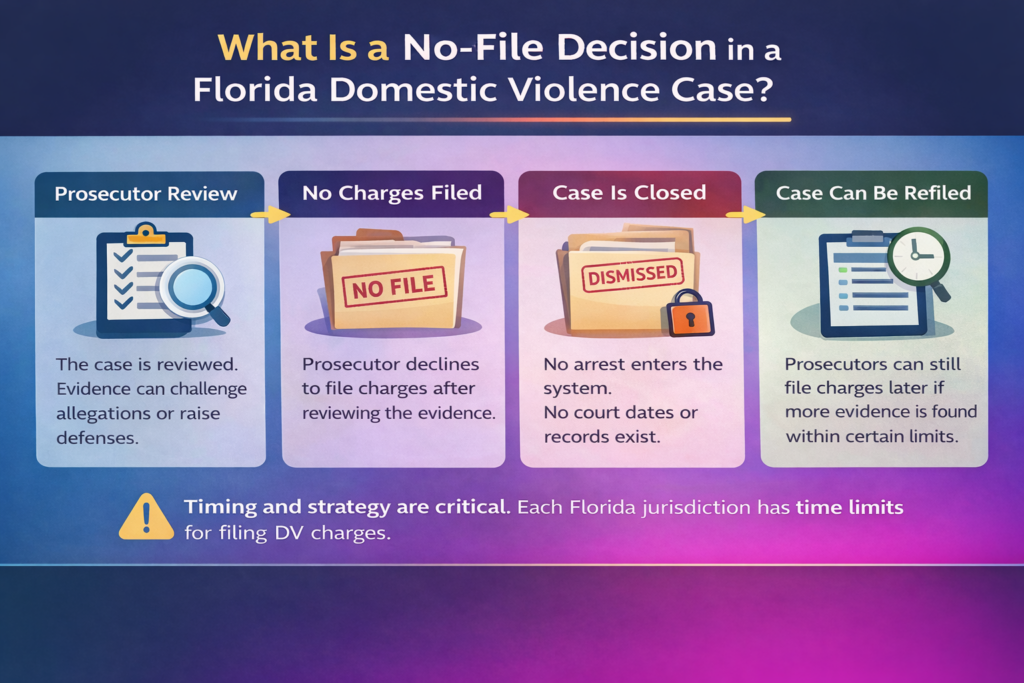
In Florida domestic violence cases, a “no-file” decision means the State Attorney’s Office has reviewed the arrest and chosen not to formally file criminal charges.
This is one of the best early outcomes a defendant can receive — but it is not automatic, and it is rarely accidental.
Understanding how no-file decisions happen — and how to position a case for one — can make the difference between a closed case and months of prosecution.
For a broader overview of how domestic violence cases are prosecuted and defended in Florida, see our
Fort Lauderdale Domestic Violence Defense Guide.
⚖️ What Happens Before Charges Are Filed?
After a domestic violence arrest in Florida:
Police submit an arrest report
Body-worn camera footage is uploaded
911 recordings are preserved
The case is forwarded to the State Attorney’s Office
At that point, a prosecutor reviews the file to decide whether:
Charges should be formally filed
Charges should be reduced
Additional investigation is needed
The case should be declined (no-file)
An arrest does not automatically mean charges will be filed.
🧾 What Does “No-File” Legally Mean?
A no-file decision means:
No formal criminal charges are filed in court
No arraignment is scheduled
No plea negotiations occur
The case does not proceed into the criminal court process
The arrest still exists — but the prosecution does not move forward.
In many counties, including Broward, this is sometimes referred to internally as a “declination.”
🔍 Why Would a Prosecutor Issue a No-File?
Prosecutors may decline to file charges when:
1️⃣ Insufficient Evidence
No visible injuries
No corroborating witnesses
Weak or inconsistent statements
Conflicting body-cam footage
2️⃣ Credibility Issues
Recanting alleged victim
Prior false accusations
Inconsistent 911 narrative
3️⃣ Self-Defense Indicators
Defensive wounds
Mutual combat evidence
Lack of primary aggressor clarity
4️⃣ Constitutional Problems
Unlawful arrest
Miranda violations
Illegal entry
Domestic violence cases are aggressively prosecuted — but they are also highly evidence-dependent.
🕰️ Timing Is Critical in No-File Outcomes
No-file decisions often occur before formal charges are filed, sometimes within days of arrest.
Early defense intervention allows counsel to:
Present exculpatory evidence
Highlight weaknesses before filing
Submit witness statements
Clarify misinterpreted facts
Prevent prosecutors from locking into a trial posture
Waiting until arraignment may eliminate early no-file opportunities.
⚠️ Does a No-File Mean the Case Is Gone Forever?
Not necessarily.
A no-file decision:
Ends the current prosecution
Closes the active case
However, charges may technically be refiled later if new evidence emerges — as long as the statute of limitations has not expired.
That said, in most domestic violence cases, once prosecutors decline to file, the matter is effectively over.
📂 What About the Arrest Record?
Even if charges are never filed:
The arrest remains on your record
It may appear on background checks
It may impact employment or licensing
You may be eligible to seek expungement if no charges were filed.
Record relief is a separate legal process and requires formal petitioning.
🛡️ How Defense Strategy Creates No-File Decisions
No-file outcomes rarely happen by luck.
They often result from:
Early attorney involvement
Strategic evidence presentation
Professional communication with prosecutors
Controlling narratives before assumptions solidify
Former prosecutors understand what internal review looks like — and what triggers a declination.
📍 Fort Lauderdale Domestic Violence Defense
At Michael White, P.A., we frequently intervene in domestic violence cases before formal filing.
By acting quickly, we can:
Challenge probable cause
Present mitigating evidence
Highlight inconsistencies
Position cases for no-file review
If you have recently been arrested for domestic violence in South Florida, early action may significantly improve your outcome.
📞 Schedule a free consultation to discuss whether a no-file decision is possible in your case.
❓ Frequently Asked Questions
What is a no-file decision in a Florida domestic violence case?
A no-file decision means the State Attorney’s Office reviewed the arrest and chose not to formally file criminal charges.
Does a no-file mean I was found innocent?
No. It means prosecutors decided not to proceed. It is not a formal finding of innocence, but it ends the criminal prosecution.
Can charges be filed later after a no-file?
In rare cases, yes — if new evidence emerges and the statute of limitations has not expired.
Will the arrest still show on my record?
Yes. Even if no charges are filed, the arrest remains unless expunged through a separate legal process.
How can I improve my chances of a no-file decision?
Early legal representation, strategic evidence presentation, and addressing weaknesses in the State’s case can increase the likelihood of a no-file outcome.